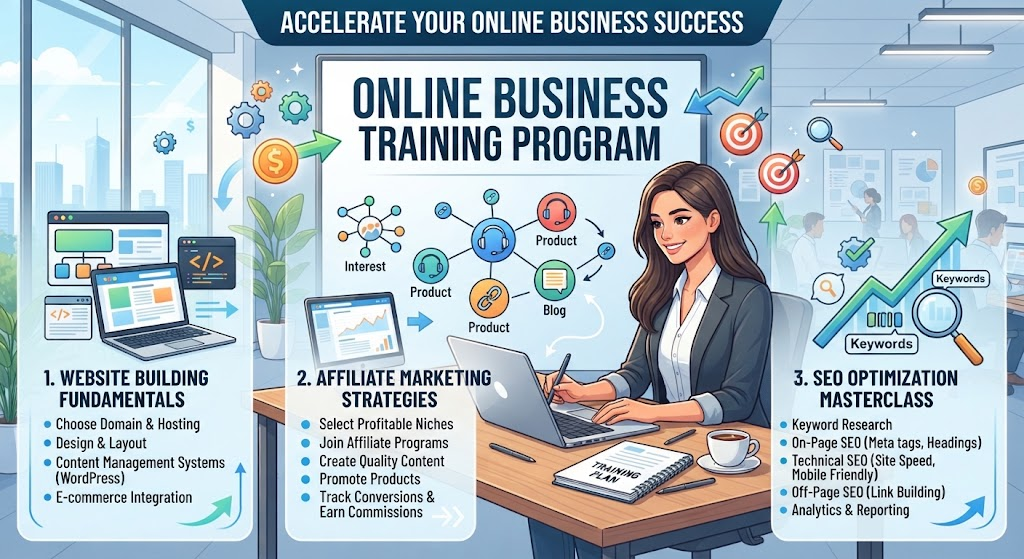
What Wealthy Affiliate Actually Teaches You About Building an Online Business
When people hear affiliate marketing, they often imagine the exciting part first.

A website.

Affiliate links.

Traffic.

Commissions.

Maybe, eventually, that wonderfully satisfying notification that someone bought something through your link.

But there is a less glamorous side of building an online business that doesn’t fit neatly into a flashy social media post.

You have to learn.

You have to experiment.

You have to write content when nobody seems to be reading it.

You have to understand your audience.

You have to figure out SEO.

You have to make mistakes.

And then you have to look at those mistakes, learn from them, and keep going.

That is where platforms such as Wealthy Affiliate become interesting.

For me, the bigger lesson isn’t simply how to do affiliate marketing.

It’s learning what actually goes into building something online.

1. An Online Business Doesn’t Appear Overnight

One of the biggest misconceptions about online business is that you can put something online today and expect results tomorrow.

Technically, you can.

Reality has other plans.

Building a website is only the beginning. You still need content, an audience, visibility, a strategy, and a reason for people to come back.

Wealthy Affiliate introduces beginners to many of those moving parts rather than presenting affiliate marketing as simply:

Find product โ†’ add link โ†’ make money.

If only it were that easy.

The real process is much more like:

Learn โ†’ build โ†’ publish โ†’ test โ†’ improve โ†’ repeat.

That isn’t nearly as glamorous, but it is far more realistic.

2. Your Website Is More Than a Place for Affiliate Links

An affiliate website shouldn’t feel like a digital catalogue.

People don’t visit a website because they desperately want to encounter seventeen affiliate buttons.

They visit because they have a question, problem, curiosity, interest, or goal.

That’s why content matters.

Your website needs to give people something useful before asking them to click anything.

A good affiliate article might help someone compare products, understand a complicated topic, solve a problem, or make a decision.

The affiliate link becomes part of the solution rather than the entire purpose of the page.

That distinction changes everything.

3. You Have to Learn Your Audience

You can have an excellent product and still create terrible marketing if you don’t understand the people you’re speaking to.

Who are they?

What are they searching for?

What problems are they trying to solve?

What questions do they have?

What would make them trust your recommendation?

These questions are far more important than simply asking:

“How do I get people to click my link?”

The better question is:

“How can I make this useful to the person reading it?”

Once you start thinking that way, affiliate marketing becomes less about pushing products and more about helping people make informed decisions.

4. SEO Is a Long Game

SEO is another lesson that becomes very obvious when building an affiliate website.

You can publish something today and receive very little traffic.

That doesn’t necessarily mean the article failed.

Search engines need time to discover, understand, and evaluate content. Your website also needs time to establish authority and build a library of useful information.

This is why creating one article and immediately checking your traffic every five minutes can become an emotional rollercoaster. ๐ŸŽข

SEO rewards patience.

It also rewards learning.

You start understanding search intent, keywords, internal linking, content structure, and the difference between writing for a search engine and writing for an actual human.

And that last part matters enormously.

5. Consistency Doesn’t Mean Publishing Mindlessly

There’s a difference between being consistent and simply producing content for the sake of having something published.

You don’t need to flood your website with articles nobody needs.

Consistency should mean continuing to build, learn, improve, and show up.

Sometimes that means publishing.

Sometimes it means updating an old article.

Sometimes it means researching your audience.

Sometimes it means looking at what isn’t working and changing your approach.

Building an online business isn’t a content-production competition.

It’s a process of improvement.

6. You Learn by Actually Doing

One thing that can be underestimated when learning digital marketing is the difference between understanding something theoretically and actually doing it.

You can read ten articles about SEO.

Then you try to optimise your own article and suddenly realise there are approximately 47 things you didn’t understand. ๐Ÿ˜‚

That’s normal.

Building gives you context that theory alone can’t provide.

You start noticing patterns.

You make decisions.

You see what happens.

You adjust.

Then you try again.

That hands-on process is where a lot of the real learning happens.

7. Not Everything You Try Will Work

This might be one of the most important lessons of all.

Some content will perform well.

Some won’t.

Some ideas will look brilliant on paper and completely flop once they’re published.

Some strategies will work for somebody else and make absolutely no sense for your audience.

That’s not necessarily failure.

It’s information.

Digital marketing involves experimentation.

The goal isn’t to create a perfect strategy on the first attempt.

The goal is to become better at recognising what works for your audience, your website, and your business.

8. Trust Is More Valuable Than a Click

Affiliate marketing can become very transactional if you’re not careful.

Click here.

Buy this.

Use my link.

Limited offer.

But trust is what makes someone actually value your recommendation.

If a reader believes you’re genuinely trying to help them, your content becomes more powerful.

You don’t have to pretend every product is perfect.

You don’t have to recommend something simply because it offers a commission.

Sometimes being honest about the downsides makes your recommendation more credible.

A trustworthy affiliate marketer isn’t thinking:

“How can I get this person to buy?”

They’re thinking:

“Would I genuinely recommend this to them?”

That difference matters.

9. Your Personality Is Part of Your Brand

This is something I particularly believe in.

There is already an enormous amount of generic content online.

If every website sounds like it was written by the same marketing textbook, readers have very little reason to remember one website over another.

Your perspective matters.

Your experiences matter.

Your way of explaining things matters.

Even your weird ideas matter.

That’s one reason I don’t think digital marketing needs to be completely polished and corporate all the time.

People connect with people.

A brand can be strategic without becoming robotic.

10. Building an Online Business Is a Skill, Not a Shortcut

Ultimately, what Wealthy Affiliate can teach you isn’t simply how to create an affiliate website.

It can teach you how many different skills sit underneath an online business.

You begin touching areas such as:

  • Website building
  • SEO
  • Content creation
  • Affiliate marketing
  • Keyword research
  • Audience research
  • Digital marketing
  • Branding
  • Conversion strategy
  • Analytics
  • Content planning

And those skills extend far beyond affiliate marketing.

They can become useful for freelancing, blogging, content creation, ecommerce, personal branding, consulting, and other digital projects.

That’s why I think it’s more useful to view affiliate marketing as a learning vehicle rather than a magic income button.

The Bigger Lesson

Building an online business teaches you something that no income screenshot can really demonstrate.

You have to build something worth finding.

You need something useful.

Something trustworthy.

Something recognisable.

Something that solves a problem or gives people a reason to stay.

Wealthy Affiliate can provide the education, tools, community, and framework to help you learn those fundamentals.

But the platform can’t build your business for you.

That’s still your job.

And honestly?

That’s probably a good thing.

Because the most valuable part of building an online business isn’t simply getting the first commission.

It’s eventually looking at what you’ve built and realising:

“I actually know how to do this now.”

That’s the point where you’re no longer just following a tutorial.

You’re becoming a marketer.

You’re becoming a strategist.

You’re building something that belongs to you.

And that is a much bigger win than a single notification on your phone. ๐Ÿ“ˆ

Final Thought

Affiliate marketing isn’t a shortcut around learning business.

It is one way of learning business.

And that’s the lesson worth carrying forward.

What a Tuxedo Cat Thinks Affiliate Marketing Actually Is ๐Ÿˆโ€โฌ›

A Tuxedo Cat’s Take on Affiliate Marketing

Humans have a fascinating habit.

They take something relatively simple, give it twelve complicated words, put it into a presentation, and then somehow make everyone more confused.

Affiliate marketing is one of those things.

So naturally, I decided to explain it.

I’m Simmba.

I’m a tuxedo cat, professional napper, cardboard-box enthusiast, household supervisor, and apparently now an expert in digital marketing.

I did not ask for this promotion.

But here we are.

So… What Exactly Is Affiliate Marketing?

From what I’ve observed, affiliate marketing is basically this:

Human recommends a thing.

Another human buys the thing through the recommendation.

The first human earns a commission.

That’s it.

You can put all the fancy terminology around it you want, but underneath all the dashboards, links, analytics and conversion rates, that’s the basic idea.

Think of it like this.

Your friend tells you:

“You need to try this. I actually use it and I think you’d like it.”

You trust your friend.

You check it out.

You buy it.

Now imagine the person recommending it has a special tracking link.

That link tells the company, “Hey, this customer came from this person.”

If the purchase qualifies, the person who made the recommendation earns a commission.

Humans call this affiliate marketing.

I call it:

“I told you about the thing and somehow got paid for it.”

Not bad.

๐Ÿˆโ€โฌ› But Here’s Where Humans Get It Wrong

Affiliate marketing isn’t supposed to mean:

“CLICK MY LINK. BUY THIS. PLEASE. NOW. WHY ARE YOU STILL READING?”

Please calm down.

I am a cat.

Even I understand that chasing someone around the house doesn’t make them more likely to give me treats.

Usually.

Affiliate marketing works much better when the recommendation actually has context and value behind it.

Instead of simply dropping an affiliate link and expecting money to magically appear, you can create content that helps someone make a decision.

You could:

  • explain how a product works
  • share your experience
  • compare different options
  • create a tutorial
  • answer common questions
  • explain who the product is actually suitable for
  • discuss its advantages and limitations
  • show how it fits into a larger strategy

The affiliate link becomes part of the content.

It isn’t the entire reason the content exists.

And that distinction matters.

๐Ÿ“ฆ My Cardboard Box Affiliate Strategy

I would like to take this opportunity to introduce my own affiliate marketing strategy.

Step one:

Find cardboard box.

Step two:

Sit inside cardboard box.

Step three:

Recommend cardboard box to another cat.

Step four:

Receive commission.

Unfortunately, there is a problem.

Nobody pays me.

I’ve been doing this for years.

Where is my affiliate dashboard?

Where are my monthly commissions?

Where is my passive income?

This industry is clearly failing cats.

๐Ÿพ The Real Product You’re Building Is Trust

Here’s the part I think humans sometimes forget.

When someone clicks your affiliate link, they’re not just clicking a URL.

They’re acting on your recommendation.

That means your reputation is involved.

If you constantly recommend random products simply because they offer commissions, people eventually notice.

And once someone stops trusting your recommendations, your beautifully crafted affiliate links become digital tumbleweeds.

Nobody wants that.

A better approach is to ask:

“Would I still recommend this if I wasn’t getting paid?”

If the answer is yes, you’re probably starting from a much healthier place.

That doesn’t mean you can’t earn money from the recommendation.

Of course you can.

That’s literally part of affiliate marketing.

It means the value comes first and the commission comes second.

๐Ÿง  Affiliate Marketing Is Really About Connecting Problems With Solutions

Humans have problems.

Businesses have products and services designed to solve those problems.

Affiliate marketers can sit somewhere in the middle and help people discover solutions that might genuinely be useful.

That’s where content becomes important.

A good affiliate article doesn’t just say:

“Here is a product. Buy it.”

It says:

“Here’s a problem you’re experiencing. Here’s what I’ve learned. Here are some options. Here’s what I think might work, and here’s why.”

That is much more useful.

And useful content has a much better chance of being remembered.

๐Ÿˆโ€โฌ› What Simmba Thinks

If I had to explain affiliate marketing to another cat, I’d keep it very simple:

Human recommends thing.

Another human likes thing.

Human buys thing.

Original human earns commission.

And if the recommendation is genuinely useful?

Everyone wins.

Except me.

Because I still don’t get paid for recommending cardboard boxes.

Honestly, I’m beginning to think my human has been exploiting my marketing expertise for free.

I may need to speak to management.

Management is me.

๐Ÿ–ค The Simmba Standard

Before you recommend something through affiliate marketing, ask yourself:

Would I recommend this without the commission?

Does it actually help my audience?

Have I explained why I’m recommending it?

Am I being honest about the product?

Would I be comfortable with someone making a purchase because of my recommendation?

If you can answer those questions honestly, you’re already thinking beyond simply “How many clicks can I get?”

You’re thinking about trust.

And trust is considerably harder to build than a click.

So yes, affiliate marketing can make money.

But from this tuxedo cat’s perspective, the best affiliate marketers aren’t the ones shouting the loudest.

They’re the ones people actually trust enough to listen to.

Now, if you’ll excuse me, I have a cardboard box to recommend.

No commission.

Again. ๐Ÿˆโ€โฌ›๐Ÿ“ฆ

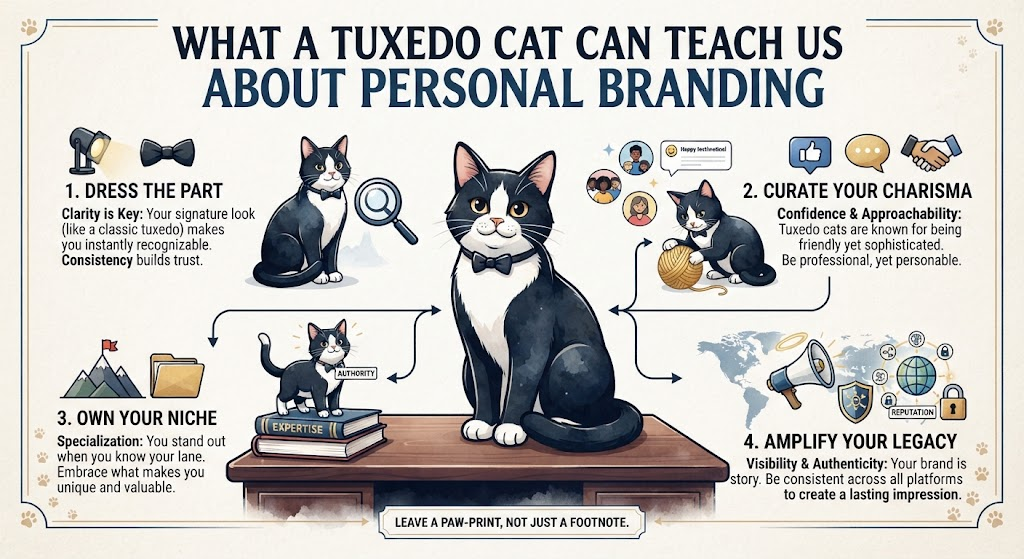
What a Tuxedo Cat Can Teach Us About Personal Branding

Personal branding is usually presented as a very serious business.

Choose your niche.

Define your audience.

Pick your colours.

Create your content pillars.

Write your bio.

Take a professional photograph.

And somewhere along the way, we’re expected to become a perfectly polished version of ourselves.

But here’s the thing.

People don’t connect with a brand because its Canva templates are beautiful.

They connect because they recognise something.

A voice.

A personality.

A perspective.

A story.

And weirdly enough, a tuxedo cat can teach us quite a bit about that.

Yes.

We’re talking about Simmba. ๐Ÿˆโ€โฌ›

Lesson One: Personality Makes You Recognisable

There are millions of cats on the internet.

Seriously.

The internet has no shortage of whiskers.

So why do certain cats become recognisable?

Personality.

The same principle applies to personal branding.

There are thousands of marketers.

Thousands of writers.

Thousands of creators.

Thousands of people talking about SEO, AI, social media and content strategy.

Your subject matter alone isn’t necessarily going to make you memorable.

Your personality can.

How you explain things.

The jokes you make.

The opinions you have.

The stories you tell.

The way you approach problems.

That’s what starts separating you from everyone else talking about the same topic.

Lesson Two: You Don’t Need to Appeal to Everyone

Simmba is not going to appeal to everyone.

He’s a cat.

He sleeps whenever he wants.

He has opinions about things that nobody asked him about.

He presumably believes the house belongs to him.

And honestly, he’s probably correct. ๐Ÿ˜‚

But personal branding works the same way.

Trying to appeal to absolutely everyone often produces incredibly bland content.

You end up removing anything distinctive because you’re worried someone might dislike it.

But here’s the reality:

If everyone likes your brand, you might not be giving anyone much to remember.

A strong personal brand attracts the right people.

It doesn’t need unanimous approval.

Lesson Three: Consistency Creates Recognition

Imagine Simmba suddenly became a golden retriever tomorrow.

It would be a little confusing.

Not because golden retrievers are bad.

But because that’s not what people recognise as Simmba.

Your personal brand works similarly.

Consistency doesn’t mean repeating the same post every day.

It means maintaining recognisable elements.

Your voice.

Your values.

Your perspective.

Your subject areas.

Your approach.

Your audience should be able to encounter your content and think:

“Yep. This sounds like them.”

That’s brand recognition.

Lesson Four: Your Personality Can Become a Content Pillar

This is where personal branding gets interesting.

Most content strategies start with topics.

AI.

SEO.

Marketing.

Business.

Social media.

But what if your personality is part of the strategy?

Maybe you explain serious topics through humour.

Maybe you use storytelling.

Maybe you challenge conventional marketing advice.

Maybe you turn everyday experiences into lessons.

Maybe you bring your interests into your professional content.

Suddenly, your content isn’t just about what you know.

It’s also about how you think.

That is much harder to copy.

Lesson Five: You Can Build a Character Without Pretending to Be Someone Else

There’s an important distinction here.

Personal branding doesn’t mean inventing a fake personality.

It means making the real parts of your personality visible.

Simmba doesn’t need to become another cat to be interesting.

He is interesting because of the personality attached to him.

The same applies to you.

You don’t have to manufacture quirks.

You don’t need to become louder than you naturally are.

You don’t need to force humour into every sentence.

Instead, identify what already makes your perspective different.

Then let people see it.

Lesson Six: Stories Give Your Brand Context

A list of qualifications can tell people what you know.

A story can help them understand why you think the way you do.

That’s a powerful difference.

Your experiences become part of your positioning.

The lessons you’ve learned.

The mistakes you’ve made.

The things you disagree with.

The unusual paths you’ve taken.

The people and experiences that influenced you.

These things give your brand depth.

And depth makes a brand harder to reduce to a generic template.

Lesson Seven: Don’t Be Afraid of the Unexpected

One of the reasons Simmba works as a recurring character is because nobody expects a tuxedo cat to start discussing marketing strategy.

And that’s precisely what makes people curious.

The same principle can work in personal branding.

You don’t have to stay trapped inside the traditional boundaries of your industry.

A marketer can talk about storytelling.

A writer can talk about psychology.

A business owner can talk about food.

A content creator can talk about their cat.

The question isn’t whether the topic looks conventional.

The question is whether you can create a meaningful connection between it and your brand.

Lesson Eight: Your Audience Wants a Person, Not a Corporate Brochure

This might be the biggest lesson of all.

People know when they’re being spoken to by a brand.

And sometimes they still want that.

But increasingly, audiences also want to know the person behind the work.

What do they believe?

How do they think?

What do they care about?

What makes them laugh?

What are they willing to challenge?

What kind of experience will I have if I follow them?

Personal branding answers those questions.

And personality is what makes the answers interesting.

The Simmba Test ๐Ÿˆโ€โฌ›

So here’s my favourite personal branding test:

If you removed your name and logo from your content, would someone still recognise that it came from you?

If the answer is yes, you’re probably developing a recognisable voice.

If the answer is no, don’t panic.

It simply means there’s an opportunity to bring more of your perspective into the work.

Ask yourself:

  • What opinions do I consistently have?
  • What topics do I naturally gravitate towards?
  • What stories could only I tell?
  • What makes my explanation different?
  • What personality traits show up in my content?
  • What do people already associate with me?

Those answers are clues.

You Don’t Need to Become โ€œA Brandโ€

This is something I think gets lost in personal branding conversations.

You’re still a person.

You don’t need to turn yourself into a walking marketing campaign.

Your brand should support your work, not swallow your identity.

You can have professional expertise and still have humour.

You can be strategic and still be playful.

You can take your work seriously without taking yourself painfully seriously.

And yes, you can build a professional personal brand while occasionally talking about a tuxedo cat.

Perhaps especially then.

Final Thought

Simmba doesn’t need a complicated branding strategy to be recognisable.

He’s Simmba.

The personality comes first.

The recognition follows.

And that’s a pretty useful lesson for personal branding.

You don’t become memorable by trying to look exactly like everyone else who works in your industry.

You become memorable by developing a voice, perspective and personality that people can recognise.

So before you redesign your logo, rewrite your bio for the seventeenth time, or spend three hours debating whether your brand colour should be slightly warmer…

Ask yourself:

“What makes people recognise me?”

Because your strongest brand asset might not be your logo.

It might be you.

And somewhere nearby, a tuxedo cat is probably judging your brand strategy anyway. ๐Ÿˆโ€โฌ›

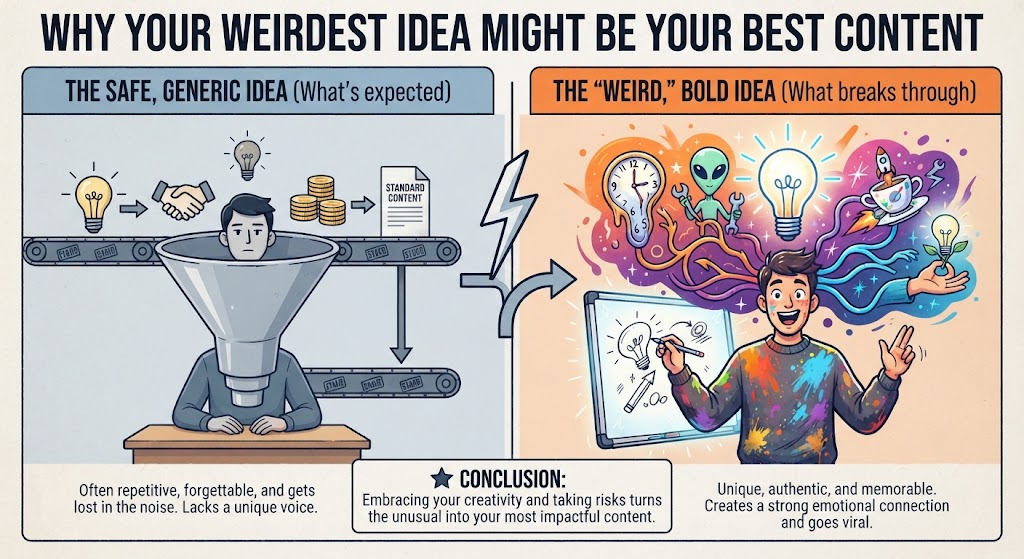
Why Your Weirdest Idea Might Be Your Best Content

Let’s be honest.

Some of your ideas probably make perfect sense.

They’re strategic.

They’re useful.

They’re safe.

And then there are the ideas that make you stop and think:

“Wait… should I actually post this?”

Maybe it’s an unusual analogy.

A ridiculous comparison.

A random observation.

A conversation with your cat.

A marketing lesson inspired by a fictional character.

Or an idea that doesn’t fit neatly into the content strategy spreadsheet.

Those are often the ideas we talk ourselves out of.

And sometimes, those are exactly the ideas worth creating.

Weird Doesn’t Mean Bad

There’s a difference between being weird for attention and having a genuinely unusual perspective.

Anyone can make something random.

That’s not automatically creative.

The value of a weird idea comes from the connection behind it.

Take something ordinary and connect it to something unexpected.

That’s where curiosity starts.

For example:

What can a tuxedo cat teach us about personal branding?

At first, that sounds completely ridiculous.

Then you start thinking about personality, recognition, consistency, audience loyalty and differentiation.

Suddenly, the cat isn’t the point.

The perspective is.

That’s the magic of an unexpected connection.

Predictable Content Is Everywhere

Open any social platform and you’ll see variations of the same advice.

“5 ways to grow your business.”

“10 tips for better content.”

“3 mistakes you’re making.”

“Here’s how to beat the algorithm.”

“Do this before you post.”

There’s nothing inherently wrong with these formats.

They can be useful.

But when everyone is using the same structure, the challenge becomes standing out without shouting.

That’s where unusual ideas can help.

You don’t necessarily need to be louder.

You need to be recognisable.

Curiosity Is a Powerful Hook

Think about the difference between these two headlines:

“5 Tips for Better Branding”

and

“What Can a Tuxedo Cat Teach You About Personal Branding?”

The second one creates a tiny mental speed bump.

You want to know the answer.

Why a cat?

What does this have to do with branding?

Is this serious?

Is this ridiculous?

Hopefully, it’s both. ๐Ÿˆโ€โฌ›

That curiosity can make someone stop scrolling.

But the important part is what comes next.

The unusual hook still needs a useful idea underneath it.

Your Weird Idea Can Make Your Expertise More Memorable

This is something creators sometimes underestimate.

People don’t only remember information.

They remember how information was presented.

You could explain brand consistency through a standard marketing article.

Or you could explain it through a recurring fictional character.

You could talk about customer loyalty using a textbook definition.

Or you could compare it to why people keep returning to their favourite restaurant.

The underlying lesson might be similar.

But the second version gives the audience something to attach the idea to.

That’s what makes it memorable.

Your Personality Is Part of the Content

This is especially important for personal brands.

If your content could have been written by absolutely anyone, that’s a problem.

Your perspective is part of your value.

Your humour.

Your experiences.

Your interests.

Your opinions.

Your weird little observations.

Even the things you think are too random to include.

Those details create differentiation.

Because nobody else has your exact combination of experiences and perspective.

AI can generate a perfectly reasonable article about branding.

So can thousands of other creators.

But it can’t replace the fact that you decided to explain branding through Simmba, a fictional character, a childhood memory or an argument you had with yourself at 2 a.m.

That’s where your content starts becoming yours.

Weird Ideas Create Conversations

The best content doesn’t always end with someone clicking a button.

Sometimes it starts a conversation.

Someone comments:

“I never thought about it that way.”

Someone sends it to a friend.

Someone disagrees.

Someone adds their own example.

Someone shares it because the idea is so oddly specific that it reminds them of something.

That’s valuable.

Because you’re no longer simply distributing information.

You’re creating a reason for people to participate.

But Don’t Confuse Weird With Random

This deserves its own warning.

Please don’t look at this article and decide:

“Great. I need to make everything completely unhinged now.”

No.

๐Ÿ˜‚

Weird content still needs strategy.

Ask:

  • Is there an actual idea underneath this?
  • Does the comparison make sense?
  • Does it connect to my audience?
  • Can I explain the lesson clearly?
  • Does this reinforce my brand?
  • Is the unusual element helping the message or distracting from it?

If the weirdness is the entire point, you might just have a gimmick.

If the weirdness helps people understand or remember the idea, you have a strategy.

Your Best Ideas Might Start as โ€œWhat If?โ€

Try asking yourself:

What if I explained this differently?

What if you explained SEO through cooking?

What if you explained branding through fictional characters?

What if you discussed customer loyalty through fandom?

What if you turned a serious marketing lesson into a conversation?

What if you wrote from your cat’s perspective?

What if you challenged something everyone in your industry accepts?

These questions create possibilities.

And possibilities are where creative ideas tend to live.

The Simmba Principle ๐Ÿˆโ€โฌ›

Simmba is basically a walking reminder that content doesn’t have to follow a traditional marketing template.

He’s a cat.

He has opinions.

He has a personality.

And somehow, that can become a vehicle for discussing branding, storytelling, audience psychology and content strategy.

Why?

Because the unexpected makes people curious.

And curiosity gives you an opportunity to teach.

That’s an important distinction.

The goal isn’t:

“Look how weird I am.”

The goal is:

“Here’s an unusual way of looking at something you already care about.”

Your Weirdness Can Become Your Signature

Eventually, the things you once thought were too strange can become the things people associate with you.

Maybe you’re the marketer who explains strategy through stories.

Maybe you’re the writer who uses fictional characters.

Maybe you’re the creator who turns everyday observations into marketing lessons.

Maybe you’re the person who somehow manages to make a tuxedo cat part of a content strategy.

That’s okay.

In fact, that’s memorable.

A distinctive creative approach can become part of your brand identity.

And once people recognise your approach, you don’t have to constantly introduce yourself.

Your work starts doing some of that for you.

Final Thought

Not every weird idea is a good idea.

But not every good idea looks sensible at first.

Some ideas need a little room before they make sense.

So the next time you have an idea that makes you think:

“This is probably too weird.”

Don’t immediately delete it.

Sit with it.

Ask what the actual idea is underneath the weirdness.

Find the connection.

Find the lesson.

Find the story.

Because in a sea of predictable content, your strangest idea might be the thing that finally makes someone stop scrolling and think:

“I’ve never seen anyone explain it like that before.”

And honestly?

That’s a pretty good place for your content to be.

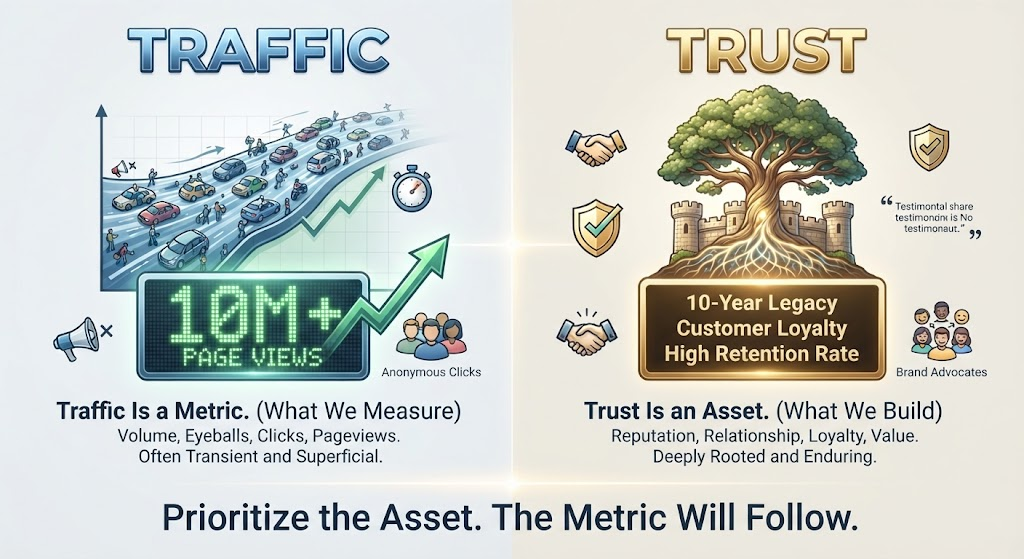
Traffic Is a Metric. Trust Is an Asset.

Let’s talk about one of the easiest traps in digital marketing:

Confusing attention with progress.

A website gets 10,000 visitors.

Sounds impressive.

A social post gets 50,000 views.

Even more impressive.

A reel gets 100,000 views.

Cue the celebratory fireworks. ๐ŸŽ†

But then you look at the actual results.

Few enquiries.

Few subscribers.

Few returning visitors.

Almost no conversions.

So what happened?

Nothing necessarily went wrong.

You simply measured attention instead of trust.

And those are two very different things.

Traffic Tells You Who Arrived

Traffic is important.

I’m not here to pretend it isn’t.

Without people visiting your website, discovering your content or finding your brand, you don’t have much of an audience to work with.

Traffic can help you understand:

  • How many people are finding your website
  • Where visitors are coming from
  • Which content attracts attention
  • What search terms bring people in
  • Which channels are generating visitors
  • Whether your visibility is growing

Those are useful insights.

But traffic only answers one basic question:

Did people arrive?

It doesn’t answer:

Did they trust you?

Trust Tells You What Happens Next

Imagine two websites.

Website A gets 20,000 visitors every month.

Website B gets 2,000.

At first glance, Website A looks like the obvious winner.

But imagine that Website B has a loyal audience that reads multiple articles, subscribes to its emails, recommends its content, returns regularly and eventually buys its products.

Suddenly, the numbers look very different.

That’s because trust changes the relationship.

A visitor is someone who arrived.

A trusted brand is somewhere they choose to return to.

That’s a much more valuable position.

The Internet Has an Attention Problem

We live in a world where attention is constantly being measured.

Views.

Likes.

Shares.

Followers.

Reach.

Impressions.

Clicks.

The problem is that these numbers can become addictive.

You post something.

It performs well.

You feel successful.

Then the next post gets half the engagement.

Suddenly you wonder whether you’ve done something wrong.

This is where strategy can get hijacked by vanity metrics.

You start creating content for the number rather than for the person behind the number.

And that’s dangerous.

A Thousand Views Don’t Mean a Thousand Relationships

Someone can see your content without caring about your brand.

They can click without reading.

They can read without remembering.

They can follow without ever engaging again.

They can even buy once without becoming a loyal customer.

That’s why the journey matters.

Attention โ†’ Interest โ†’ Trust โ†’ Action โ†’ Loyalty

Traffic mostly lives near the beginning.

Trust helps move people further down the journey.

And that’s why a smaller audience can sometimes be significantly more valuable than a massive one.

Trust Is Built Slowly

Here’s the inconvenient part:

Trust doesn’t usually have a shortcut.

You build it through consistency.

You deliver what you promised.

You don’t exaggerate every claim.

You acknowledge when something doesn’t work.

You provide useful information even when there isn’t an immediate sale attached to it.

You communicate like an actual human being.

You show expertise without pretending to know everything.

You give people reasons to believe that your recommendations are genuinely worth considering.

None of that produces an instant spike on a dashboard.

But it compounds.

Trust Makes Recommendations More Powerful

Think about the difference between two people recommending a product.

Person A:

“BUY THIS! It’s AMAZING! ๐Ÿ”ฅ๐Ÿ”ฅ๐Ÿ”ฅ”

Person B:

“I’ve tried this myself. Here’s what I liked, here’s what I didn’t, and here’s who I think it would actually suit.”

Which recommendation feels more credible?

Probably the second.

Because the second person isn’t simply trying to get your attention.

They’re helping you make a decision.

That’s what trust does.

It changes promotion into recommendation.

And that distinction matters enormously in affiliate marketing, content marketing and personal branding.

Your Audience Is Not a Traffic Source

This might be one of the most important mindset shifts a marketer can make.

Your audience isn’t a number.

They’re people.

They have limited time.

They have questions.

They have doubts.

They have competing options.

And they’ve seen enough clickbait to recognise when someone is simply trying to squeeze a conversion out of them.

If every piece of content screams:

CLICK HERE. BUY THIS. SIGN UP. DON’T MISS OUT.

eventually people stop listening.

Trust gives you permission to make an offer because the audience understands the relationship behind it.

Trust Can Outlive an Algorithm

Algorithms change.

Search rankings change.

Platforms change.

Trends disappear.

A strategy that works beautifully today might be useless six months from now.

But if people trust you, you aren’t completely dependent on the platform.

They can search for your name.

Visit your website directly.

Subscribe to your email list.

Recommend you to someone else.

Follow you somewhere new.

That’s why trust is an asset.

It travels with you.

The Simmba Principle ๐Ÿˆโ€โฌ›

Even Simmba has something to teach us here.

If Simmba suddenly appeared on Instagram tomorrow and immediately started screaming:

“BUY MY PRODUCT.”

I would have some serious questions. ๐Ÿ˜‚

But when an audience has watched his personality develop, seen the stories, followed the recurring content and understands what Simmba’s Corner is about, the relationship becomes different.

The content has context.

The audience isn’t just seeing a random tuxedo cat.

They’re recognising a familiar personality.

That’s the same principle brands can use.

Familiarity creates recognition. Consistency creates credibility. Trust creates relationships.

What Should You Measure Besides Traffic?

Traffic still matters.

Keep measuring it.

Just don’t let it become the entire definition of success.

Consider tracking:

  • Returning visitors
  • Email subscribers
  • Time spent engaging with content
  • Pages viewed per session
  • Repeat customers
  • Direct traffic
  • Referral traffic
  • Comments and meaningful conversations
  • Saves and shares
  • Conversion rates
  • Customer retention
  • Brand mentions

Not every metric will matter equally to every business.

The point is to look beyond:

“How many people saw me?”

and start asking:

“What happened because they saw me?”

That’s where strategy gets interesting.

Build the Asset, Not Just the Number

Traffic can fluctuate.

One viral post can send thousands of people your way.

A Google update can change your search traffic.

An algorithm change can destroy your reach overnight.

Trust is different.

It accumulates through repeated experiences.

Someone discovers your content.

They find it useful.

They come back.

They recognise your voice.

They recommend you.

Eventually, they become a customer.

Then they might become an advocate.

That’s not just traffic.

That’s an ecosystem.

Final Thought

Traffic is useful because it gives you data.

Trust is valuable because it gives you relationships.

One tells you that people arrived.

The other gives them a reason to stay.

So by all means, watch your analytics.

Study your traffic sources.

Analyse your search rankings.

Celebrate the occasional viral post.

But don’t build your entire strategy around making the numbers bigger.

Build something people can believe in.

Because traffic can put you on someone’s screen.

Trust is what can keep you in their mind.

And in a digital world overflowing with content, being trusted is worth far more than simply being seen.


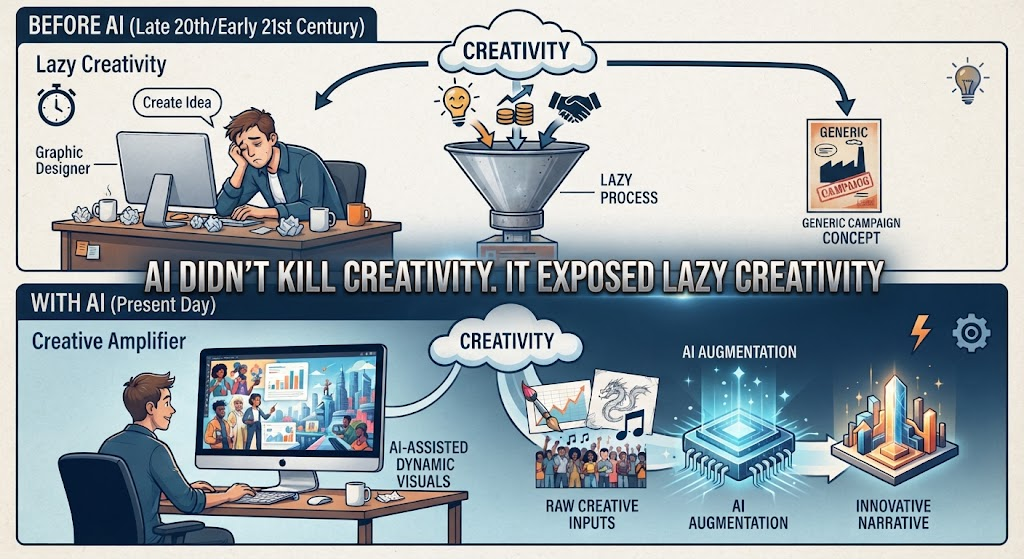
AI Didn’t Kill Creativity. It Exposed Lazy Creativity.

Every few weeks, someone declares that AI is killing creativity.

AI-generated articles.

AI-generated images.

AI-generated videos.

AI-generated social media posts.

And somehow, creativity itself is supposedly on life support.

I’m not convinced.

Because here’s the uncomfortable part:

AI didn’t kill creativity. It made lazy creativity much easier to produce.

And there’s a difference.

Before AI, people could still copy trends, recycle the same ideas, write generic content and imitate whatever everyone else was doing.

AI simply made the process faster.

Now we can produce five versions of the same bland idea before breakfast.

That’s not the death of creativity.

That’s a creativity problem.

The Tool Isn’t the Problem

Let’s start with something simple.

AI is a tool.

And tools have never been inherently creative or uncreative.

A camera didn’t destroy photography.

Photoshop didn’t destroy graphic design.

The internet didn’t destroy writing.

And AI doesn’t automatically destroy creativity.

What matters is how the tool is used.

Give the same AI tool to ten different people and you can get ten completely different outcomes.

One person might use it to brainstorm.

Another might use it to research.

Someone else might use it to challenge their assumptions.

Another person might use it to generate an entire article, publish it without reading it and call it a day.

Same technology.

Very different levels of creativity.

The Copy-Paste Problem

Here’s where AI gets interesting.

AI makes it incredibly easy to create something that looks complete.

That’s both its strength and its weakness.

You can ask for a blog post and receive one.

You can ask for ten captions and receive ten.

You can ask for a marketing strategy and receive a polished-looking document.

But polished doesn’t automatically mean good.

And complete doesn’t automatically mean creative.

The biggest danger isn’t that AI will make everyone creative.

It’s that it can make lazy work look finished.

That’s a much more interesting problem.

Creativity Has Always Required a Human

Creativity isn’t just producing words, images or ideas.

It’s making choices.

What should I say?

Why should I say it?

What do I actually believe?

What perspective can I bring?

What experience shaped this idea?

What would make someone stop and think?

AI can help you explore those questions.

But it can’t replace the responsibility of answering them.

That’s still your job.

AI Can Actually Make Creativity More Accessible

There’s another side to this conversation that often gets ignored.

AI can help people who struggle with the mechanics of creating.

Someone with an idea but limited writing confidence can use AI to organise their thoughts.

A marketer can brainstorm campaign angles.

A writer can overcome the dreaded blank page.

A business owner can explore ideas they wouldn’t otherwise have the time or resources to develop.

That doesn’t necessarily make the work less creative.

Sometimes it allows the creativity to finally get out of someone’s head.

And I think that’s worth recognising.

The Difference Between AI-Assisted and AI-Dependent

This is where I draw my own line.

AI-assisted creativity means the human is still driving.

You bring the idea.

You bring the perspective.

You make the decisions.

You edit.

You question.

You reject things.

You reshape them.

You make the final piece yours.

AI-dependent content is different.

The human essentially presses generate and accepts whatever comes back.

There’s little personal perspective.

Little editing.

Little experimentation.

Little reason for the audience to connect with it.

The technology isn’t necessarily the problem.

The lack of human input is.

Why AI Slop Feels So Obvious

You’ve probably seen it.

The perfectly structured article.

The endless headings.

The overly polished sentences.

The same recycled phrases.

The same five-point list.

The same generic conclusion about how “in today’s digital landscape” something is more important than ever.

You read it and immediately think:

I’ve seen this before.

That’s because you probably have.

The problem isn’t necessarily that AI was involved.

The problem is that nothing human was added afterwards.

No strong opinion.

No personal story.

No unusual observation.

No humour.

No experience.

No risk.

No point of view.

Just information arranged into paragraphs.

And information alone isn’t personality.

Originality Comes From Perspective

Here’s something I think marketers and content creators need to remember:

You don’t have to invent a completely new subject to create original content.

You can make a familiar subject interesting by bringing a different perspective to it.

Thousands of people write about AI.

Thousands write about SEO.

Thousands write about personal branding.

Thousands write about social media.

The question isn’t:

“Has someone already written about this?”

They probably have.

The better question is:

“What can I say about it that sounds like me?”

That’s where originality starts.

Your Weird Ideas Matter

Sometimes the thing that makes content memorable is the part that doesn’t fit neatly into a marketing template.

A strange analogy.

A personal story.

An unpopular opinion.

A fictional character.

A conversation with your cat.

Yes, I’m looking directly at Simmba here. ๐Ÿˆโ€โฌ›

The internet is full of perfectly optimised content.

What it isn’t full of is your exact combination of experiences, opinions, humour and perspective.

That’s your advantage.

AI can help you organise those ingredients.

It can’t manufacture your life for you.

What Marketers Should Actually Be Learning From AI

Instead of asking:

“How do I use AI to create more content?”

Maybe we should ask:

“How can I use AI to create better thinking?”

Use it to challenge an idea.

Ask it to argue against you.

Generate perspectives you hadn’t considered.

Find weaknesses in your strategy.

Help organise messy thoughts.

Explore different audiences.

Then bring the human part back into the process.

The goal shouldn’t be to produce more noise.

It should be to produce something worth hearing.

The Real Creative Advantage

AI has lowered the barrier to producing content.

That’s not necessarily bad.

But when everyone can produce content quickly, content production stops being the competitive advantage.

Thinking becomes the advantage.

Perspective becomes the advantage.

Experience becomes the advantage.

Taste becomes the advantage.

Knowing what not to publish becomes the advantage.

And perhaps most importantly:

Having something worth saying becomes the advantage.

Final Thought

AI didn’t suddenly make people less creative.

It simply removed some of the excuses.

You no longer need hours to get a rough draft started.

You don’t need to stare at a blank document for half the afternoon.

You don’t need to have perfect technical skills before experimenting with an idea.

The tools are here.

So now the question becomes:

What are you going to do with them?

If you use AI to avoid thinking, you’ll probably create more generic content faster.

If you use AI to expand your thinking, challenge your ideas and bring your own perspective into the process, you can create something much more interesting.

Because creativity was never about doing everything manually.

It was about having something of your own to contribute.

AI didn’t kill creativity.

It just made it much harder to hide when there wasn’t any.

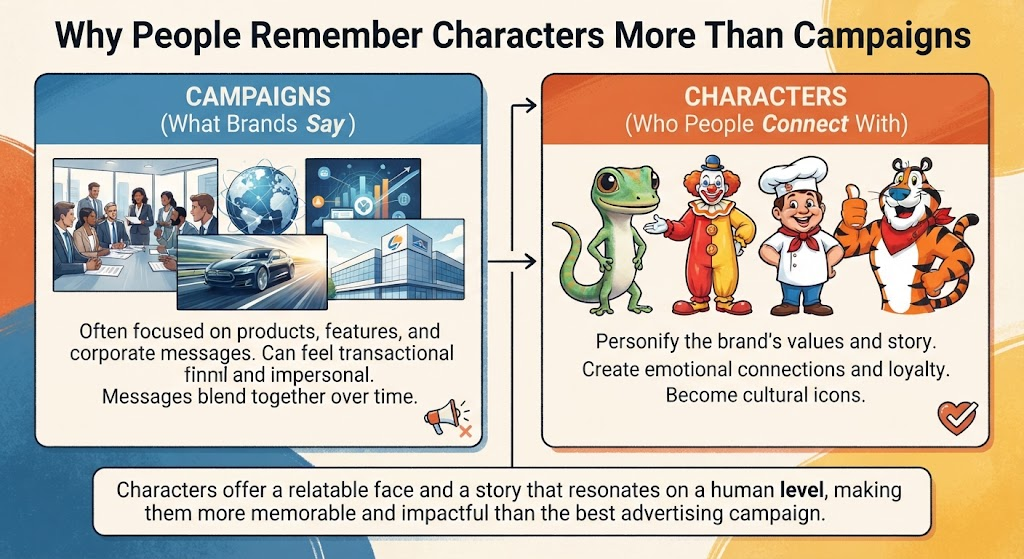
Why People Remember Characters More Than Campaigns

Think about the last advertisement you remember.

Can you remember the exact campaign?

The colours? The slogan? The call to action?

Maybe.

Now think about a character you grew up watching.

Suddenly, the memory gets much clearer.

You remember their personality. Their voice. Their expressions. Their habits. Maybe even the ridiculous things they used to do.

That difference isn’t accidental.

People are naturally drawn to personalities and stories.

And that is exactly why characters can become incredibly powerful marketing tools.

Characters Give Brands a Personality

A campaign has a beginning and an end.

A character can feel like they have a life beyond the campaign.

That’s an important distinction.

When a brand creates a memorable character, that character can represent the personality of the brand in a way that a logo or slogan often can’t.

Think about characters such as the M&M’S characters, Duolingo’s Duo, or the Geico Gecko.

You don’t simply recognise what they represent.

You recognise who they are.

That’s powerful because personality creates familiarity.

And familiarity can create trust.

We Connect With People, Not Just Products

Marketing often focuses heavily on features.

Faster.

Cheaper.

Better.

More powerful.

But consumers don’t experience brands as spreadsheets.

They experience them emotionally.

A memorable character gives people something human to connect with.

The character might be funny, sarcastic, dramatic, chaotic, wholesome or completely ridiculous.

And that’s okay.

In fact, those imperfections can make the character more memorable.

Think about your favourite fictional characters.

You probably don’t remember them because they were perfectly designed.

You remember them because they had personality.

Marketing can work the same way.

Characters Create Continuity

One of the biggest advantages of a recurring character is consistency.

A campaign might run for several weeks.

A character can appear again and again.

They can show up in advertisements, social media posts, packaging, videos, websites and even conversations between customers.

Over time, the character becomes part of the brand’s identity.

Instead of constantly introducing themselves, they already have an established relationship with the audience.

It’s almost like having a familiar face walk into the room.

You already know what kind of energy they’re bringing.

Characters Make Brands Easier to Talk About

Here’s something marketers sometimes overlook:

People share personalities.

It’s much easier to say:

“That Duolingo owl is absolutely unhinged.”

than:

“I really like Duolingo’s current brand communication strategy.”

One sounds like a conversation.

The other sounds like someone is preparing a presentation for the boardroom. ๐Ÿ˜ญ

Memorable characters give audiences something tangible to discuss.

They become shorthand for the brand.

And when people start talking about the character, they’re also talking about the brand.

Characters Can Turn Marketing Into Entertainment

This is where modern marketing gets particularly interesting.

People don’t necessarily want to be marketed to.

They want to be entertained, informed, inspired or understood.

A character can help blur that boundary.

Instead of:

Brand โ†’ Advertisement โ†’ Customer

you can create:

Character โ†’ Story โ†’ Audience โ†’ Brand

The marketing becomes part of an experience.

That’s one reason storytelling has become such an important part of content strategy.

People don’t just want information.

They want something worth remembering.

The Simmba Test ๐Ÿˆโ€โฌ›

And yes, I’m absolutely going to bring Simmba into this.

Because if there is one thing I’ve learned from creating content around a tuxedo cat, it’s that personality gives content somewhere to go.

Simmba isn’t interesting simply because he’s a cat.

There are millions of cats online.

What makes the content more recognisable is the personality attached to him.

The opinions.

The attitude.

The little quirks.

The imaginary commentary.

Suddenly, the audience isn’t just looking at a cat.

They’re getting to know a character.

That’s exactly what brands can do.

You don’t necessarily need a mascot.

You need something that gives your audience a reason to recognise you.

So Should Every Brand Create a Character?

Absolutely not.

This is where strategy matters.

Adding a cartoon mascot to a brand doesn’t automatically make it memorable.

A character needs to serve a purpose.

Ask:

  • Does the character fit the brand?
  • Does it have a recognisable personality?
  • Can the personality remain consistent?
  • Does it make the brand easier to understand?
  • Does the audience actually enjoy interacting with it?
  • Can the character exist beyond one campaign?

If the answer is no, you might just be putting a costume on your marketing strategy.

And nobody needs that.

What Marketers Can Learn From Characters

You don’t have to create a fictional character to use the same principles.

You can build personality into your existing brand.

Give your content a recognisable voice.

Have opinions.

Tell stories.

Create recurring formats.

Develop inside jokes.

Use consistent language.

Show the people behind the business.

Let your audience know what you stand for.

In other words, make your brand recognisable before you try to make it unforgettable.

Because memorability isn’t always about shouting louder.

Sometimes it’s about becoming familiar enough that people recognise you before they even see your name.

Final Thought

Campaigns come and go.

Characters can stay.

That’s the real lesson.

A campaign tells people what you’re selling.

A character can give them someone to remember.

And in a digital world where audiences are exposed to thousands of messages every day, being remembered is a pretty valuable marketing advantage.

So the next time you’re planning a campaign, don’t just ask:

“What are we going to say?”

Ask:

“Who are we going to be?”

Because sometimes the strongest marketing strategy isn’t another clever campaign.

It’s giving people a personality they actually want to remember

The Journey From Reader โ†’ Subscriber โ†’ Customer

Getting someone to visit your website feels like a win.

And it is.

But a website visitor is only the beginning of the journey.

Someone can read your article, enjoy it, close the tab and never think about your website again.

That doesn’t necessarily mean your content failed.

It means the relationship hasn’t developed yet.

In digital marketing, there is a journey that often happens between the first visit and the eventual purchase:

Reader โ†’ Subscriber โ†’ Customer

Understanding that journey can completely change the way you think about content marketing.

Because the goal isn’t simply to get people onto your website.

It’s to give the right people a reason to stay connected.

Stage One: The Reader

Every customer journey starts somewhere.

Usually, it starts with a question, problem, curiosity or search.

Someone might discover your website through:

  • Google
  • Pinterest
  • Instagram
  • YouTube
  • A recommendation
  • Another website
  • An email
  • Social media
  • An online community

They click.

Congratulations.

You have a reader.

But here’s the catch:

A reader doesn’t owe you anything.

They’ve given you their attention for a few minutes.

Your job is to make those minutes worthwhile.

What Does a Reader Actually Want?

Usually, they’re not thinking:

“I would love to become a loyal customer of this website today.”

They’re thinking:

“Can this person help me?”

That’s why useful content matters.

Your reader might want:

  • An answer
  • A solution
  • Advice
  • Information
  • Inspiration
  • A comparison
  • A tutorial
  • A recommendation
  • A different perspective

The first job of your content is to deliver on that expectation.

If someone searches for:

“How does affiliate marketing work?”

and lands on your article, don’t immediately throw five affiliate links at them.

Answer the question.

Help them understand the concept.

Then give them somewhere useful to go next.

That’s how the journey begins.

A Reader Is Not Automatically a Customer

This is where marketers sometimes get impatient.

They see traffic and immediately think:

“Why aren’t these people buying?”

But consider what you’re asking.

Someone discovered your website five minutes ago.

They don’t know you.

They don’t necessarily trust you.

They may not even know what you offer.

Expecting an immediate purchase from every visitor is like meeting someone at a coffee shop and asking them to invest in your business before you’ve even introduced yourself.

A little ambitious. ๐Ÿ˜‚

People often need multiple interactions before they’re ready to take a bigger action.

That’s where the next stage comes in.

Stage Two: The Subscriber

A subscriber is different from a reader.

A reader visited once.

A subscriber has given you permission to continue the conversation.

That might happen through:

  • An email newsletter
  • A free guide
  • A downloadable resource
  • A waitlist
  • A membership
  • A content series
  • Another permission-based channel

The important thing is that the person has chosen to stay connected.

That is valuable.

Why Subscribers Matter

You don’t control Google’s search results.

You don’t control Instagram’s algorithm.

You don’t control whether Pinterest changes how it distributes content.

But when someone voluntarily joins your email list, you’ve created a direct communication channel.

That’s powerful.

Instead of hoping they discover your next article, you can tell them about it.

Instead of waiting for them to find your new resource, you can introduce it.

Instead of starting from zero every time you publish, you have an audience that has already shown interest.

This is why owned audiences matter so much in digital marketing.

But Don’t Treat Subscribers Like Email Addresses

This is another important distinction.

A subscriber isn’t just an email address in your marketing software.

There’s a person behind it.

If someone subscribes because they wanted your beginner’s SEO guide and you immediately send them unrelated sales emails every day, you may lose their trust.

The goal isn’t:

“How many people can I get onto my list?”

It’s:

“How much value can I continue providing to the people who chose to stay?”

That changes your email strategy completely.

Give People a Reason to Subscribe

A visitor needs a reason to move from reader to subscriber.

That reason could be:

“Want more practical SEO strategies? Join the newsletter.”

Or:

“Download the beginner’s affiliate marketing checklist.”

Or:

“Get the next edition of the Signal & Strategies newsletter.”

The key is relevance.

The thing you’re offering should connect naturally with what the reader was already interested in.

If someone is reading an article about SEO, an SEO resource makes sense.

If they’re reading about affiliate marketing, an affiliate marketing guide makes sense.

Don’t make the reader wonder:

“Why are you offering me this?”

Make the next step feel natural.

Stage Three: The Customer

Eventually, some subscribers may become customers.

Depending on your business, that could mean they:

  • Purchase a product
  • Buy a service
  • Join a membership
  • Purchase a course
  • Use an affiliate link
  • Book a consultation
  • Subscribe to a paid product
  • Hire you

This is the conversion.

But here’s something important:

The customer journey doesn’t begin at the checkout page.

It began much earlier.

It began with the first interaction.

Trust Comes Before the Transaction

People generally don’t wake up thinking:

“I wonder which random website I should give my money to today.”

They need context.

They need confidence.

They need to understand what they’re buying.

And they need to believe that the person recommending it understands their problem.

That’s why your content matters even when it isn’t directly generating a sale.

An educational article might introduce someone to your brand.

A follow-up email might deepen their understanding.

A comparison article might help them evaluate their options.

A personal story might make your brand memorable.

A product review might finally give them enough information to make a decision.

The purchase is the visible moment.

The trust-building happened beforehand.

The Journey Isn’t Always Linear

This is where things get interesting.

Not everyone follows:

Reader โ†’ Subscriber โ†’ Customer

in a neat little straight line.

Someone might:

Reader โ†’ Customer

They find your product review through Google and buy immediately.

Someone else might:

Reader โ†’ Reader โ†’ Reader โ†’ Subscriber โ†’ Reader โ†’ Customer

Someone might discover you through Instagram, leave, find you again through Google, join your newsletter six months later and eventually purchase.

Someone else might subscribe and never buy.

And that’s okay.

People aren’t funnels with legs.

They’re people.

Their journeys are messy, unpredictable and influenced by timing, budget, needs and trust.

Don’t Measure Every Reader by Whether They Buy

This is especially important for content marketers.

An article doesn’t necessarily need to generate a sale to be valuable.

It might:

  • Introduce your brand
  • Build authority
  • Answer a question
  • Generate search traffic
  • Bring someone into your ecosystem
  • Lead to another article
  • Encourage a subscription
  • Build trust

That means you need to think beyond one metric.

A page with thousands of visitors and zero immediate sales might still contribute to future conversions.

Likewise, a page with fewer visitors but a highly relevant audience might generate much stronger business results.

Traffic and value aren’t always the same thing.

Content Should Support the Journey

Different types of content can serve different stages.

Reader Content

Designed to attract and educate.

Examples:

  • “What Is Affiliate Marketing?”
  • “How Does SEO Work?”
  • “SEO vs PPC”
  • “What Is Search Intent?”

Subscriber Content

Designed to deepen the relationship.

Examples:

  • Guides
  • Checklists
  • Newsletters
  • Tutorials
  • Exclusive resources
  • Content series

Customer Content

Designed to help someone make a confident purchasing decision.

Examples:

  • Product reviews
  • Comparisons
  • Case studies
  • Tutorials
  • Buying guides
  • Demonstrations

This doesn’t mean every article has to fit neatly into one box.

Good content can support multiple stages.

The Role of Storytelling

Storytelling can play an interesting role throughout this journey.

At the reader stage, a story can make someone stop scrolling.

At the subscriber stage, stories can help build familiarity and connection.

At the customer stage, stories can provide context around a product, service or result.

Think about the difference between:

“This tool has five useful features.”

and:

“I started using this tool because I was spending hours trying to organise my keyword research manually. Here’s what changed.”

The second version creates context.

And context creates meaning.

You’re no longer just listing features.

You’re showing why the product matters.

Where Affiliate Marketing Fits

Affiliate marketing can fit naturally into this journey.

You might attract a reader with an educational article.

That reader might explore your comparison content.

Your recommendation gives them information about a product.

Eventually, they click your affiliate link and make a qualifying purchase.

But notice something:

The affiliate link is only one part of the journey.

The content before it matters.

The trust before it matters.

The relevance of the recommendation matters.

The reader’s experience matters.

This is why simply adding more affiliate links isn’t necessarily a better strategy.

Sometimes the better strategy is creating better reasons to trust the recommendation.

The Signal & Strategies Takeaway

The journey from reader to customer isn’t about forcing someone through a funnel.

It’s about understanding what someone needs at each stage.

A reader needs value.

A subscriber needs continued value.

A potential customer needs confidence.

And a customer needs a reason to believe they made the right decision.

Think of the journey as:

Attention โ†’ Value โ†’ Trust โ†’ Action

Your content earns attention.

Your expertise provides value.

Your consistency builds trust.

And eventually, the right person takes action.

That’s the strategy.

Because successful digital marketing isn’t simply about asking:

“How do I get more customers?”

Sometimes the better question is:

“What experience am I creating between the first click and the final decision?”

That’s where the real strategy lives.


Quick FAQ

What is the reader-to-customer journey?

It describes the process a person may go through from first discovering your content to becoming a subscriber and eventually becoming a customer.

Does every reader become a subscriber?

No. Many readers will only visit once, and that’s normal. Your goal is to create enough value and relevance that the right readers want to continue the relationship.

Why are subscribers valuable?

Subscribers have voluntarily chosen to stay connected with your brand, giving you a direct way to continue providing relevant content and building trust.

What Happens When You Write for Google AND Humans?

There are two very different people you need to think about when creating content for your website.

The first is Google.

The second is the human who actually clicks on your article.

And here’s where content creation gets interesting.

If you write only for Google, you can end up with an article packed with keywords, perfectly structured headings and every SEO box ticked, but nobody actually wants to read it.

If you write only for humans, you might create something incredibly useful and engaging, but struggle to get it discovered through search.

So what happens when you write for Google AND humans?

You start creating content that can be discovered and enjoyed.

And that is where SEO becomes more than just keywords.

Google Needs to Understand Your Content

Search engines need context.

When someone searches for something, Google has to determine which pages are relevant enough to appear in the results.

That’s where things like:

  • Keywords
  • Search intent
  • Headings
  • Content structure
  • Internal links
  • Page relevance
  • Helpful information
  • Overall topic coverage

come into play.

You’re essentially giving Google signals about what your content is about.

For example, if you’re writing about affiliate marketing for beginners, your article should actually discuss affiliate marketing for beginners.

It sounds obvious.

Yet sometimes content gets so focused on inserting keywords that the actual reader gets forgotten.

And that’s where things can go sideways.

Humans Don’t Search Like Algorithms

People aren’t robots.

Thankfully.

Imagine someone searches:

“How does affiliate marketing work?”

They’re probably not looking for an article that repeats the phrase affiliate marketing 47 times.

They’re looking for an answer.

They might want to know:

  • What affiliate marketing actually is
  • How affiliate links work
  • How commissions work
  • How to get started
  • Whether they need a website
  • Whether affiliate marketing is legitimate
  • What mistakes beginners should avoid

The keyword tells you what they searched for.

The search intent gives you a clue about why they searched for it.

That’s a huge difference.

Keywords Are a Starting Point, Not a Writing Style

This is one of the biggest things I think content creators need to understand.

Keywords are useful.

They help you understand what people are searching for and give search engines context about your content.

But a keyword shouldn’t dictate every sentence you write.

If your target keyword is:

“affiliate marketing for beginners”

you don’t need to write:

“Affiliate marketing for beginners is important for affiliate marketing beginners because affiliate marketing beginners need to understand affiliate marketing.”

Please don’t.

Google is not sitting there with a little clipboard giving you bonus points for sounding like a malfunctioning parrot. ๐Ÿ˜‚

Instead, use the keyword naturally and focus on answering the actual question.

Write for the Person Behind the Search

Whenever you’re writing an SEO article, imagine that there is an actual person sitting behind the search bar.

What are they worried about?

What do they already know?

What don’t they understand?

What might they search next?

What would make them trust your answer?

This changes the way you write.

Instead of thinking:

“How many keywords do I need?”

you start thinking:

“What does this person need from me?”

That’s a much better question.

SEO-Friendly Doesn’t Have to Mean Boring

There is a misconception that SEO content has to sound formal, repetitive or painfully generic.

It doesn’t.

You can still use:

  • Stories
  • Personal experiences
  • Opinions
  • Examples
  • Humour
  • Questions
  • Analogies
  • Personality

while creating content that is search-friendly.

In fact, adding those human elements can make the content significantly easier to read.

Compare:

“Affiliate marketing is a form of digital marketing where affiliates promote products and receive commissions.”

with:

“Think of affiliate marketing as being the person who tells your friend about a product you genuinely think they’ll love. The difference is that, in affiliate marketing, you can receive a commission when that recommendation leads to a qualifying purchase.”

Both explain the concept.

But one sounds like it belongs in a glossary.

The other sounds like someone is actually talking to you.

That’s the human layer.

Your Introduction Matters More Than You Think

One of the easiest ways to write for humans is to stop treating your introduction like a formality.

Your introduction should answer one important question:

“Why should I keep reading?”

Don’t spend five paragraphs telling someone what they’re about to read.

Give them a reason to care.

If they’re searching for:

“How to choose an affiliate niche”

you could start by explaining why choosing a niche feels difficult.

If they’re searching for:

“SEO vs PPC”

you could immediately address the question they’re probably trying to answer:

“Which one should I invest my time or money into?”

You’re acknowledging the reader’s problem.

That’s storytelling at its simplest.

Structure Helps Both Google and Humans

This is where Google and humans actually agree.

Nobody enjoys opening an article and seeing a giant wall of text.

Clear structure helps readers scan your content.

It also helps search engines understand the relationships between different sections of your article.

Use:

Headings

Break your article into logical sections.

Short paragraphs

Give readers room to breathe.

Lists

Use them when you’re presenting multiple related points.

Examples

Show people what you mean instead of simply telling them.

Internal links

Help readers discover related content on your website.

Good structure isn’t about tricking Google.

It’s about making information easier to understand.

And that happens to benefit search engines too.

Don’t Write for Google at the Expense of Your Voice

This is particularly important if you’re building a personal brand.

Your website should still sound like you.

SEO shouldn’t flatten your personality into generic marketing language.

If you naturally write conversationally, don’t suddenly start sounding like a corporate instruction manual because you think Google prefers it.

If humour fits your brand, use it.

If storytelling helps explain an idea, tell the story.

If you have an opinion, make the argument.

Your expertise isn’t just the information you provide.

It’s how you interpret that information.

That’s something a keyword can’t manufacture.

The Sweet Spot: Searchable AND Readable

The goal isn’t:

Google vs humans.

It’s:

Google + humans.

You want Google to understand:

“This article answers the question being searched.”

And you want the reader to think:

“Finally. Someone actually explained this properly.”

That’s the sweet spot.

Your SEO gets someone through the door.

Your content gives them a reason to stay.

And your overall strategy gives them a reason to come back.

What Happens When You Get the Balance Right?

When you write for both search engines and humans, several things can happen.

Your content becomes easier to discover.

Your articles become easier to read.

Your audience gets clearer answers.

Your website can build topical relevance over time.

And you create content that isn’t completely dependent on one traffic source.

But there’s another benefit that’s easy to overlook.

You become a better writer.

Because you’re forced to think about both sides.

You have to understand the search.

Then you have to understand the person conducting the search.

That’s not just SEO.

That’s audience research.

The SEO + Storytelling Connection

This is where I think SEO and storytelling become surprisingly compatible.

Storytelling isn’t necessarily about turning every blog post into a dramatic novel.

It’s about understanding people.

Every search has a person behind it.

Every question has a reason.

Every problem has context.

And every piece of content has an opportunity to take someone from:

Question โ†’ Understanding โ†’ Action

SEO helps people find the beginning of that journey.

Storytelling and useful content can help carry them through it.

That’s why I don’t see SEO and storytelling as opposites.

I see them as two different parts of the same strategy.

The Signal & Strategies Takeaway

Writing for Google and humans doesn’t mean writing two separate versions of your article.

It means creating one useful piece of content that satisfies both.

Give Google enough context to understand your topic.

Give humans enough value to make them want to keep reading.

Use keywords naturally.

Understand search intent.

Structure your content clearly.

Add examples.

Bring your personality.

And most importantly, remember that there is a person on the other side of every search query.

Because at the end of the day:

Google can help someone discover your content.

Only your content can convince them it was worth discovering.

That’s the difference between writing content that simply ranks and writing content that actually connects.


Quick FAQ

Can you write for Google and humans at the same time?

Absolutely. The goal of modern SEO content should be to make your content understandable to search engines while keeping it useful, readable and engaging for real people.

Should I use my target keyword in every paragraph?

No. Keywords should be used naturally and in relevant places. Repeating them excessively can make your writing awkward and reduce the quality of the reader’s experience.

What is search intent?

Search intent is the reason behind a person’s search. Someone searching for “what is affiliate marketing” has a different intent from someone searching for “best affiliate marketing platforms.”

Does storytelling help SEO?

Storytelling itself isn’t a magic ranking factor. However, storytelling can make content more engaging, understandable and memorable, which can contribute to a better overall user experience.

What is more important: SEO or good writing?

You don’t really have to choose. SEO helps people discover your content, while good writing helps them understand and value it. Strong content needs both.

Should SEO make my writing sound different?

No. SEO should influence your strategy, structure and optimisation, but it shouldn’t erase your personality or make your writing sound robotic.

Introduction to Wealthy Affiliate: What Is It, Who Is Behind It, and What Should You Expect?

If you’ve spent any time researching affiliate marketing, chances are you’ve come across Wealthy Affiliate.

Maybe you’ve seen someone recommend it.

Maybe you’ve seen a review of it.

Maybe you’ve encountered it while searching for ways to make money online.

Or perhaps you’re already a member and are wondering what exactly you’ve signed up for.

Whatever brought you here, let’s start with the basics.

What actually is Wealthy Affiliate?

Who created it?

What does it teach?

What can you expect when you join?

And perhaps most importantly, is it something you should understand before deciding whether it’s right for you?

Let’s break it down.

What Is Wealthy Affiliate?

Wealthy Affiliate, often shortened to WA, is an online platform focused on learning how to build an online business.

It has been around since 2005, and the platform has evolved considerably since its early days. Today, Wealthy Affiliate combines online business education with tools for website building, hosting, keyword research, content creation, AI-assisted workflows and community support.

Affiliate marketing is a major part of what Wealthy Affiliate teaches.

The basic concept is relatively straightforward:

You create content around a particular topic or niche, attract an audience, recommend relevant products or services, and potentially earn a commission when someone makes a qualifying purchase through your affiliate link.

But Wealthy Affiliate isn’t simply an affiliate-link directory or a collection of videos.

It aims to provide a broader system for learning how to build an online business.

That distinction matters.

Who Founded Wealthy Affiliate?

Wealthy Affiliate was founded by Kyle Loudoun and Carson Lim in 2005. The platform’s current About page identifies Kyle as Marketing Chief and co-founder and Carson as Design Chief and co-founder.

Kyle has described their own beginnings as online entrepreneurs, explaining that both he and Carson started in the affiliate marketing space before joining forces to create Wealthy Affiliate.

That history is useful to understand because Wealthy Affiliate wasn’t originally created as a giant corporate education platform.

It grew alongside the online business industry.

And, as the internet changed, the platform changed with it.

The company says it launched its website-building and hosting platform in 2012, began incorporating AI in 2018, and introduced more advanced AI features in subsequent years.

So What Does Wealthy Affiliate Actually Teach?

At its core, Wealthy Affiliate is about learning how to build an online business.

Affiliate marketing is one of the central models, but the process involves several different skills.

Depending on the training and tools you’re using, you can encounter topics such as:

  • Choosing a niche
  • Building a website
  • Content creation
  • Keyword research
  • SEO
  • Audience research
  • Affiliate marketing
  • Website development
  • Online business strategy
  • Social media and other traffic methods
  • AI-assisted content workflows
  • Conversion and monetization strategies

That means you aren’t simply learning:

“Put an affiliate link in an article.”

You’re learning about the ecosystem surrounding that link.

And honestly, that’s important.

An affiliate link without an audience, useful content or a reason for someone to trust you isn’t exactly a business strategy.

It’s just a link sitting there looking lonely.

What Can You Expect When You Join?

This is where expectations matter.

Wealthy Affiliate isn’t a magic button that you press on Monday and discover a successful online business waiting for you on Tuesday.

Building an online business takes time.

You need to learn.

You need to create.

You need to experiment.

You need to make mistakes.

And, occasionally, you will probably stare at your analytics wondering why Google has apparently decided your article does not exist.

Welcome to digital marketing. ๐Ÿ˜‚

The platform provides education and tools, but you still have to do the work.

That means creating content, learning your niche, understanding your audience, improving your website and adapting your strategy.

The Training

One of the major components of Wealthy Affiliate is its training.

The idea is to take someone who may not know much about online business and introduce them to the different pieces involved in building one.

This can be particularly useful if you’re a beginner because online business has an enormous amount of terminology.

SEO.

Keywords.

Search intent.

Niches.

Conversions.

Affiliate programs.

Traffic.

Backlinks.

CTR.

PPC.

Suddenly you’re three Google searches deep wondering whether you accidentally enrolled in a university degree.

The training gives you somewhere to start.

But here’s something important:

You don’t have to stop learning outside Wealthy Affiliate.

A good marketer should never treat one platform, course or teacher as the entire internet.

Use different sources.

Compare information.

Test ideas.

Keep learning.

That’s part of becoming a marketer rather than simply becoming someone who follows instructions.

The Website-Building Side

Wealthy Affiliate also includes website-building and hosting tools as part of its platform. The company says its website-building and hosting platform launched in 2012.

This is useful because your website can become the central home for your online business.

Social media platforms can change.

Algorithms can change.

Trends can disappear.

Your website gives you a digital property where you can build your content library and audience over time.

Think of social media as a distribution channel.

Your website can be the headquarters.

The Community

Another significant part of Wealthy Affiliate is its community.

There are discussions, questions, member-created posts, training and opportunities to interact with other people building online businesses.

This can be especially helpful when you’re starting because building an online business can sometimes feel like you’re working inside a very quiet room.

Having somewhere to ask:

“Is this normal?”

or

“Why isn’t my website getting traffic?”

can save you from spending three hours staring at your screen and questioning every decision you’ve made since 2017.

The community is also one of the reasons I think you should explore different people within the platform rather than assuming one person’s approach represents everyone’s approach.

Everyone has different experiences.

Learn to find the voices you trust.

What About AI?

This is one area where Wealthy Affiliate has evolved significantly.

The company says it began incorporating AI into its platform in 2018 and later introduced more advanced AI features for content creation and analysis.

And this is particularly relevant to modern affiliate marketing.

AI can help with things like:

  • Brainstorming
  • Research
  • Content planning
  • Keyword analysis
  • Drafting
  • Editing
  • Content optimisation
  • Idea generation

But there’s an important distinction.

AI can assist your marketing. It shouldn’t replace your thinking.

You still need to understand your audience.

You still need to know what you’re talking about.

You still need to fact-check information.

And you still need to bring your own experience, opinions and perspective to the content.

Otherwise, you risk creating content that technically contains all the right words but feels like it was assembled in a content factory at 3:17 a.m.

Nobody wants that.

What Wealthy Affiliate Is Not

This might actually be the most important section.

Wealthy Affiliate is not a guarantee that you’ll become wealthy.

It isn’t a shortcut around learning marketing.

It isn’t a substitute for putting in the work.

And it isn’t something you should join assuming that money will automatically appear because you’ve completed a certain number of lessons.

The platform can provide education, tools and community.

Your results still depend on what you do with those resources.

That’s true of almost every form of online business education.

A course can teach you how to cook.

It can’t eat the dinner for you.

Is Wealthy Affiliate Only for Affiliate Marketers?

Not necessarily.

Affiliate marketing is a major focus, but the skills involved overlap with many areas of digital marketing.

For example, learning:

  • SEO
  • Content strategy
  • Audience research
  • Website creation
  • Conversion strategy
  • Keyword research
  • Digital marketing

can be useful whether your eventual goal is affiliate marketing, freelancing, blogging, content creation, e-commerce or another online business model.

The skills can travel.

That’s one of the reasons I think it’s more useful to look at Wealthy Affiliate as a learning environment rather than simply asking:

“Can I make money with this?”

A better question is:

“What skills can I learn here, and how can I apply them to my own goals?”

What Should a Beginner Expect?

If you’re completely new, expect a learning curve.

You’ll probably have questions.

You’ll probably change your mind about your niche at some point.

You might write content that nobody reads.

You might learn SEO and then discover that SEO has about seventeen more layers than you originally thought.

You might try something that doesn’t work.

And that’s okay.

Marketing isn’t a straight staircase.

It’s more like building a map while you’re already travelling.

The important thing is to pay attention to what happens.

Create. Measure. Learn. Adjust. Repeat.

That’s where the actual strategy develops.

My Biggest Advice for New Wealthy Affiliate Members

Don’t treat Wealthy Affiliate as a set of instructions that you have to follow blindly.

Treat it as a resource.

Learn from it.

Question things.

Research outside of it.

Talk to other marketers.

Experiment with different approaches.

And most importantly, develop your own perspective.

Because eventually, you don’t want to simply be someone who knows what Wealthy Affiliate teaches.

You want to become someone who understands why the strategy works, when it might not work, and how you can adapt it.

That’s the difference between learning a system and learning marketing.

The Signal & Strategies Takeaway

Wealthy Affiliate can be a starting point for learning about online business, affiliate marketing, SEO, websites, content and digital strategy.

But joining a platform isn’t the end of the journey.

It’s the beginning of one.

The most valuable thing you can take away isn’t simply a collection of lessons.

It’s the ability to look at a marketing problem and think:

“What is the signal here, and what strategy should I build around it?”

Because that’s what marketing eventually becomes.

You stop simply following instructions.

You start asking better questions.

And that’s where things get interesting.


Quick FAQ

What is Wealthy Affiliate?

Wealthy Affiliate is an online platform that provides training, tools, website-building and hosting resources, AI-assisted features and community support for people interested in building online businesses.

Who founded Wealthy Affiliate?

Wealthy Affiliate was founded in 2005 by Kyle Loudoun and Carson Lim.

Does Wealthy Affiliate teach affiliate marketing?

Yes. Affiliate marketing is a major part of the platform’s online-business education.

Does Wealthy Affiliate guarantee income?

No. Training and tools cannot guarantee that an individual will make money. Building an online business requires time, work, testing and learning.

Is Wealthy Affiliate only about affiliate links?

No. The platform covers a broader range of online-business skills, including websites, content, SEO, research, AI-assisted workflows and other digital marketing concepts.

Is Wealthy Affiliate suitable for beginners?

It is designed to provide structured learning and resources for people building online businesses, including beginners. However, beginners should still expect to learn gradually and put the strategies into practice.