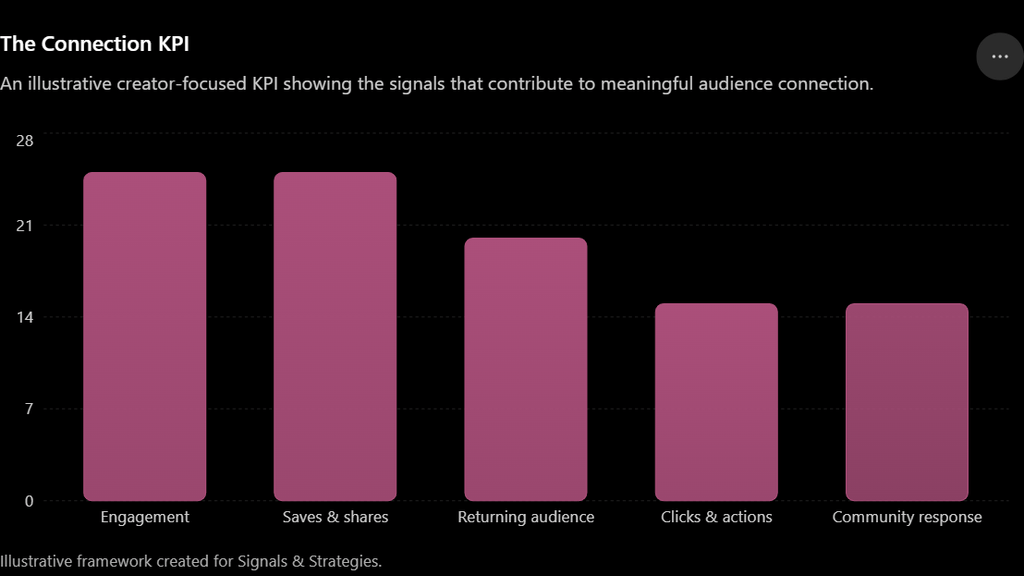
Connection KPI = Engagement + Saves/Shares + Returning Audience + Actions and Community Response.
The point of this KPI isn’t that every creator has to use these exact percentages. The framework is about looking at several signals together instead of deciding whether content worked based on views alone.
As content creators, we’re constantly told to look at the numbers.
How many views did you get?
How many likes?
How many followers?
How much engagement?
Those numbers can be useful, but I think we sometimes forget about the most important one.
Did the content actually connect with someone?
That’s where I came up with what I call The Connection KPI
The idea is simple: content success isn’t just about reach. It’s about what happens after someone sees it.
The Formula
Connection Score = (E + S + R + A + C) ÷ 5
Where each signal is scored from 0–100:
Signal
What it measures
E = Engagement
Likes, comments and meaningful interactions
S = Saves & Shares
Whether people found the content valuable enough to keep or pass on
R = Returning Audience
Whether people come back for more
A = Actions
Clicks, subscriptions, enquiries or other intentional actions
C = Community Response
Conversations, replies and genuine audience participation
📊 Your Connection Score
90–100 → Strong Connection 🟢 Your content isn’t just being seen. It’s resonating.
70–89 → Healthy Connection 🔵 You’re building meaningful audience relationships, with room to strengthen certain signals.
50–69 → Developing 🟡 People are noticing your content, but the relationship may need more nurturing.
0–49 → Weak Connection 🔴 Your content may be getting impressions without creating much meaningful response.
🧠 Why I Like This Framework
The beauty of the C.O.N.N.E.C.T. KPI is that it doesn’t punish smaller creators.
A creator with 800 followers can have a stronger Connection Score than an account with 80,000 followers if their audience is actually interacting, returning, sharing and taking action.
That’s the whole philosophy behind it:
Reach tells you who saw you. Connection tells you who stayed.
And for content creators, the people who stay are often more valuable than the people who simply scroll past.
🧠 What Is the Connection KPI?
The Connection KPI is about measuring the quality of the relationship your content is building with your audience , rather than simply measuring how many people interacted with it.
For me, connection can look like someone saving a post because it helped them, commenting because they relate to it, sharing it with someone else,. subscribing to your website, or even coming back to your next post.
A post with 50,000 views might look impressive.
But a post with 500 views that bring you 20 genuinely interested readers could be far more valuable
📈 Why Does It Matter?
Content creators can easily become obsessed with chasing numbers.
I know I’ve caught myself thinking “Why didn’t this get more views?”
But views don’t automatically equal value.
The Connection KPI encourages you to ask a different question:
“Did this content reach the people I actually wanted to reach?”
The shift can completely change how you approach your content strategy.
Instead of creating content purely because you think the algorithm will like it, you start creating content that your audience will care about.
🎯 How I Use It
I look at engagement , but I also pay attention to the signals behind it.
Are people returning to my content?
Are they saving it or sharing it?
Are they clicking through to my website?
Are they responding to the ideas I’m putting forward?
These are the signals that tell me whether I’m building something meaningful.
The Connection KPI isn’t about ignoring traditional analytics.
It’s about looking beyond them.
Because at the end of the day, content isn’t created for numbers.
The audience starts following the actors outside the show.
They become interested in their fashion, interviews, friendships, social media, partnerships, appearances, and future projects.
Suddenly, the cast isn’t just part of a television series.
They’ve become part of the cultural conversation surrounding it.
That’s exactly what makes the Off Campus cast interesting from a marketing perspective.
The series stars Ella Bright as Hannah Wells, Belmont Cameli as Garrett Graham, Mika Abdalla as Allie Hayes, Antonio Cipriano as John Logan, Jalen Thomas Brooks as John Tucker, Stephen Kalyn as Dean Di Laurentis, and Josh Heuston as Justin Kohl.
And since the show’s May 2026 debut, the cast has experienced a rapid rise in visibility, with Season 2 already in production.
For marketers, that’s worth paying attention to.
Because a successful entertainment property can turn its cast into individual brands.
🎬 A Cast Starts as an Ensemble
When a new show launches, audiences generally encounter the cast as a group.
They’re introduced through the story.
In Off Campus, viewers aren’t initially thinking about separate celebrity brands.
They’re thinking about:
Hannah and Garrett.
Allie and Dean.
Logan.
Tucker.
The Briar hockey team.
The actors are part of the fictional universe.
But once audiences become invested in the show, their attention can expand beyond the characters.
They start asking:
Who plays Garrett?
What’s Ella Bright like in real life?
What are the cast members doing when they’re not filming?
And that’s when the cast begins transitioning from television talent to individual public figures.
📈 The Breakout Effect
One of the most valuable things a successful show can give an emerging actor is momentum.
Belmont Cameli is a particularly obvious example.
His role as Garrett Graham has been described as a breakout moment, with PEOPLE noting that his visibility continued to rise after the show’s debut and that he was already experiencing significant attention while returning to film Season 2.
But here’s the important marketing distinction:
The show created the attention.
The actor now has to build something with it.
That second part is where personal branding begins.
🌟 From Cast Member to Personal Brand
An actor’s public identity doesn’t have to stop at:
“I’m the person who plays Garrett Graham.”
Eventually, the goal can become:
“I’m Belmont Cameli.”
The same applies across the ensemble.
Ella Bright isn’t only Hannah Wells.
Mika Abdalla isn’t only Allie Hayes.
Antonio Cipriano isn’t only John Logan.
Stephen Kalyn isn’t only Dean Di Laurentis.
Their characters may be the introduction.
But their personal identities are what can sustain their careers after the show changes focus.
And Off Campus is particularly interesting because the series itself moves between couples and characters.
Season 2 shifts the central romance toward Allie Hayes and Dean Di Laurentis, while Hannah and Garrett remain part of the ensemble.
That structure naturally encourages audiences to keep following the wider cast.
📱 The Audience Follows the People, Not Just the Episodes
This is where social media changes entertainment marketing.
A television episode might last around an hour.
A fan’s relationship with the cast can last all week.
They can see:
Behind-the-scenes content
Interviews
Cast friendships
Fashion
Brand partnerships
Events
Photoshoots
Fan interactions
New projects
The show becomes only one piece of the content ecosystem.
That’s extremely valuable.
The cast can continue generating attention even when there isn’t a new episode airing.
❤️ The Cast Itself Becomes Part of the Product
This is one of the most fascinating parts of Off Campus right now.
Audiences aren’t only interested in the fictional relationships.
They’re also interested in the real relationships between the cast members.
Recent coverage has highlighted the cast’s close friendship and the way they publicly support each other’s projects.
That’s important because audiences love seeing chemistry continue beyond the screen.
It creates another layer of storytelling:
Characters have relationships.
Actors have friendships.
Fans watch both.
That makes the cast itself part of the entertainment experience.
🧠 Familiarity Creates Commercial Value
From a marketing perspective, familiarity is powerful.
Imagine seeing an advertisement featuring an actor you’ve never heard of.
You might scroll past.
Now imagine seeing the same advertisement featuring someone you’ve spent eight episodes watching every week.
You already recognise them.
You already have associations with them.
You already know something about their public identity.
That doesn’t guarantee that you’ll buy the product.
But it can make you stop and pay attention.
And in an increasingly crowded digital environment, attention is valuable.
👟 The Brand Partnership Effect
This is where the Off Campus cast’s evolution becomes particularly relevant.
Belmont Cameli has moved into brand partnerships beyond the series, including work with Reebok and TRESemmé. PEOPLE recently discussed his TRESemmé partnership while covering his return to Off Campus Season 2.
That demonstrates an important shift.
The actor isn’t simply being marketed as:
“The guy from Off Campus.”
He’s becoming commercially relevant in his own right.
And that’s exactly what brands want from celebrity partnerships.
They aren’t simply buying an appearance.
They’re buying access to an existing audience, a recognisable identity, and cultural relevance.
💄 Ella Bright Is Another Example
Ella Bright’s Rare Beauty partnership demonstrates the same evolution from character recognition to personal celebrity brand.
Bright is known to audiences as Hannah Wells, but a partnership like Rare Beauty’s gives her another identity:
beauty ambassador.
That’s valuable because it creates associations that exist independently of the show.
Someone can discover Bright through Off Campus and then encounter her through beauty content.
The audience relationship expands.
The actor’s commercial identity expands.
And eventually, the celebrity can become bigger than the original role.
🔄 The Show Creates a Launchpad
This is the key strategic idea.
A successful television show can function as a launchpad.
It gives emerging actors:
Visibility → Recognition → Audience → Cultural relevance → Brand opportunities → New projects
The television series is therefore not necessarily the final destination.
It’s the first major platform.
That is particularly important for emerging actors because they can use the attention generated by a successful show to establish careers across multiple industries.
🏒 The Briar U Effect
There’s another reason Off Campus is particularly useful as a case study.
The characters exist within a shared universe.
That means the audience isn’t emotionally attached to only one actor.
They’re attached to the group.
Garrett, Logan, Tucker and Dean have their hockey-team friendships.
Hannah and Allie have their friendship.
The romances overlap.
The characters appear in each other’s stories.
That ensemble structure creates something similar to a brand ecosystem.
One character can introduce audiences to another.
One actor’s popularity can bring attention to another cast member.
And when fans become invested in the group, the entire cast benefits from the shared cultural momentum.
📡 A Cast Can Become a Network
Think about it this way:
One show
⬇️
Multiple characters
⬇️
Multiple actors
⬇️
Multiple personal brands
⬇️
Multiple audiences
⬇️
Multiple commercial opportunities
That’s much more valuable than thinking about a television cast as six or seven people who simply appear on screen together.
The cast becomes a network of attention.
⚠️ But Fame Isn’t a Personal Brand
There’s an important warning here.
Being recognised isn’t the same as having a strong personal brand.
An actor can become incredibly famous because of one role and still struggle to establish an identity beyond it.
That’s why the transition matters.
Character recognition gets you noticed.
Personality keeps people interested.
Consistency builds familiarity.
Individual identity creates longevity.
And eventually:
Your work outside the original role determines what people remember you for next.
🚀 Why This Matters for Marketers
For brands, emerging casts like Off Campus present an interesting opportunity.
Instead of asking:
“Who is already famous?”
brands can ask:
“Who is becoming culturally relevant?”
That’s a different strategy.
A breakout cast can bring:
A rapidly growing audience
Fresh cultural relevance
Strong fandom
Emerging personal brands
Multiple audience segments
Long-term commercial potential
And because the actors are still developing their identities, brands may have an opportunity to become part of that journey.
📡 What Off Campus Teaches Us
The biggest marketing lesson isn’t that television actors can get brand deals.
We already know that.
It’s that entertainment can create personal brands at scale.
A successful show gives actors an audience.
A strong character gives them recognition.
Fandom gives them community.
Social media gives them a direct relationship with that audience.
And brand partnerships give them another way to participate in culture.
The television cast becomes something much larger:
a collection of individual creators, personalities, and commercial identities connected by the same story.
🐈⬛ Simmba’s Signal
Simmba: “So they’re not just a cast anymore?”
Correct.
Simmba: “They’re brands?”
Exactly.
Simmba:stares into camera like he’s just discovered capitalism.
😭🐈⬛
The Off Campus cast demonstrates how quickly a successful entertainment property can transform emerging actors into recognisable public figures.
And that’s the signal marketers should watch.
Don’t just look at the show.
Look at what the show is creating around itself.
Because sometimes the biggest commercial opportunity isn’t the television series.
It’s the people audiences discover because of it. 📡✨
Celebrity marketing used to be relatively straightforward.
Find someone famous. Put them in a campaign. Borrow their audience. Sell the product.
But modern celebrity marketing is becoming much more strategic.
Brands are increasingly looking beyond established household names and paying attention to who is rising, who is culturally relevant, and who already has a meaningful relationship with the audience they want to reach.
Ella Bright’s 2026 partnership with Rare Beauty is a particularly interesting example.
Bright, who plays Hannah Wells in Off Campus, became Rare Beauty’s first celebrity ambassador other than founder Selena Gomez, fronting the brand’s Made You Blush campaign for its Soft Pinch Liquid Blush.
For marketers, the interesting part isn’t simply that a young actress got a beauty campaign.
It’s why this particular partnership makes strategic sense.
🌱 Emerging Talent Can Create a Different Kind of Opportunity
Established celebrities already have enormous commercial value.
But they’re also heavily marketed.
Their audiences have seen countless campaigns.
They may already represent multiple brands.
And their celebrity identity can be so established that there’s less room for a brand to become part of their next chapter.
Emerging talent is different.
Someone at the beginning of a major breakout can bring:
Freshness
Cultural momentum
Curiosity
A rapidly growing audience
Strong fandom
Less celebrity saturation
Long-term potential
That’s what makes emerging talent particularly interesting.
You’re not only partnering with where someone is now.
You’re potentially partnering with where they’re going.
🎬 Ella Bright Arrived at the Right Moment
Bright’s rise as Hannah Wells came at an interesting cultural moment.
Off Campus quickly became a major streaming success, and Bright’s performance placed her directly in front of a young, highly engaged audience. Glossy reported that the show reached 36 million viewers in its first two weeks and became Amazon’s top show among women aged 18 to 34.
That’s a valuable signal for marketers.
Rare Beauty wasn’t choosing an actress in a vacuum.
It was choosing someone whose profile was actively accelerating.
There’s a difference between:
“This person is famous.”
and:
“This person’s audience is growing right now.”
The second can be incredibly powerful.
💄 Rare Beauty Didn’t Just Pick Ella. It Picked the Moment.
This is perhaps the most interesting part of the partnership.
Rare Beauty’s campaign wasn’t simply:
Ella Bright + blush.
It was Ella Bright + Off Campus + romance + blush + fandom.
The Made You Blush campaign plays directly with the romantic world audiences associate with Bright through Hannah Wells. The campaign features suitors attempting to make her blush, while the product becomes the thing that actually does.
That’s smart because the campaign isn’t fighting against the cultural conversation surrounding Bright.
It’s joining it.
Glossy reported that Rare Beauty’s team specifically developed the concept from an Off Campus moment involving Hannah and Garrett, rather than simply choosing a celebrity first and figuring out the creative afterward.
That’s a very useful lesson for marketers:
Don’t just ask which celebrity fits your brand. Ask which cultural moment your brand can meaningfully participate in.
❤️ Authenticity Helps
Another reason the partnership works strategically is that Bright has said she’s been a longtime fan of Rare Beauty’s Soft Pinch Liquid Blush, using it since 2020 and incorporating it into her makeup routine.
That’s important.
There’s a major difference between:
“Here’s an actor we paid to hold our product.”
and:
“Here’s an actor who already knows and likes the product.”
The second creates a much stronger narrative.
It gives the audience a reason to believe the partnership.
And authenticity doesn’t have to mean a celebrity was secretly using a product for ten years before a brand discovered them.
It simply means the partnership should feel credible.
📈 Cultural Momentum Is a Marketing Signal
One of the biggest lessons here is the value of momentum.
Imagine you’re a brand looking at two celebrities.
Celebrity A
Already massively famous.
Huge audience.
Constantly appearing in campaigns.
Celebrity B
Currently having a breakout moment.
Audience growing quickly.
People are discovering them.
Fans are highly engaged.
Their cultural relevance is accelerating.
Celebrity A might deliver enormous reach.
But Celebrity B may offer something different:
momentum.
And momentum can be incredibly valuable.
Because brands aren’t always trying to reach people who already know everything about a celebrity.
Sometimes they want to reach people who are just discovering them.
🎯 Emerging Talent Can Help Brands Reach New Audiences
Rare Beauty has long been closely associated with Selena Gomez.
That’s a powerful existing brand identity.
But introducing another celebrity face allows the brand to enter another audience ecosystem.
Bright brings a different generational and cultural connection through Off Campus.
This doesn’t replace Selena.
It expands the universe around Rare Beauty.
That’s an important distinction.
A strong celebrity partnership doesn’t necessarily have to change what a brand already represents.
It can help the brand reach another group of people without abandoning its core identity.
🧠 The Audience Doesn’t Just Follow the Actor
This is where our previous Off Campus case studies connect.
Audiences may discover Bright through:
Hannah Wells → Ella Bright → Rare Beauty
The character is the introduction.
The actress becomes the familiar face.
The brand then enters the conversation.
That doesn’t mean every Off Campus fan becomes a Rare Beauty customer.
But the pathway creates an opportunity.
And that’s what marketers should be watching.
🌸 The Product and the Story Actually Match
https://nz.pinterest.com/pin/814729388885458079/
This might be my favourite part of the campaign from a strategy perspective.
Rare Beauty didn’t choose a completely random product for Bright.
It chose Soft Pinch Liquid Blush, a hero product that naturally connects with the campaign’s romantic “made you blush” concept.
The product itself becomes part of the joke.
Part of the story.
Part of the cultural reference.
That is much stronger than simply putting Ella in front of a backdrop holding a bottle.
The campaign effectively says:
Hannah’s romantic world → blushing → Ella → Rare Beauty blush.
That’s storytelling.
And storytelling makes advertising easier to remember.
⚠️ Emerging Talent Isn’t Automatically the Right Choice
There is, however, a trap here.
Brands shouldn’t look at every breakout actor and think:
“Quick, sign them before someone else does.”
That’s not strategy.
The person still needs to fit the brand.
Marketers should consider:
Audience
Who follows them?
Relevance
Does their audience overlap with the brand’s target customer?
Personality
Does their public identity fit the brand?
Authenticity
Do they have a believable relationship with the product?
Momentum
Is their cultural relevance growing?
Longevity
Can they potentially represent the brand beyond one campaign?
Creative Potential
Can the celebrity actually contribute to a story?
That last one is underrated.
A good ambassador isn’t simply someone who looks good in an advertisement.
They can become part of the creative idea.
🚀 The “Next Big Thing” Isn’t the Same as the “Biggest Thing”
This is perhaps the biggest lesson from Ella Bright’s partnership.
The smartest brands aren’t always asking:
“Who is the biggest celebrity we can get?”
They’re asking:
“Who is becoming culturally important, and why?”
That’s a much more interesting question.
Because if a brand gets there early enough, the partnership can grow alongside the celebrity.
The brand becomes part of their story.
And the celebrity becomes part of the brand’s story.
That’s where a simple endorsement can become a genuine brand relationship.
📡 What Marketers Can Learn From Ella Bright
The Rare Beauty partnership demonstrates several useful principles:
1. Watch momentum, not just fame.
A rapidly growing audience can be more strategically interesting than a stagnant enormous one.
2. Look for genuine product affinity.
Existing familiarity with a product can make a partnership more believable.
3. Connect the campaign to culture.
Rare Beauty didn’t ignore Off Campus. It used the show’s romantic associations as part of the creative concept.
4. Think beyond follower counts.
Audience relevance and cultural context matter.
5. Give emerging talent room to grow.
A partnership can become more valuable as the celebrity’s career develops.
🐈⬛ Simmba’s Signal
Simmba: “So the strategy is to find the person everyone is about to become obsessed with?”
Pretty much.
Simmba: “Before the other brands do?”
Exactly.
Simmba:nods approvingly and walks away
Very insightful for someone who spends 16 hours a day sleeping. 🐈⬛
The lesson is simple:
Emerging talent isn’t valuable because they’re famous enough.
They’re valuable because they may be becoming influential at exactly the moment a brand needs to reach a new audience.
Ella Bright’s Rare Beauty partnership is a useful example of what happens when talent, timing, fandom, product affinity, cultural relevance, and creative storytelling all meet in the same campaign.
Rare Beauty didn’t simply find a celebrity.
It found a moment.
And that’s the signal marketers should be watching. 📡✨
What happens when audiences don’t simply watch a character, but become emotionally attached to them?
They root for them. They quote them. They debate their decisions. They make edits of them. They recommend the story because of them.
And eventually, they may start following the actor behind the character.
That creates an interesting question for marketers:
Can the emotional connection audiences have with fictional characters influence how they perceive the actors who play them, and eventually the brands those actors represent?
The Off Campus series gives us an especially interesting case study because its characters already had dedicated audiences through Elle Kennedy’s books before they arrived on screen.
The actors weren’t introducing completely unknown personalities to audiences.
They were stepping into characters people already cared about.
And that changes the marketing equation.
🎭 The Character Comes First
When viewers meet the Off Campus cast, they’re introduced to a collection of characters with established identities and relationships.
Belmont Cameli → Garrett Graham
Ella Bright → Hannah Wells
Mika Abdalla → Allie Hayes
Antonio Cipriano → John Logan
Jalen Thomas Brooks → John Tucker
Stephen Kalyn → Dean Di Laurentis
The actors bring those characters to life, but the audience’s emotional investment begins with the story.
For book readers especially, these characters aren’t new.
They already have personalities, histories, relationships, and expectations attached to them.
That gives the television adaptation something incredibly valuable from a marketing perspective:
Existing emotional investment.
❤️ People Don’t Just Remember Characters. They Feel Them.
Think about the way people talk about fictional characters.
They don’t usually say:
“The character had an interesting narrative arc.”
They say:
“I love him.”
“She deserved better.”
“That’s my favourite character.”
“I cannot stand him.”
That’s emotional language.
And emotion is one of the strongest forces in consumer behaviour.
When audiences become emotionally invested in a character, that character becomes associated with particular feelings and ideas.
For Garrett, viewers might associate the character with confidence, hockey, romance, popularity, and the broader Briar University lifestyle.
For Hannah, they might associate her with intelligence, ambition, vulnerability, music, and personal growth.
Those associations become part of the world surrounding the story.
👀 Then We Meet the Actor
Here’s where things get interesting.
A viewer watches Garrett Graham and thinks:
“I like this character.”
Then they discover Belmont Cameli.
They follow him on Instagram.
They watch an interview.
They see behind-the-scenes footage.
They notice what he wears.
They discover his other work.
Suddenly, the audience’s relationship isn’t only with the character.
It’s with the person who plays him.
The journey can look like:
Character → Actor → Familiarity → Personal Brand → Brand Partnership
That doesn’t mean audiences automatically transfer every feeling from the character to the actor.
But the character can be the introduction.
🏒 Garrett Graham Is Not Belmont Cameli
This distinction matters.
Garrett Graham is a fictional character.
Belmont Cameli is a real person.
They’re not interchangeable.
But audiences can still develop associations between them because the actor is the face, voice, and physical presence they’ve repeatedly seen representing that character.
This is particularly relevant when an actor becomes strongly associated with a breakout role.
The character can become the first thing people recognise.
Over time, the actor can build an identity beyond it.
That’s the transition from:
“That’s Garrett Graham.”
to:
“That’s Belmont Cameli, who plays Garrett Graham.”
and eventually:
“That’s Belmont Cameli.”
That final stage is where personal branding becomes particularly interesting.
🛍️ So Where Do Brands Come In?
Imagine you’ve watched Off Campus.
You recognise Belmont.
You’ve followed his career.
Then you see him in a campaign for a brand.
You may stop scrolling because you already know who he is.
That doesn’t guarantee a purchase.
But it can create something valuable:
attention.
And attention is the first step in many consumer journeys.
The brand is no longer being introduced by a completely unfamiliar face.
It’s appearing alongside someone the audience already recognises.
👟 The Reebok Example
Belmont Cameli’s partnership with Reebok provides an interesting real-world example.
Reebok announced Cameli as a global brand ambassador, highlighting his relationship with the brand and his existing affinity for its Classics sneakers.
That’s strategically interesting because the partnership isn’t solely about:
“Belmont is famous because of Off Campus.”
There’s another layer:
Belmont already fits the world Reebok wants to represent.
The actor brings his own identity, his growing cultural relevance, and his existing relationship with the product.
The Off Campus association can then become part of the wider recognition surrounding him.
It’s a useful example of how character recognition can contribute to celebrity visibility without being the entire reason a partnership works.
🧠 But Would You Actually Buy It?
Here’s where marketers need to be realistic.
Loving Garrett Graham doesn’t mean you automatically want whatever Belmont Cameli promotes.
You might see a pair of sneakers and think:
“Okay, those are actually nice.”
But then you might also think:
“They’re $180. Absolutely not.” 😂
That’s consumer behaviour in action.
Celebrity influence can create:
Awareness
Interest
Curiosity
Recognition
Conversation
Consideration
But there are still other factors involved in the purchase.
Price.
Quality.
Need.
Trust.
Brand reputation.
Personal preference.
Fandom can get someone to look.
It can’t force them to buy.
✨ Characters Also Sell Aspirations
There’s another layer to this.
Fictional characters often represent aspirational identities.
Garrett isn’t simply a hockey player.
He’s part of a world built around sport, friendship, romance, confidence, university life, and social status.
Hannah represents another set of qualities.
The audience isn’t necessarily thinking:
“I want to literally become Hannah Wells.”
Instead, they may connect with elements of her identity.
The same thing happens with fashion, beauty, fitness, and lifestyle marketing.
Consumers often buy products because of what those products represent.
The product becomes a tiny piece of an identity they admire.
📱 Fandom Amplifies Everything
The internet makes this even more powerful.
A character doesn’t disappear when the episode ends.
Fans create:
TikToks
Instagram edits
Pinterest boards
Memes
Fan accounts
Character discussions
Cast edits
Quotes
Reaction videos
The audience effectively keeps marketing the story to itself.
That’s powerful.
And when the actors participate in that ecosystem through interviews, social media, events, or partnerships, the boundary between show, celebrity, fandom, and brand becomes increasingly interconnected.
⚠️ But Character Love Doesn’t Equal Brand Loyalty
This is where brands can get things very wrong.
A celebrity can have an incredibly passionate fandom and still be completely wrong for a particular product.
If the partnership feels random, audiences notice.
If the celebrity promotes every product imaginable, audiences notice.
If the product doesn’t fit their identity, audiences notice.
And if the campaign relies entirely on:
“You like this person, therefore buy this.”
that’s not really a strategy.
It’s wishful thinking with a marketing budget.
The strongest partnerships give audiences an actual reason to believe the collaboration makes sense.
🔗 The Character-to-Consumer Journey
For marketers, the Off Campus example can be viewed as a broader journey:
📚 Story The audience discovers the world.
❤️ Character They develop an emotional connection.
🎭 Actor They become familiar with the person behind the character.
📱 Fandom They engage with the wider community.
✨ Celebrity Identity The actor develops a public identity beyond the role.
🛍️ Brand A relevant product enters that ecosystem.
💳 Consumer The audience decides whether the product is actually worth buying.
The crucial point is that the final step isn’t guaranteed.
Every stage has to earn the next one.
📡 What Marketers Can Learn From Off Campus
The lesson isn’t:
“Hire actors from popular shows.”
It’s much more useful than that.
Marketers should pay attention to the emotional associations surrounding the people they partner with.
Ask:
What character made audiences notice them?
What does that character represent?
What does the actor represent outside that character?
Who follows them?
Why does that audience care?
What brands naturally fit their identity?
Does the partnership feel believable?
Can the relationship continue beyond the current show?
That’s how you move from celebrity recognition to actual marketing strategy.
🐈⬛ Simmba’s Signal
Simmba has reviewed the evidence.
His conclusion:
“People may notice the product because they like the celebrity. They will only buy it if they like the product.”
Honestly?
The cat has a point.
Characters create emotional connections.
Actors create recognition.
Fandom creates community.
Brands create opportunities.
And when all four align, entertainment can become a surprisingly powerful marketing ecosystem.
So, would you buy something because Garrett Graham uses it?
Maybe.
But the more interesting question is:
Would Garrett Graham make you notice something you otherwise would’ve ignored?
You see someone you like wearing something and suddenly you’re thinking:
“Wait…where did they get that?”
Maybe it’s a pair of sneakers.
A jacket.
A skincare product.
A coffee machine.
A lipstick.
Or, in the case of Off Campus, perhaps you’re looking at Garrett Graham, played by Belmont Cameli, and wondering whether those Reeboks suddenly look a little more appealing. 👀
That’s the funny thing about celebrity marketing.
We like to believe we’re rational consumers.
Then our favourite actor appears wearing something and suddenly our carefully constructed purchasing logic starts looking a little shaky.
But what’s actually happening?
Can a fictional character influence what we want to buy?
Can the actor who plays that character carry some of that influence into real life?
And where does marketing end and fandom begin?
Let’s investigate.
🏒 Meet Garrett Graham
For anyone unfamiliar with Off Campus, Garrett Graham is the star hockey player at the centre of the first season’s story.
He’s played by Belmont Cameli, with Prime Video describing the first season as following the relationship between Garrett and Hannah Wells, played by Ella Bright.
And Garrett isn’t exactly presented as an ordinary college student.
He’s an athlete.
He’s confident.
He’s fashionable.
He’s popular.
He’s part of an aspirational fictional world built around university life, hockey, friendships, romance, and the Briar University social scene.
That matters because characters don’t just sell stories.
They can sell identities.
👕 You’re Not Just Buying the Product
Imagine you see Garrett wearing a particular pair of sneakers.
You probably aren’t literally thinking:
“I would like to become a fictional hockey player.”
But you might subconsciously associate the sneakers with things Garrett represents:
Confidence.
Style.
Youth.
Sport.
Coolness.
The Briar U aesthetic.
That’s where aspirational marketing comes into play.
Consumers don’t always purchase something because of what it does.
Sometimes they also respond to what the product represents.
A pair of sneakers becomes more than footwear.
It becomes part of a lifestyle.
👟 Enter Belmont Cameli and Reebok
This is where the fictional character and real-world celebrity distinction becomes particularly interesting.
Belmont Cameli recently became a global brand ambassador for Reebok in a multi-season partnership centred on the brand’s Classics category. Reebok describes Cameli as a longtime Reebok fan and highlighted the fact that he arrived at the campaign shoot wearing one of his favourite pairs.
That is a fascinating marketing choice.
Because Reebok isn’t simply saying:
“This is the actor from a popular show.”
The partnership also connects Cameli’s existing personal relationship with the product to his growing cultural relevance.
That’s much more compelling.
🧠 The Character Creates Recognition
Here’s where Garrett Graham enters the equation.
Someone might discover Belmont because of Off Campus.
That doesn’t mean every Off Campus viewer will suddenly buy Reeboks.
But the brand has gained something extremely valuable:
attention from an audience that already knows the person representing it.
❤️ Fandom Can Make Marketing Feel Personal
Traditional advertising often begins with:
“Look at our product.”
Celebrity marketing can begin with:
“Look at someone you already care about.”
That’s a significant difference.
If you have no emotional connection to the person in an advertisement, you may simply ignore it.
But if you’ve spent hours watching them on screen, following their career, seeing interviews, and discussing their character online, you already have familiarity.
The celebrity doesn’t have to introduce themselves.
You already know who they are.
That familiarity can make the advertisement feel more relevant.
But Would You Actually Buy It?
Here’s where we need to pump the brakes.
Attention isn’t conversion.
You might see Belmont wearing Reebok.
You might think he looks great.
You might even think:
“Okay, those sneakers are actually nice.”
But that doesn’t necessarily mean you’re buying them.
There are still questions:
Do you like the product?
Is it affordable?
Do you need it?
Does it suit your style?
Do you trust the brand?
Is the celebrity partnership believable?
Have you seen the product enough times to remember it?
Celebrity influence can move someone from awareness to consideration.
It can’t magically eliminate every other part of the purchasing decision.
🎭 Garrett Isn’t Belmont
This distinction is crucial.
Garrett Graham is a fictional character.
Belmont Cameli is a real person.
The audience knows that.
But entertainment can create associations between the two.
When viewers see Belmont, some will immediately think of Garrett.
That’s not necessarily a problem.
In fact, it can be incredibly useful for personal branding.
A successful character can become the first chapter of an actor’s public identity.
But eventually, the actor needs to establish an identity beyond that role.
That’s where celebrity branding becomes more sophisticated.
✨ From Character Recognition to Personal Brand
Think about the evolution:
“That’s Garrett Graham.”
becomes:
“That’s Belmont Cameli, who plays Garrett Graham.”
And eventually:
“That’s Belmont Cameli.”
That’s a huge shift.
The actor is no longer dependent entirely on the fictional character.
They’ve developed their own public identity.
For brands, that’s potentially more valuable in the long term.
Instead of borrowing the popularity of a character, the brand is partnering with an individual who is developing influence of their own.
📡 Why Reebok Is an Interesting Example
The Reebok partnership is particularly useful because the brand has emphasised authenticity and existing product affinity.
Reebok described Cameli as a longtime fan, while Cameli himself said the Classics had been his go-to sneakers for years.
That matters.
There’s a huge difference between:
“Celebrity is paid to wear product.”
and:
“Celebrity already wears product, and now the brand has formalised that relationship.”
The second story is much easier for audiences to believe.
It gives the campaign a narrative.
And narratives are powerful marketing tools.
🛍️ We Don’t Just Buy Products
This is the bigger lesson.
People often purchase things that help express who they are or who they want to be.
That’s why celebrity marketing works particularly well in categories like:
Fashion
Beauty
Fitness
Travel
Technology
Lifestyle
Food and drink
The celebrity becomes part of the product’s meaning.
They’re showing the audience:
“This is what this product looks like in my world.”
And consumers get to decide whether they want a piece of that world.
🧩 The Four-Part Formula
For marketers, I’d break this down into four pieces:
1. Character
What does the fictional character represent?
2. Celebrity
What does the actor represent outside the role?
3. Audience
Why does that audience care about them?
4. Brand
Does the product naturally belong within that world?
When those four elements align, you have something much stronger than a random celebrity endorsement.
You have association.
⚠️ But Don’t Manufacture the Connection
There’s a temptation for brands to jump onto every popular character or celebrity.
That’s risky.
If the connection doesn’t make sense, audiences notice.
You can’t simply take:
Popular actor + random product = successful campaign.
It doesn’t work that way.
The product has to fit.
The celebrity has to fit.
The audience has to care.
And the partnership needs to feel believable.
Otherwise, the campaign becomes another advertisement that people scroll past.
🐈⬛ Simmba Has a Question
Anisha: “Simmba, would you buy something because Garrett Graham uses it?”
Simmba:stares.
Anisha: “That’s not an answer.”
Simmba:looks at the Reeboks.
Anisha: “You’re considering them?”
Simmba: “I have four paws. I don’t need sneakers.”
Fair.
Simmba remains undefeated in consumer research. 😂
📡 Simmba’s Signal
Here’s the real marketing lesson:
People don’t only buy products. They buy associations.
They buy the feeling.
The identity.
The aspiration.
The story.
The familiarity.
A character like Garrett Graham can create emotional associations that make the actor playing him more recognisable.
An actor like Belmont Cameli can then develop an independent public identity that brands can work with.
And when the celebrity already has genuine affinity with the product, the partnership becomes even more believable.
So…
Would you buy it because Garrett Graham uses it?
Maybe.
But the more interesting question is:
Would you buy it because the person representing the brand has made you see the product differently?
That’s where celebrity marketing gets really interesting.
Because the best partnerships don’t simply make you notice a product.
They make you imagine yourself using it.
And sometimes, apparently, that’s all it takes for a perfectly sensible person to start eyeing a pair of sneakers they absolutely did not need five minutes ago. 👟😭
What happens when audiences don’t simply watch a character, but become emotionally invested in them?
They laugh with them.
They root for them.
They argue about their choices.
They obsess over their relationships.
And eventually, they may start following the actor who brought that character to life.
That creates an interesting question for marketers:
Can an audience’s emotional connection with a fictional character influence how they perceive the actor, and eventually the brands that actor represents?
The answer isn’t as simple as “fans love the character, therefore they’ll buy whatever the actor promotes.”
But there is a fascinating marketing relationship between characters, actors, fandom, and brands.
The Off Campus cast gives us a particularly interesting case study.
🎬 We Meet the Character Before We Meet the Celebrity
When audiences watch Off Campus, they aren’t simply being introduced to six actors.
They’re being introduced to the world of Briar University.
Ella Bright becomes Hannah Wells.
Belmont Cameli becomes Garrett Graham.
Mika Abdalla becomes Allie Hayes.
Antonio Cipriano becomes John Logan.
Jalen Thomas Brooks becomes John Tucker.
Stephen Kalyn becomes Dean Di Laurentis.
Amazon’s official cast guide confirms these character pairings.
For fans of Elle Kennedy’s books, there’s an additional layer because these characters already existed in the minds of readers before the television adaptation arrived.
So the actors aren’t starting with a blank canvas.
They’re stepping into characters that already have history, personalities, relationships, and devoted audiences.
That’s incredibly interesting from a branding perspective.
🧠 Emotional Attachment Is a Marketing Asset
Fiction can create surprisingly strong emotional responses.
We don’t just watch characters.
We form opinions about them.
We want Hannah and Garrett to work out.
We get invested in Allie and Dean.
We develop opinions about Logan and Tucker.
We debate characters online.
We make edits.
We quote scenes.
We recommend the books and the show to other people.
That emotional investment creates something marketers are always trying to build:
attention with meaning attached to it.
A billboard can get someone’s attention.
A character they’ve spent eight episodes caring about can create an entirely different emotional response.
And when that character is connected to an actor, the actor can become part of that emotional ecosystem.
🎭 But Hannah Wells Isn’t Ella Bright
This distinction is incredibly important.
Hannah Wells is fictional.
Ella Bright is the actor who portrays her.
Audiences understand that.
But repeated exposure can create strong associations between the two.
Someone may first discover Ella Bright because they watched her play Hannah.
They may then follow Bright on social media.
They might become interested in her interviews, fashion, projects, or partnerships.
The journey can look something like this:
Character → Actor → Audience relationship → Celebrity identity → Brand awareness
That doesn’t mean every fan will follow that path.
But the possibility is exactly what makes character-driven entertainment interesting to marketers.
🏒 Garrett Graham and Belmont Cameli
The same principle applies to Belmont Cameli and Garrett Graham.
Garrett is not simply a character who appears in the series.
For many viewers, he’s the person at the centre of the show’s first major romance.
That means Cameli’s public identity can become associated with characteristics audiences connect with Garrett: the hockey world, Briar University, romance, confidence, style, and the wider Off Campus universe.
And Cameli’s real-world visibility has expanded alongside the show’s success. People described Off Campus as his breakout moment and has also covered his work with brands including TRESemmé.
This is where the character-to-celebrity transition becomes commercially interesting.
The audience isn’t necessarily thinking:
“I want Garrett Graham’s life.”
They may simply think:
“I recognise Belmont. I like him. I associate him with this world.”
That familiarity can be valuable to brands.
💄 Allie Hayes and Mika Abdalla
Then there’s Mika Abdalla as Allie Hayes.
Allie isn’t simply another character in the ensemble. She’s part of the social and emotional world surrounding Hannah and the Briar hockey players.
That means audiences develop familiarity with Abdalla through a character who already has relationships and a distinct personality within the story.
For brands, this matters because context creates meaning.
A celebrity isn’t just a face.
They’re a collection of associations.
The roles they’ve played.
The stories they’ve been part of.
The communities that follow them.
The aesthetic they’ve developed.
And the emotions audiences connect with them.
🎙️ John Logan, Tucker and Dean
The same principle applies across the rest of the Briar hockey group.
Antonio Cipriano as John Logan.
Jalen Thomas Brooks as John Tucker.
Stephen Kalyn as Dean Di Laurentis.
Amazon identifies all three as members of the show’s core cast, alongside Garrett.
That ensemble matters because audiences don’t experience these characters separately.
They exist within a shared universe.
Garrett is connected to Logan, Tucker, and Dean.
Hannah is connected to Allie.
Their friendships, romances, rivalries, and social dynamics create a network of associations.
That’s something traditional advertising doesn’t always have.
A character doesn’t just exist.
They belong somewhere.
❤️ Fandom Changes the Equation
This is where fandom becomes particularly powerful.
Fans don’t simply consume entertainment.
They participate in it.
They create:
Fan edits
Discussions
Memes
Fan art
Character rankings
Quotes
TikToks
Instagram posts
Book recommendations
Cast compilations
That means attention can continue long after an episode ends.
A brand partnership involving one of the actors can therefore enter an audience ecosystem that already exists.
The brand doesn’t necessarily have to create the conversation from scratch.
But there’s a catch.
Fandom creates attention. It doesn’t automatically create trust.
🛍️ Would You Actually Buy It?
This is the question marketers need to ask.
Someone can absolutely adore Hannah Wells and still have zero interest in buying something Ella Bright promotes.
Someone can be obsessed with Garrett Graham and not care about Belmont Cameli’s latest partnership.
Someone can love Dean Di Laurentis and still scroll straight past an advertisement featuring Stephen Kalyn.
That’s because character attachment and purchasing behaviour aren’t identical.
A celebrity partnership still needs:
Relevance + credibility + brand fit + value.
Fandom may get someone to stop scrolling.
It doesn’t guarantee that they’ll reach for their wallet.
✨ The Aspirational Effect
There’s another reason celebrity marketing works.
People don’t necessarily want to become the celebrity.
Sometimes they want to experience a small piece of the world associated with them.
Their fashion.
Their beauty choices.
Their lifestyle.
Their aesthetic.
Their interests.
Their confidence.
Their identity.
This is where entertainment and lifestyle marketing overlap.
If an actor becomes strongly associated with a particular cultural moment, brands can potentially position themselves within that same moment.
The product becomes part of the story surrounding the celebrity.
📸 From Character Recognition to Celebrity Familiarity
One of the most interesting things about successful entertainment franchises is how quickly audiences can move from:
“I know that character.”
to:
“I know that actor.”
And eventually:
“I know what that actor represents.”
That final stage is particularly important for personal branding.
Because once an actor develops an identity beyond their character, brands aren’t simply working with the person who played Garrett, Hannah, Allie, Logan, Tucker, or Dean.
They’re working with the actor’s own emerging public identity.
That’s a much longer-term asset.
⚠️ The Danger of Assuming Character Love Equals Brand Loyalty
Marketers shouldn’t overestimate the transfer.
A character can be beloved while the actor’s commercial partnership falls completely flat.
Why?
Because audiences are increasingly sophisticated.
They understand sponsorships.
They recognise advertising.
And they can tell when a partnership doesn’t feel natural.
If an actor suddenly promotes five completely unrelated products in the space of a month, audiences may start questioning the authenticity of all of them.
That’s why brand fit matters.
The celebrity needs to make sense for the product.
And the product needs to make sense for the celebrity.
📡 What Off Campus Teaches Marketers
The interesting lesson isn’t:
“Find a popular TV actor and give them a brand deal.”
It’s much more nuanced.
Entertainment can create a chain of associations:
Story → Character → Emotion → Actor → Audience → Brand
Each stage can strengthen the next.
But marketers need to understand what audiences are actually responding to.
Are they responding to the actor?
The character?
The story?
The actor’s personality?
The lifestyle?
The fandom?
Or some combination of all of them?
That’s where the real strategy lives.
🐾 The Simmba Test
Let’s put it through the world’s least qualified marketing department.
Anisha: “Simmba, if people love Garrett Graham, will they automatically buy something Belmont Cameli promotes?”
Simmba:stares.
Anisha: “No?”
Simmba:slow blink.
Anisha: “Right. We need relevance and trust.”
Simmba:knocks pen off desk.
Anisha: “Was that your contribution?”
Simmba: “Yes.”
Fair enough. 🐈⬛
📡 Simmba’s Signal
Character creates emotional connection.
Celebrity creates recognition.
Fandom creates conversation.
Brand fit creates credibility.
Put them together thoughtfully, and entertainment can become a powerful marketing ecosystem.
The Off Campus cast is an interesting example because each actor entered the spotlight through characters that audiences already had reasons to care about. As the show grows, those actors can develop identities and commercial opportunities of their own. The series has already been renewed for Season 2, with the story shifting toward Dean and Allie, played by Stephen Kalyn and Mika Abdalla.
But the biggest lesson isn’t about Off Campus specifically.
It’s about understanding why people connect with the people you want to put in front of them.
Because sometimes the most powerful thing a celebrity brings to a brand isn’t their follower count.
It’s the story audiences already associate with their name. 📡
When brands think about celebrity partnerships, it’s easy to assume that bigger is better.
More followers. More recognition. More media attention. More reach.
But celebrity marketing isn’t quite that simple.
The Off Campus cast offers an interesting example of why brands may choose emerging actors with strong audience connections rather than automatically reaching for the biggest celebrity available.
The better question isn’t:
“How famous is this person?”
It’s:
“Why is this person relevant to our audience?”
Bigger Doesn’t Always Mean Better
Imagine a brand has two choices.
Celebrity A has 20 million followers but has very little connection to the brand’s target audience.
Celebrity B has 2 million followers, but those followers are highly engaged, closely match the brand’s target demographic, and genuinely care about the celebrity’s work and personality.
Which one is more valuable?
There isn’t a universal answer, but Celebrity B may have the stronger strategic fit.
This is because reach is only one part of a successful partnership.
A brand also needs to think about relevance, trust, personality, audience alignment, and cultural momentum.
The Off Campus Effect
The Off Campus adaptation created a fascinating environment for its cast.
Actors who were already building their careers suddenly became associated with characters that had enormous existing fanbases.
For audiences familiar with the Briar U universe, these actors weren’t simply new faces.
They became:
Garrett.
Allie.
Logan.
Hannah.
And so on.
That connection matters.
A successful entertainment property can create a powerful bridge between character, actor, fandom, and culture.
For brands, that creates opportunities that don’t necessarily depend on having the most famous actor in Hollywood.
Audience Relevance Beats Raw Numbers
A celebrity’s audience isn’t just a number.
It’s a group of people with interests, identities, habits, preferences, and emotional connections.
That’s why marketers need to look beyond:
“How many followers do they have?”
and ask:
“Who are those followers?”
If an actor’s audience is heavily interested in fashion, beauty, fitness, lifestyle, entertainment, or other categories relevant to your product, their commercial value can be much greater than their follower count suggests.
The audience has to make sense for the campaign.
Personality Is Part of the Product
When someone becomes a brand ambassador, the brand isn’t simply borrowing their audience.
It’s also borrowing part of their public identity.
That’s why personality matters.
A celebrity partnership works differently when the person feels naturally connected to the brand.
If their existing image already aligns with what the brand represents, the partnership can feel like a natural extension of their identity.
If it doesn’t, audiences may immediately recognise the disconnect.
And social media audiences are pretty good at spotting a forced sponsorship.
Cultural Momentum Is Powerful
One of the biggest advantages emerging celebrities can have is momentum.
A person doesn’t need to have been famous for twenty years to become culturally relevant.
Sometimes one role changes everything.
A successful series can suddenly introduce an actor to millions of people around the world.
That creates a fascinating opportunity for brands.
Instead of asking:
“Who is already the biggest?”
They can ask:
“Who is becoming impossible to ignore?”
That’s a completely different strategy.
Getting There Early
Emerging talent can also give brands something established celebrities may not:
room to grow together.
When a brand partners with someone at an earlier stage of their career, there may be an opportunity to build a longer-term relationship as that person’s profile develops.
That’s particularly interesting when the celebrity already has:
A growing fanbase
Strong audience engagement
A recognisable personality
Cultural relevance
A breakout project
Genuine connections to the brand category
The goal isn’t to predict the future perfectly.
It’s to recognise potential.
Brand Fit Still Comes First
None of this means brands should simply choose the newest or trendiest celebrity.
Emerging talent isn’t automatically the right talent.
The partnership still needs to make sense.
A useful framework is:
Celebrity + Audience + Brand + Context
If those four elements work together, you have the foundations of a strong partnership.
For example:
Who is the celebrity?
What do they represent?
Who is their audience?
Would those people actually care about the product?
What is the brand?
Does its identity complement the celebrity?
What’s the context?
Does the partnership make sense within the moment they’re currently experiencing?
That’s far more strategic than simply buying the biggest available name.
The Danger of Chasing Fame
There’s also a downside to choosing celebrities purely because they’re famous.
You can end up with a campaign that gets enormous exposure but very little meaningful connection.
People remember:
“Oh, that’s the campaign with that famous person.”
But they don’t remember:
“That’s the brand I actually want.”
And that’s a problem.
The celebrity should help strengthen the brand’s message, not completely overshadow it.
What Marketers Can Learn From Off Campus
The Off Campus cast demonstrates the potential value of emerging entertainment talent.
The lesson isn’t that every brand should start hiring actors from television shows.
It’s that commercial influence doesn’t always arrive with the largest possible follower count.
Sometimes it arrives through:
Relevance.
Personality.
Timing.
Audience connection.
Cultural momentum.
And most importantly:
Fit.
The smartest partnership isn’t necessarily the one with the most famous person.
It’s the one where the audience looks at the partnership and thinks:
“That actually makes sense.”
📡 Simmba’s Signal
🐈⬛ Simmba says:
“A bigger following doesn’t automatically mean a bigger influence.”
He’s right.
A celebrity with millions of followers can still be the wrong choice for a campaign.
Meanwhile, an emerging actor with a highly relevant and engaged audience can potentially create a much stronger connection between the consumer and the brand.
So before asking “Who’s the biggest celebrity we can afford?”, marketers should ask:
“Who’s the right person for this audience, this brand, and this moment?”
Because sometimes the most valuable person in the room isn’t the one with the biggest spotlight.
Brands no longer have to choose the biggest name in the room with the largest follower count. Increasingly, they are looking at emerging actors, breakout stars, cultural relevance, audience connection, and brand fit.
The cast of Off Campus offers an interesting example of this shift.
The Prime Video adaptation of Elle Kennedy’s popular book series has introduced its cast to a large international audience, creating opportunities that extend beyond the show itself. Actors including Belmont Cameli, Ella Bright, and Mika Abdalla have been connected with major beauty, fashion, and lifestyle brands.
But the interesting marketing lesson isn’t simply that these actors landed brand partnerships.
It’s why brands might want them in the first place.
Celebrity Marketing Isn’t Just About Follower Counts
One of the easiest mistakes marketers can make is assuming that the person with the most followers automatically makes the best ambassador.
That’s not necessarily true.
Imagine two potential ambassadors.
Celebrity A has 10 million followers but has little connection to your product category.
Celebrity B has 2 million followers, a highly engaged audience, a strong connection to your target demographic, and a personality that naturally fits your brand.
Celebrity B could potentially be the stronger choice.
Why?
Because reach is only one part of influence.
Brands also need to consider:
Audience relevance
Engagement
Credibility
Personality
Cultural relevance
Brand alignment
Existing audience perception
Content style
Long-term potential
A celebrity doesn’t just bring an audience.
They bring an identity.
The Emerging Celebrity Advantage
One particularly interesting opportunity for brands is partnering with talent while they’re still emerging.
Once an actor becomes globally established, their commercial value can become enormous. But brands that identify promising talent earlier may have the opportunity to establish a partnership while that person is still building their public identity.
That’s where emerging actors become particularly interesting.
The Off Campus cast represents a new generation of entertainment talent whose visibility can grow rapidly when a successful adaptation reaches a large audience.
For marketers, that raises an important question:
Can you identify cultural momentum before everyone else does?
The answer isn’t always obvious.
But marketers can look for signals.
A growing fanbase.
Increasing search interest.
Strong social engagement.
A breakout television or film role.
An audience that genuinely cares about the person.
These can sometimes be more valuable indicators than simply looking at today’s follower count.
Brand Fit Matters
There’s another lesson here that is arguably even more important:
The celebrity needs to make sense for the brand.
A celebrity partnership can have enormous reach and still feel completely disconnected.
Imagine a celebrity known primarily for fitness suddenly promoting a product that has nothing to do with their established identity.
The audience may immediately think:
“They’re just being paid to say this.”
And once that happens, trust becomes harder to build.
The strongest partnerships tend to create a logical connection between:
Celebrity + Audience + Product + Brand
When those four elements overlap, the partnership feels less like an advertisement and more like a natural extension of the celebrity’s identity.
Belmont Cameli and Reebok
Belmont Cameli provides an interesting example of this idea.
The actor, who plays Garrett Graham in Off Campus, became a global ambassador for Reebok. According to Reebok’s talent marketing leadership, the relationship wasn’t simply about waiting for the show to become successful. The brand had identified Cameli’s potential before Off Campus premiered and saw a genuine connection between him and the brand.
That’s an important distinction.
The strategy wasn’t simply:
“This actor is famous. Let’s hire him.”
It was closer to:
“This person has potential, fits our brand, and could become increasingly influential.”
That’s a much more strategic way to approach celebrity partnerships.
Ella Bright and Rare Beauty
Ella Bright’s partnership with Rare Beauty offers another interesting example.
Bright, who plays Allie in Off Campus, became Rare Beauty’s first celebrity ambassador outside founder Selena Gomez.
That is significant from a branding perspective.
Rather than relying exclusively on an established global celebrity, the brand created space for emerging talent whose audience was already highly connected to her work and the character she portrayed.
This is where entertainment and marketing begin to overlap.
Fans don’t experience actors in isolation.
They experience them through characters, stories, interviews, social media, fashion, events, and increasingly, brand campaigns.
That creates a much larger ecosystem for marketers to work within.
The Character-Actor Connection
Here’s where celebrity marketing gets particularly interesting.
If someone becomes emotionally attached to a fictional character, some of that affection can potentially extend toward the actor portraying them.
Think about the chain:
Character → Actor → Audience → Brand
A successful show creates characters people care about.
Those characters introduce audiences to actors.
The actors develop their own identities outside the show.
Brands then have the opportunity to become part of that conversation.
But marketers need to be careful.
The audience may love a character without automatically trusting every product the actor promotes.
That’s why authenticity and consistency still matter.
Celebrity Doesn’t Equal Influence
This distinction is important.
Someone can be famous without being influential in a particular category.
A celebrity might have millions of followers but very little ability to influence someone’s decision about skincare, fashion, fitness, technology, or food.
Influence is contextual.
A person becomes commercially valuable when their audience believes their opinions, lifestyle, expertise, taste, or identity are relevant to the decision being made.
That’s why brands should ask:
“Does this person’s audience care about what we’re selling?”
before asking:
“How many followers do they have?”
What Marketers Should Look At
If you’re considering a celebrity or creator partnership, follower count should be only the beginning.
1. Audience Alignment
Who actually follows this person?
Are they the people your brand wants to reach?
2. Engagement
Do people genuinely interact with their content, or are they simply passive followers?
3. Brand Fit
Would the partnership make sense if the audience didn’t know it was sponsored?
That’s a useful test.
4. Personality
Does the celebrity’s public identity complement your brand?
5. Cultural Relevance
Are they part of a conversation people currently care about?
6. Long-Term Potential
Could this person become significantly more influential over the next few years?
7. Authenticity
Does the partnership feel believable?
If the answer is no, millions of impressions won’t necessarily save the campaign.
The Bigger Lesson
The Off Campus cast demonstrates something marketers should pay attention to:
Celebrity value isn’t static.
An emerging actor today can become a major cultural figure tomorrow.
A relatively small audience can grow rapidly when the right project comes along.
And a brand that recognizes potential early can sometimes build a relationship before the market becomes saturated with opportunities.
That’s why smart celebrity marketing isn’t simply about asking:
“Who is famous right now?”
It’s about asking:
“Who is becoming influential, who connects with our audience, and who genuinely fits our brand?”
Those are much better questions.
📡 Simmba’s Signal
🐈⬛ Simmba says:
“Stop counting followers. Start paying attention to who people actually listen to.”
And honestly, he’s got a point.
Celebrity partnerships work best when there is something deeper than fame connecting the person, the audience, and the brand.
The Off Campus cast is an interesting case study because it shows how emerging entertainment talent can become commercially valuable very quickly when audience attention, cultural momentum, personality, and brand strategy intersect.
For marketers, that’s the real lesson.
Don’t just look for the biggest name. Look for the right signal.
AI has become one of the most debated tools in digital marketing.
Some people love it.
Some people hate it.
Some people see the words “AI-generated content” and immediately prepare a twelve-paragraph speech about the death of creativity.
Meanwhile, AI is sitting there like:
“I was literally just helping with the outline.” 🤖
The conversation around AI content often focuses on the wrong question.
Instead of asking:
“Was AI used to create this?”
I think we should be asking:
“Does this content actually have something to say?”
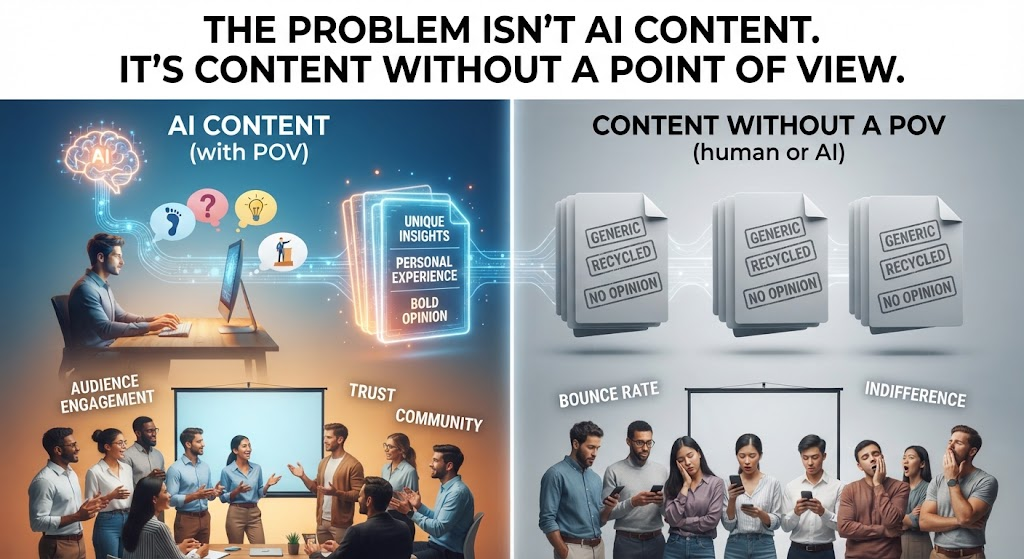
Because the real problem isn’t AI.
It’s content without a point of view.
AI Didn’t Invent Generic Content
Here’s the uncomfortable part.
Generic content existed long before generative AI.
People were already rewriting the same articles.
They were already copying competitors.
They were already stuffing keywords into awkward paragraphs.
They were already publishing posts that technically contained information but gave readers absolutely no reason to remember who wrote them.
AI didn’t invent bland content.
It simply made producing it much faster.
And that’s where the problem begins.
Information Isn’t the Same as Perspective
AI can give you information.
It can explain concepts.
It can organise ideas.
It can help you brainstorm.
It can turn a messy collection of thoughts into something more structured.
But information alone doesn’t necessarily make memorable content.
Think about two articles explaining affiliate marketing.
One says:
Affiliate marketing is a performance-based marketing strategy where affiliates earn commissions for referring customers to a business.
Accurate.
Useful.
Also something you’ve probably read approximately 900 times.
The second article might explain affiliate marketing through the writer’s own experience.
They might talk about what confused them when they started.
What they got wrong.
What strategy surprised them.
What they disagree with.
What they would do differently now.
Suddenly, the subject becomes more interesting.
The information may be similar.
The perspective isn’t.
Your Point of View Is Your Differentiator
The internet doesn’t have a shortage of information.
It has a shortage of genuinely interesting perspectives.
That’s why your point of view matters.
Your point of view can come from:
Your experiences
Your opinions
Your mistakes
Your observations
Your expertise
Your sense of humour
Your values
Your way of explaining things
Your interpretation of trends
Your disagreements with conventional advice
You don’t need to invent a revolutionary theory every time you publish.
Sometimes your perspective is simply:
“I’ve tried this, and here’s what I actually think.”
That’s enough.
AI Can Write the Sentence. You Need to Bring the Thought.
This is where I think AI works best.
Use it to help you develop an idea.
Use it to organise your thoughts.
Use it to brainstorm angles.
Use it to identify questions your audience might have.
Use it to improve clarity.
Use it to help you get unstuck.
But don’t hand over your entire brain and say:
“Go on then, build my personality too.”
That’s where things get flat.
Your AI assistant shouldn’t replace your thinking.
It should help you express your thinking more effectively.
There is a huge difference.
The Human Part Happens Before the Prompt
One of the easiest ways to create generic AI content is to give AI a generic instruction.
Something like:
“Write a 1,500-word article about affiliate marketing.”
Of course the result is going to sound generic.
The machine has almost nothing to work with.
Now compare that with:
“I believe beginners focus too much on earning their first commission and not enough on learning how to create useful content. Explain why building trust and understanding an audience matters more than immediately placing affiliate links.”
Now there is an argument.
There is a perspective.
There is something to develop.
The difference isn’t necessarily the AI model.
It’s the thinking behind the prompt.
Your Prompts Should Contain Your Brain
This is one reason I think people should stop treating prompting as simply finding the perfect magic sentence.
A strong prompt often starts with strong thinking.
Before opening an AI tool, ask yourself:
What do I actually think about this?
Then:
Why do I think that?
Then:
What have I seen that supports it?
Then:
What would I disagree with?
Then:
What would make this useful to my audience?
Now you’ve got something.
AI can help you turn those ingredients into content.
But the ingredients came from you.
Personality Isn’t Just Adding Slang
Another common misconception is that “humanising AI content” means adding a few jokes, emojis, or casual phrases.
That’s not really personality.
Personality isn’t just saying:
“Let’s dive in! 🚀”
every three paragraphs.
Your personality comes through in what you choose to say.
It’s your opinions.
Your examples.
Your analogies.
Your humour.
Your frustrations.
Your observations.
Your willingness to say:
“Actually, I don’t agree with that.”
That’s what makes content feel like it came from someone.
A Strong Opinion Can Be More Valuable Than Another Definition
Imagine writing about social media marketing.
You could write:
“Social media is an effective way for brands to engage with their audiences.”
True.
But what do you actually think?
Maybe you believe:
“Posting every day is overrated when half of the content you’re publishing has nothing meaningful to say.”
Now you’ve got an article.
You’ve got a discussion.
You’ve got something people can agree or disagree with.
And disagreement isn’t automatically a bad thing.
Sometimes it means you’ve actually said something.
This Matters for Affiliate Marketing Too
Point of view is especially important for affiliate marketers.
If your website consists entirely of:
Product → Features → Price → Buy Now
then you’re competing with thousands of other websites doing exactly the same thing.
But what happens when you add your perspective?
You can explain:
Who the product is actually suitable for
Who should avoid it
What surprised you
What you like
What you dislike
What alternatives exist
What beginners should know
Whether the product is worth the cost
How it compares with competing options
Now you’re not simply repeating the manufacturer’s information.
You’re helping the reader make a decision.
That’s far more valuable.
AI Can Scale Your Voice. It Can’t Invent Your Identity.
This is probably the biggest lesson I take from the AI conversation.
AI can help you create more efficiently.
But efficiency isn’t the same thing as identity.
You can use AI to help scale a content strategy.
You can use it to brainstorm dozens of ideas.
You can use it to repurpose content.
You can use it to research questions.
You can use it to improve your workflow.
But if the underlying content has no perspective, you’re simply scaling the absence of one.
And that’s not particularly useful.
Don’t Ask AI to Think Instead of You
Use AI as a collaborator.
Not an autopilot.
Give it your argument.
Give it your examples.
Give it your experiences.
Give it the audience you’re trying to reach.
Give it the tone and purpose of the piece.
Then challenge the output.
Question it.
Rewrite it.
Add your own ideas.
Remove things that don’t sound like you.
Fact-check claims.
And most importantly, have an opinion before you ask AI to help you express it.
The Future of Content Won’t Belong to Whoever Uses AI the Most
It will belong to people who know what they want to say.
That’s an important distinction.
AI is becoming increasingly accessible.
That means producing more content is becoming easier.
But when everyone can produce content quickly, volume becomes less impressive.
Perspective becomes more valuable.
Your readers don’t need another article that sounds vaguely like every other article online.
They need something useful.
Something thoughtful.
Something specific.
Something they can remember.
Something that sounds like it came from an actual person who has spent time thinking about the subject.
Final Thought
The question shouldn’t be:
“Did AI write this?”
The better question is:
“What did the human behind it contribute?”
If AI helped you organise your thoughts, that’s a tool.
If AI helped you brainstorm, that’s a tool.
If AI helped you polish your writing, that’s a tool.
But if you never brought your own perspective into the process, you haven’t really created a point of view.
You’ve created content.
And the internet already has plenty of that.
AI isn’t the enemy of good content.
Content without a reason to exist is.
So use the tools.
Experiment.
Let AI make the process faster.
But bring your brain to the keyboard.
Because your point of view is the part no prompt can manufacture for you. 🤖🧠
“I really hope someone gives me an affiliate link today.”
They have a question.
They’re researching a product.
They’re trying to solve a problem.
They’re comparing options.
They’re looking for advice.
The affiliate link comes later.
And that’s exactly why content should come before the affiliate link.
Affiliate marketing isn’t really about putting links in front of people.
It’s about creating something useful enough that people want to explore your recommendation.
That distinction is small on paper but massive in practice.
The Affiliate Link Isn’t the Content
One of the easiest mistakes for a beginner affiliate marketer to make is treating the affiliate link as the main event.
The article becomes a long introduction followed by:
“Anyway, here’s the product. Buy it here.”
That approach can make content feel less like an article and more like a sales funnel wearing a fake moustache. 🎭
The affiliate link should support the content.
It shouldn’t replace it.
Your article needs to stand on its own as something useful, even before someone clicks a single link.
Start With the Reader’s Problem
Instead of starting with:
“What product can I promote?”
Try starting with:
“What problem is my reader trying to solve?”
That’s a much stronger starting point.
For example, someone searching for the best website-building platform may not actually care about the platform itself.
They might be asking:
How do I build my first website?
Do I need technical knowledge?
How much does it cost?
What tools will I need?
Is it suitable for beginners?
What are the advantages and disadvantages?
What alternatives exist?
Those questions create opportunities for genuinely useful content.
Once you’ve helped answer them, an affiliate recommendation can naturally become part of the conversation.
Give Value Before Asking for Action
This is one of the simplest principles in marketing:
Give people a reason to trust you before asking them to do something.
Imagine walking into a shop and having someone immediately shove a product into your hands.
You haven’t even explained what you’re looking for.
You’re probably backing toward the exit.
Online marketing isn’t that different.
Content gives you the opportunity to establish context.
You can explain the problem.
You can provide information.
You can compare options.
You can share your experience.
You can explain who a product might be suitable for.
Then, if the product genuinely fits the situation, the affiliate link feels natural.
Good Affiliate Content Doesn’t Hide the Downsides
Trust doesn’t come from pretending something is perfect.
In fact, sometimes the most useful part of an affiliate article is explaining the limitations.
A product might be excellent for beginners but unnecessary for experienced users.
A platform might have great features but a learning curve.
A service might offer excellent value but lack a particular feature someone needs.
Being honest about those things doesn’t weaken your affiliate marketing.
It strengthens your credibility.
Readers are much more likely to trust someone who says:
“Here’s what I like about this, and here’s where I think it falls short.”
That’s a recommendation.
Not a sales pitch.
The Link Should Make Sense
A good affiliate link should answer the natural question:
“Where can I learn more about this?”
If your article explains why a particular tool could help someone and then provides a relevant link, the journey makes sense.
The reader has context.
They understand what they’re clicking.
They can make an informed decision.
Compare that with randomly inserting an affiliate link halfway through an unrelated paragraph.
That isn’t strategy.
That’s link confetti. 🎉
And nobody asked for link confetti.
Content Builds Search Visibility Too
Putting content first also makes sense from an SEO perspective.
People don’t usually search for an affiliate link.
They search for information.
They search questions.
They search problems.
They search comparisons.
They search reviews.
They search solutions.
That means your content gives your website opportunities to appear for searches that your target audience is already making.
Instead of building a page around:
“Buy Product X.”
You might create content around:
“Is Product X Worth It for Beginners?”
or:
“Product X vs Product Y: Which Is Better for New Website Owners?”
or:
“How to Choose the Right Website-Building Platform.”
Now you’re creating something that can actually answer a searcher’s intent.
The affiliate link becomes part of the article rather than the entire reason the article exists.
Helpful Content Can Build Long-Term Traffic
An affiliate link might earn a commission once.
A useful article can potentially bring readers to your website repeatedly over time.
That makes content an asset.
A well-written article can:
Attract search traffic
Answer questions
Build credibility
Introduce people to your brand
Encourage internal links
Lead readers to related content
Support relevant affiliate recommendations
This is why content strategy matters.
You’re not simply publishing individual articles.
You’re building an ecosystem.
Don’t Write for the Commission
This is probably the biggest mindset shift.
Don’t start with:
“What can I sell?”
Start with:
“What can I help someone understand?”
Then ask:
“Is there a product or service that genuinely helps solve this problem?”
If the answer is yes, that’s where affiliate marketing fits.
The product becomes a resource.
Not the entire purpose of the article.
Your Recommendation Should Feel Earned
There’s a huge difference between:
“This is the best tool. Click here.”
and:
“Here are the options I considered, here’s what each one does, here’s who they’re suitable for, and here’s why I think this particular option makes sense for beginners.”
The second approach takes more effort.
But it also gives the reader something valuable.
You’ve earned the recommendation.
And that is what good affiliate marketing should feel like.
This Is Where Wealthy Affiliate Fits In
One of the useful lessons when learning affiliate marketing through platforms such as Wealthy Affiliate is understanding that affiliate marketing isn’t just about affiliate links.
There is an entire process behind it.
Research.
Content.
SEO.
Audience understanding.
Website building.
Strategy.
Testing.
Improvement.
The affiliate link is only one small piece of that puzzle.
If you focus entirely on the link, you’re missing the bigger picture.
Content First. Commission Second.
The most sustainable mindset is surprisingly simple:
Help first. Recommend second.
Create something useful.
Answer the question.
Solve the problem.
Give the reader enough information to make their own decision.
Then, when there is a relevant product or service that genuinely fits, give them the opportunity to explore it.
That’s a much better relationship between content and affiliate marketing.
Because ultimately, your website shouldn’t exist simply to generate clicks.
It should exist to help people.
And when people trust that your recommendations are actually useful, the affiliate side of the business becomes much more natural.
Final Thought
An affiliate link can tell someone where to go.
Good content tells them why they should care.
That’s why content should always come first.
Don’t build content around the affiliate link. Build the affiliate recommendation around genuinely useful content.
That little shift can completely change the way you approach affiliate marketing.