


How to create an AI content workflow that saves 20 hours a week
The “save 20 hours a week” promise gets thrown around a lot in AI marketing content, usually without anyone explaining where those hours actually come from. That vagueness is the problem. If you don’t know which part of your content process is bleeding time, adding an AI tool just moves the bottleneck somewhere else.
The 20-hour claim: what it actually means and what it doesn’t
Twenty hours a week isn’t a guarantee you’ll get from installing a tool. It’s what’s available when you rebuild the entire pipeline, not just the writing part. Most teams use AI to speed up drafting and leave ideation, editing and distribution exactly as slow as before. That gets you a faster first draft and the same bottleneck everywhere else.
The hours come from removing duplicated work: the research that happens twice, the brief that gets rewritten because it was never clear, the editing pass that exists because the first draft had no guardrails. AI speeds up tasks. A workflow removes the tasks that shouldn’t exist in the first place.
Map your current content process before you automate anything

Before adding a single tool, track one week of content production hour by hour. Who does what, in what order, and where does work sit waiting for someone else? Most teams discover the real time loss isn’t writing at all. It’s unclear briefs, Slack threads chasing approvals, and editing that happens three times because nobody agreed on standards upfront.
This mapping exercise feels slow, but skipping it is how teams end up with five AI tools and the same six-day turnaround they had before.
The four stages where AI genuinely saves time
Break content production into ideation, drafting, editing and distribution. Each stage has a different relationship with AI.
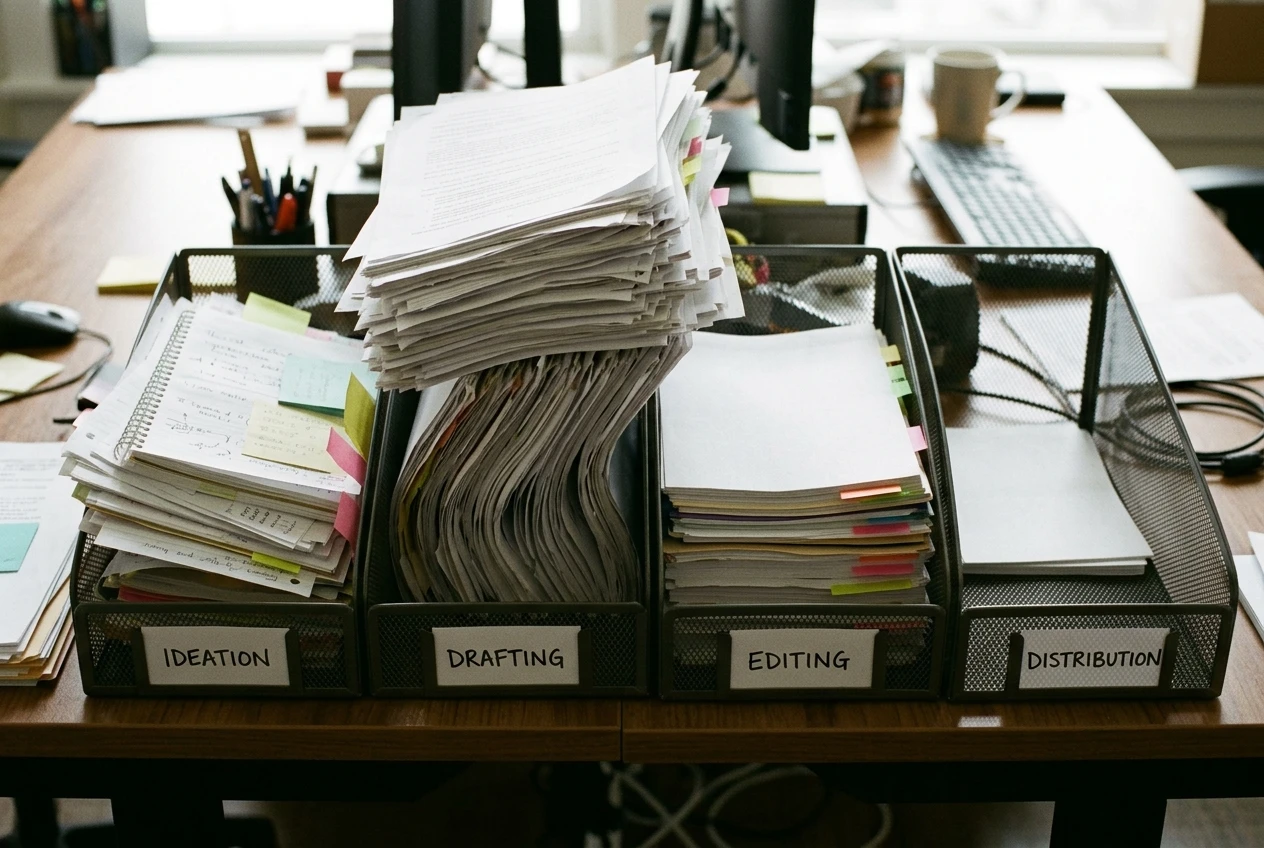
- Ideation: AI is genuinely fast here. Feeding it audience questions, competitor gaps and search data produces usable angles in minutes, not hours.
- Drafting: This is where AI saves the most raw time, provided someone has already defined the angle, the audience and the point of the piece. AI without a brief just produces faster filler.
- Editing: AI can catch structural issues and clarity problems fast. It cannot judge whether the argument is actually good, or whether a claim needs a source.
- Distribution: Repurposing one piece into five formats is largely mechanical, and AI handles the mechanical parts well.
Drafting and distribution are where the biggest time gains live. Editing is where teams lose the time back if they’re not careful.
Building the workflow: tools, handoffs and where they break
A workflow breaks at handoffs, not at tools. The moment work passes from one person or system to another is where briefs get lost, context disappears and someone has to re-explain the assignment.

Build the workflow around a single source of truth: one brief document that travels with the piece from ideation through to published draft, so nobody is reconstructing context at each stage. Whatever tools you choose, the test is whether they reduce handoffs or just add another inbox to check.
The human checkpoints you can’t delegate to AI
Three checkpoints should never be automated away. First, the angle: someone needs to confirm the piece says something worth reading before a draft gets written. Second, the fact-check: AI drafts confidently, and confidence isn’t accuracy. Third, the final read for voice and judgment, because AI can approximate tone but it can’t decide what your brand actually believes.
Skip these and you get content that’s fast, polished and indistinguishable from everything else publishing the same week.
A sample week, before and after the workflow
A typical unmanaged week might look like: 6 hours on topic research, 8 hours drafting, 10 hours of back-and-forth editing, 4 hours repurposing for social, and 2 hours chasing approvals. That’s roughly 30 hours for one piece of core content and its spin-offs.
With a structured workflow: 1 hour on AI-assisted ideation with human approval, 2 hours drafting with a clear brief, 4 hours of focused editing against defined standards, 1 hour on AI-assisted repurposing, and 1 hour final review. That’s closer to 9 hours, with the saved time coming almost entirely from removing re-work, not from writing faster.

What to measure to know the system is actually working
Track hours per published piece, not just output volume. Track how many drafts get sent back for a second editing pass, since that number tells you if your brief and your standards are doing their job upfront. And track whether published pieces are actually performing, because a workflow that produces more content faster with worse results isn’t a win, it’s a faster way to waste a week.
Before adding another tool, run your current content process through this four-stage framework for one week and track where the hours actually go. If editing keeps eating your saved time, that’s usually a sign the drafts coming out of your AI workflow aren’t ready for publication as-is. Why AI Written Content Fails (and the Edit That Fixes It) covers the fix for that specific bottleneck.
