
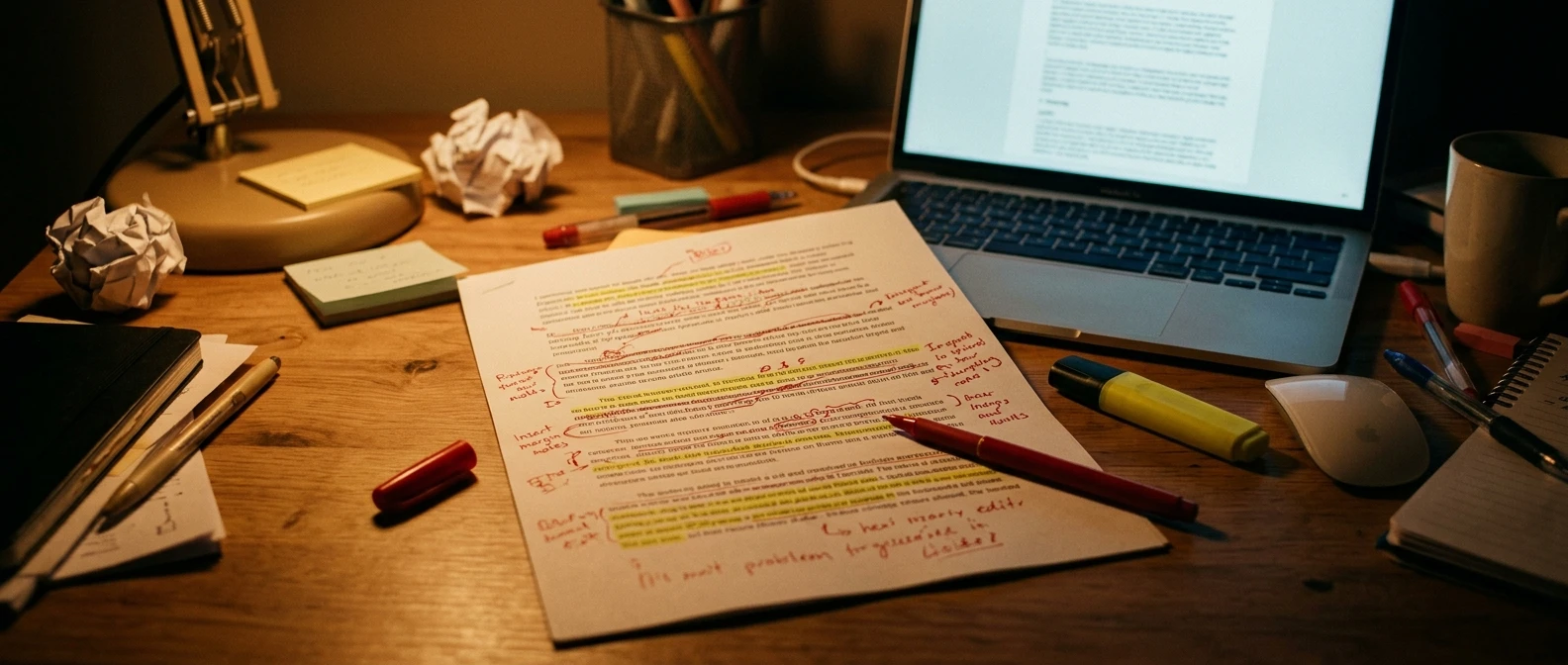
Search engines are not punishing AI content for being written by a machine. They are punishing a specific set of patterns that AI drafts produce by default, and that most writers never go back to fix. Flat sentence rhythm, facts nobody checked, headers that promise depth the paragraph never delivers, and a keyword repeated until it stops meaning anything. None of these problems are inherent to the technology. All of them are inherent to publishing the first draft.
If you already understand what AI-driven content marketing is and why it works when it’s done well, this piece picks up from there. This is about the five failure patterns that get a draft flagged as low quality, and the exact edit that fixes each one before it goes live.
The quality signal Google keeps punishing in AI drafts
Google doesn’t have a detector that sniffs out AI and penalizes it directly. What it has is a set of quality signals, originality, depth, accuracy, usefulness, and AI drafts tend to score poorly on those signals for reasons that have nothing to do with authorship. A model trained to predict the next likely word produces the statistically average sentence. Average sentences don’t get flagged as “AI.” They get flagged as thin, because they say less than a human writer saying the same thing would say.
The failure isn’t that a machine wrote the words. The failure is that nobody added anything to them. A model can assemble a correct-sounding paragraph about almost any topic without knowing a single specific fact about it, and that paragraph will read fine until you compare it to one written by someone who has actually done the thing. The comparison is what search engines are increasingly built to reward, because it’s what readers reward first.
This matters for anyone using AI to draft content at volume, because the five patterns below compound. A flat-voice draft with invented statistics and skimmable structure doesn’t fail once. It fails on every signal at the same time, which is exactly the kind of content recent search updates have been built to push down.
Flat voice: why AI content reads like everyone else’s
Ask five different AI tools to write about the same topic and you’ll get five drafts with the same shape: similar sentence lengths, similar transitions, similar hedged conclusions. That’s not a coincidence. The model is drawing from the same broad patterns in its training data every time, which means it defaults to the middle of the distribution, the version of the sentence that sounds like every other sentence written about that topic.
Flat voice doesn’t mean the writing is wrong. It means nothing in it could only have come from one person. There’s no specific decision explained, no opinion that costs the writer anything, no detail that only someone who’d actually tried the thing would know to include.
The edit: Go through the draft and find every sentence that could appear verbatim on a competitor’s page. For each one, either cut it or attach something specific to it: a number from your own experience, a decision you made and why, a disagreement with the common advice. If you can’t attach anything specific, ask whether the sentence needs to exist at all.
A useful test: read the paragraph and ask what would have to be true for only you to have written it. If the answer is nothing, rewrite it with a detail that pins it to a real person, a real result, a real situation. [Add a specific example from your own content work here, once you have one worth citing.]
Hallucinated facts and the trust problem spell check won’t catch
This is the failure pattern that does the most damage, because it’s invisible until someone checks. A model will state a statistic, a date, a study, or a product spec with complete confidence whether or not it’s accurate, because it isn’t retrieving facts from a database. It’s predicting what a plausible-sounding fact would look like in that sentence position. Most of the time that prediction is close enough to pass a casual read. Sometimes it’s a number that doesn’t exist anywhere, attached to a source that never said it.

Spell check and grammar tools won’t catch this, because the sentence is grammatically perfect. The only thing wrong with it is that it isn’t true, and the only way to find that is to check it against something real.
The edit: Treat every number, date, name, study, and specific claim in an AI draft as unverified until you’ve confirmed it against a source you can link to or a fact you already know firsthand. If you can’t verify a claim, either find the real figure or rewrite the sentence to remove the specific and keep the general point. “Studies show most marketers now use AI tools” is a claim that needs a source. “Most marketers I talk to use AI tools in some part of their workflow” is a claim you can actually stand behind, if it’s true of your own observation.
This is slower than publishing the draft as written. It’s also the single edit that protects you from the worst outcome: publishing a confident, well-written piece under your own name that contains a fact you made up without realizing it.
Structure that signals ‘skimmed’ instead of ‘researched’
AI drafts tend to produce a specific structural tell: headers that sound thorough, paragraphs underneath that restate the header instead of adding to it, and a conclusion that summarizes what was already said. The piece looks organized at a glance and says less than its outline promised on a close read.
This happens because the model generates header and body together, optimizing for a draft that looks complete rather than one that’s actually dense with information. A heading like “Five Benefits of Email Marketing” followed by five paragraphs that each restate the heading’s premise in slightly different words isn’t structure, it’s the appearance of structure.
Readers and search engines both pick up on this fast. A reader skims the first line under each header, and if that line just restates the header, they assume the rest of the section won’t tell them anything new either. They’re usually right.
The edit: Under every header, check whether the first sentence adds information or just rephrases the header. If it rephrases, delete it and start with the actual point. Then check whether each paragraph under that header says something the paragraph before it didn’t. If two paragraphs are making the same point with different words, cut one. A section should get narrower and more specific as it goes, not wider and vaguer.
Also check the ending. If your conclusion section exists to tell the reader what they just read, cut it or replace it with something that moves the reader forward: a specific next action, a related question the piece deliberately leaves open, a decision point.
The keyword stuffing habit the model can’t unlearn on its own
Ask an AI tool to write “content optimized for [keyword]” and it will often do exactly what you asked in the least useful way possible: repeating the exact phrase at a density that reads unnatural, because the model is pattern-matching to what “SEO content” has looked like in lower-quality training examples. It isn’t optimizing for ranking. It’s optimizing for the appearance of optimization.
This habit is stubborn because it comes from the prompt pattern itself, not from a single bad draft. If you keep asking for content “optimized for” a keyword, you’ll keep getting content that treats the keyword as a quota to hit rather than a concept to cover. The model doesn’t learn, across sessions, that this makes the writing worse. Every draft starts from the same instinct.
Search engines have gotten much better at recognizing natural keyword variation versus forced repetition, and forced repetition now reads as a liability rather than a signal. A page that says “AI content marketing strategy” nine times in twelve hundred words doesn’t rank better than one that says it twice and uses five close variants the other times a human would naturally reach for.
The edit: Search the draft for your target phrase and count the instances. Then read each instance in context and ask if a person writing naturally about the topic would have used that exact phrase there, or a different one. Replace the forced repeats with the phrase a person would actually use: the keyword’s close variants, the pronoun, the shortened version. Keep the handful of instances that matter, usually the opening, one subheading, and the closing section, and let the rest of the piece breathe.
A five pass edit that turns a generic draft into something worth publishing

Treating these five fixes as one editing pass instead of five separate rewrites keeps the process fast enough to actually run on every draft. Here’s the order that works, because each pass sets up the next one.
-
Voice pass. Read the whole draft once for flat, generic sentences. Mark anything that could appear on any competitor’s page. Replace marked sentences with something specific, or cut them.
-
Fact pass. Go through every number, date, study, and named claim. Verify each against a real source or your own firsthand knowledge. Rewrite anything you can’t verify so it no longer makes a specific claim.
-
Structure pass. Check every header against the sentence beneath it. Cut restated headers and redundant paragraphs. Confirm the piece gets more specific as it goes, not less.
-
Keyword pass. Count instances of the target phrase, cut the forced repeats, and replace them with natural variants.
-
Read-aloud pass. Read the full piece out loud, once, start to finish. Anything that makes you stumble, slow down, or sounds like it’s performing rather than explaining is the sentence to fix last, because by this point it’s usually the only thing left that doesn’t sound like you.
Run these five passes in order, on paper or in your editing tool of choice, and the fourth or fifth draft looks nothing like the first one, even though you haven’t rewritten it from scratch. You’ve just removed everything in it that an AI tool would have produced the same way for anyone else.
Where human judgment still beats the model every time
The five-pass edit works because it inserts a judgment the model doesn’t have: knowing what’s actually true, what’s actually new, and what a reader in your specific audience actually needs to hear next. A model can draft a plausible paragraph about almost anything. It cannot tell you whether that paragraph is the right one for the reader in front of you, because it doesn’t know that reader.
This is the gap that holds even as the tools get better at grammar, tone matching, and even fact retrieval. Knowing which fact matters to a Gen Z marketer deciding whether to try a new tool, or which detail an aspiring strategist needs before they’ll trust your advice, is a judgment call that comes from paying attention to an actual audience over actual time. No amount of model improvement replaces that, because it isn’t a language problem. It’s a knowledge-of-the-reader problem, and the reader is the one part of the equation the model never had access to in the first place.
The practical upshot: use AI to get a draft fast, and spend your editing time on the parts a model structurally can’t do. Verify the facts. Decide what’s actually worth saying. Cut what isn’t. That division of labor, draft fast, edit with judgment, is the entire difference between content that gets flagged as generic and content that ranks, gets shared, and gets trusted.
Run your next AI draft through this five-pass edit before you publish it, not after.

Leave a Reply