
Personal branding is usually presented as a very serious business.
Choose your niche.
Define your audience.
Pick your colours.
Create your content pillars.
Write your bio.
Take a professional photograph.
And somewhere along the way, we’re expected to become a perfectly polished version of ourselves.
But here’s the thing.
People don’t connect with a brand because its Canva templates are beautiful.
They connect because they recognise something.
A voice.
A personality.
A perspective.
A story.
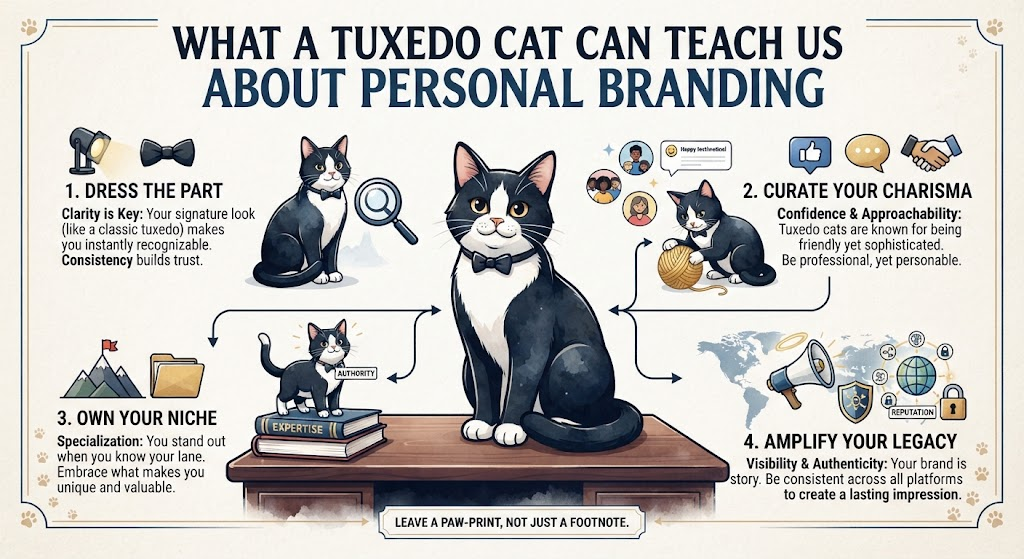
And weirdly enough, a tuxedo cat can teach us quite a bit about that.
Yes.
We’re talking about Simmba. 🐈⬛
Lesson One: Personality Makes You Recognisable
There are millions of cats on the internet.
Seriously.
The internet has no shortage of whiskers.
So why do certain cats become recognisable?
Personality.
The same principle applies to personal branding.
There are thousands of marketers.
Thousands of writers.
Thousands of creators.
Thousands of people talking about SEO, AI, social media and content strategy.
Your subject matter alone isn’t necessarily going to make you memorable.
Your personality can.
How you explain things.
The jokes you make.
The opinions you have.
The stories you tell.
The way you approach problems.
That’s what starts separating you from everyone else talking about the same topic.
Lesson Two: You Don’t Need to Appeal to Everyone
Simmba is not going to appeal to everyone.
He’s a cat.
He sleeps whenever he wants.
He has opinions about things that nobody asked him about.
He presumably believes the house belongs to him.
And honestly, he’s probably correct. 😂
But personal branding works the same way.
Trying to appeal to absolutely everyone often produces incredibly bland content.
You end up removing anything distinctive because you’re worried someone might dislike it.
But here’s the reality:
If everyone likes your brand, you might not be giving anyone much to remember.
A strong personal brand attracts the right people.
It doesn’t need unanimous approval.
Lesson Three: Consistency Creates Recognition
Imagine Simmba suddenly became a golden retriever tomorrow.
It would be a little confusing.
Not because golden retrievers are bad.
But because that’s not what people recognise as Simmba.
Your personal brand works similarly.
Consistency doesn’t mean repeating the same post every day.
It means maintaining recognisable elements.
Your voice.
Your values.
Your perspective.
Your subject areas.
Your approach.
Your audience should be able to encounter your content and think:
“Yep. This sounds like them.”
That’s brand recognition.
Lesson Four: Your Personality Can Become a Content Pillar
This is where personal branding gets interesting.
Most content strategies start with topics.
AI.
SEO.
Marketing.
Business.
Social media.
But what if your personality is part of the strategy?
Maybe you explain serious topics through humour.
Maybe you use storytelling.
Maybe you challenge conventional marketing advice.
Maybe you turn everyday experiences into lessons.
Maybe you bring your interests into your professional content.
Suddenly, your content isn’t just about what you know.
It’s also about how you think.
That is much harder to copy.
Lesson Five: You Can Build a Character Without Pretending to Be Someone Else
There’s an important distinction here.
Personal branding doesn’t mean inventing a fake personality.
It means making the real parts of your personality visible.
Simmba doesn’t need to become another cat to be interesting.
He is interesting because of the personality attached to him.
The same applies to you.
You don’t have to manufacture quirks.
You don’t need to become louder than you naturally are.
You don’t need to force humour into every sentence.
Instead, identify what already makes your perspective different.
Then let people see it.
Lesson Six: Stories Give Your Brand Context
A list of qualifications can tell people what you know.
A story can help them understand why you think the way you do.
That’s a powerful difference.
Your experiences become part of your positioning.
The lessons you’ve learned.
The mistakes you’ve made.
The things you disagree with.
The unusual paths you’ve taken.
The people and experiences that influenced you.
These things give your brand depth.
And depth makes a brand harder to reduce to a generic template.
Lesson Seven: Don’t Be Afraid of the Unexpected
One of the reasons Simmba works as a recurring character is because nobody expects a tuxedo cat to start discussing marketing strategy.
And that’s precisely what makes people curious.
The same principle can work in personal branding.
You don’t have to stay trapped inside the traditional boundaries of your industry.
A marketer can talk about storytelling.
A writer can talk about psychology.
A business owner can talk about food.
A content creator can talk about their cat.
The question isn’t whether the topic looks conventional.
The question is whether you can create a meaningful connection between it and your brand.
Lesson Eight: Your Audience Wants a Person, Not a Corporate Brochure
This might be the biggest lesson of all.
People know when they’re being spoken to by a brand.
And sometimes they still want that.
But increasingly, audiences also want to know the person behind the work.
What do they believe?
How do they think?
What do they care about?
What makes them laugh?
What are they willing to challenge?
What kind of experience will I have if I follow them?
Personal branding answers those questions.
And personality is what makes the answers interesting.
The Simmba Test 🐈⬛
So here’s my favourite personal branding test:
If you removed your name and logo from your content, would someone still recognise that it came from you?
If the answer is yes, you’re probably developing a recognisable voice.
If the answer is no, don’t panic.
It simply means there’s an opportunity to bring more of your perspective into the work.
Ask yourself:
- What opinions do I consistently have?
- What topics do I naturally gravitate towards?
- What stories could only I tell?
- What makes my explanation different?
- What personality traits show up in my content?
- What do people already associate with me?
Those answers are clues.
You Don’t Need to Become “A Brand”
This is something I think gets lost in personal branding conversations.
You’re still a person.
You don’t need to turn yourself into a walking marketing campaign.
Your brand should support your work, not swallow your identity.
You can have professional expertise and still have humour.
You can be strategic and still be playful.
You can take your work seriously without taking yourself painfully seriously.
And yes, you can build a professional personal brand while occasionally talking about a tuxedo cat.
Perhaps especially then.
Final Thought
Simmba doesn’t need a complicated branding strategy to be recognisable.
He’s Simmba.
The personality comes first.
The recognition follows.
And that’s a pretty useful lesson for personal branding.
You don’t become memorable by trying to look exactly like everyone else who works in your industry.
You become memorable by developing a voice, perspective and personality that people can recognise.
So before you redesign your logo, rewrite your bio for the seventeenth time, or spend three hours debating whether your brand colour should be slightly warmer…
Ask yourself:
“What makes people recognise me?”
Because your strongest brand asset might not be your logo.
It might be you.
And somewhere nearby, a tuxedo cat is probably judging your brand strategy anyway. 🐈⬛