

Let’s be honest.
Nobody opens an article thinking:
“I really hope someone gives me an affiliate link today.”
They have a question.
They’re researching a product.
They’re trying to solve a problem.
They’re comparing options.
They’re looking for advice.
The affiliate link comes later.
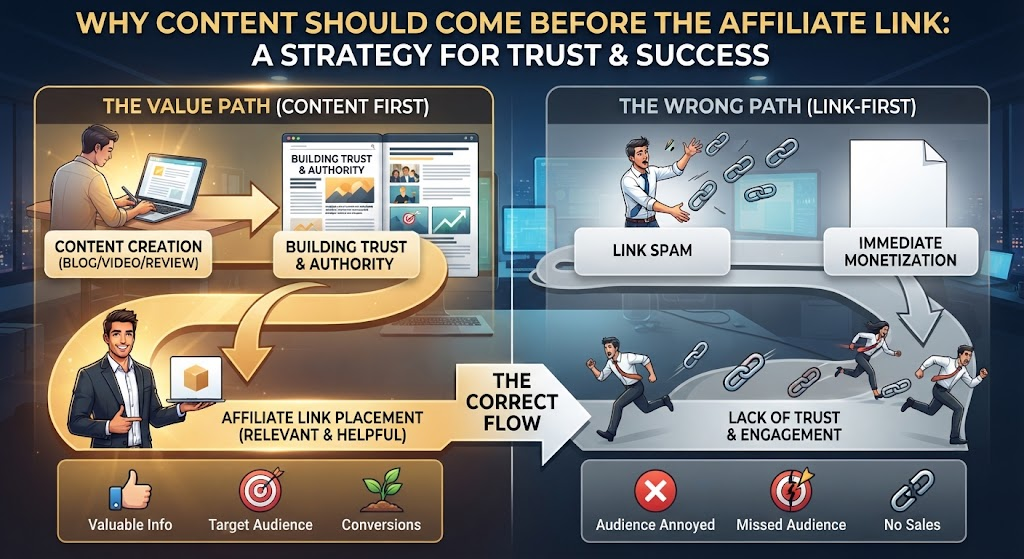
And that’s exactly why content should come before the affiliate link.
Affiliate marketing isn’t really about putting links in front of people.
It’s about creating something useful enough that people want to explore your recommendation.
That distinction is small on paper but massive in practice.
The Affiliate Link Isn’t the Content
One of the easiest mistakes for a beginner affiliate marketer to make is treating the affiliate link as the main event.
The article becomes a long introduction followed by:
“Anyway, here’s the product. Buy it here.”
That approach can make content feel less like an article and more like a sales funnel wearing a fake moustache. 🎭
The affiliate link should support the content.
It shouldn’t replace it.
Your article needs to stand on its own as something useful, even before someone clicks a single link.
Start With the Reader’s Problem
Instead of starting with:
“What product can I promote?”
Try starting with:
“What problem is my reader trying to solve?”
That’s a much stronger starting point.
For example, someone searching for the best website-building platform may not actually care about the platform itself.
They might be asking:
- How do I build my first website?
- Do I need technical knowledge?
- How much does it cost?
- What tools will I need?
- Is it suitable for beginners?
- What are the advantages and disadvantages?
- What alternatives exist?
Those questions create opportunities for genuinely useful content.
Once you’ve helped answer them, an affiliate recommendation can naturally become part of the conversation.
Give Value Before Asking for Action
This is one of the simplest principles in marketing:
Give people a reason to trust you before asking them to do something.
Imagine walking into a shop and having someone immediately shove a product into your hands.
You haven’t even explained what you’re looking for.
You’re probably backing toward the exit.
Online marketing isn’t that different.
Content gives you the opportunity to establish context.
You can explain the problem.
You can provide information.
You can compare options.
You can share your experience.
You can explain who a product might be suitable for.
Then, if the product genuinely fits the situation, the affiliate link feels natural.
Good Affiliate Content Doesn’t Hide the Downsides
Trust doesn’t come from pretending something is perfect.
In fact, sometimes the most useful part of an affiliate article is explaining the limitations.
A product might be excellent for beginners but unnecessary for experienced users.
A platform might have great features but a learning curve.
A service might offer excellent value but lack a particular feature someone needs.
Being honest about those things doesn’t weaken your affiliate marketing.
It strengthens your credibility.
Readers are much more likely to trust someone who says:
“Here’s what I like about this, and here’s where I think it falls short.”
That’s a recommendation.
Not a sales pitch.
The Link Should Make Sense
A good affiliate link should answer the natural question:
“Where can I learn more about this?”
If your article explains why a particular tool could help someone and then provides a relevant link, the journey makes sense.
The reader has context.
They understand what they’re clicking.
They can make an informed decision.
Compare that with randomly inserting an affiliate link halfway through an unrelated paragraph.
That isn’t strategy.
That’s link confetti. 🎉
And nobody asked for link confetti.
Content Builds Search Visibility Too
Putting content first also makes sense from an SEO perspective.
People don’t usually search for an affiliate link.
They search for information.
They search questions.
They search problems.
They search comparisons.
They search reviews.
They search solutions.
That means your content gives your website opportunities to appear for searches that your target audience is already making.
Instead of building a page around:
“Buy Product X.”
You might create content around:
“Is Product X Worth It for Beginners?”
or:
“Product X vs Product Y: Which Is Better for New Website Owners?”
or:
“How to Choose the Right Website-Building Platform.”
Now you’re creating something that can actually answer a searcher’s intent.
The affiliate link becomes part of the article rather than the entire reason the article exists.
Helpful Content Can Build Long-Term Traffic
An affiliate link might earn a commission once.
A useful article can potentially bring readers to your website repeatedly over time.
That makes content an asset.
A well-written article can:
- Attract search traffic
- Answer questions
- Build credibility
- Introduce people to your brand
- Encourage internal links
- Lead readers to related content
- Support relevant affiliate recommendations
This is why content strategy matters.
You’re not simply publishing individual articles.
You’re building an ecosystem.
Don’t Write for the Commission
This is probably the biggest mindset shift.
Don’t start with:
“What can I sell?”
Start with:
“What can I help someone understand?”
Then ask:
“Is there a product or service that genuinely helps solve this problem?”
If the answer is yes, that’s where affiliate marketing fits.
The product becomes a resource.
Not the entire purpose of the article.
Your Recommendation Should Feel Earned
There’s a huge difference between:
“This is the best tool. Click here.”
and:
“Here are the options I considered, here’s what each one does, here’s who they’re suitable for, and here’s why I think this particular option makes sense for beginners.”
The second approach takes more effort.
But it also gives the reader something valuable.
You’ve earned the recommendation.
And that is what good affiliate marketing should feel like.
This Is Where Wealthy Affiliate Fits In
One of the useful lessons when learning affiliate marketing through platforms such as Wealthy Affiliate is understanding that affiliate marketing isn’t just about affiliate links.
There is an entire process behind it.
Research.
Content.
SEO.
Audience understanding.
Website building.
Strategy.
Testing.
Improvement.
The affiliate link is only one small piece of that puzzle.
If you focus entirely on the link, you’re missing the bigger picture.
Content First. Commission Second.
The most sustainable mindset is surprisingly simple:
Help first. Recommend second.
Create something useful.
Answer the question.
Solve the problem.
Give the reader enough information to make their own decision.
Then, when there is a relevant product or service that genuinely fits, give them the opportunity to explore it.
That’s a much better relationship between content and affiliate marketing.
Because ultimately, your website shouldn’t exist simply to generate clicks.
It should exist to help people.
And when people trust that your recommendations are actually useful, the affiliate side of the business becomes much more natural.
Final Thought
An affiliate link can tell someone where to go.
Good content tells them why they should care.
That’s why content should always come first.
Don’t build content around the affiliate link. Build the affiliate recommendation around genuinely useful content.
That little shift can completely change the way you approach affiliate marketing.

Leave a Reply