

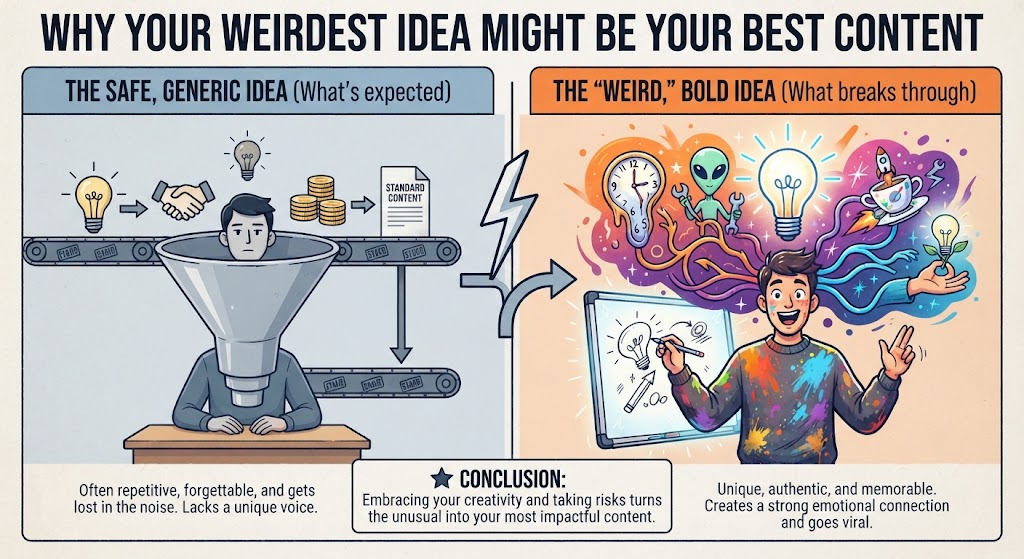
Let’s be honest.
Some of your ideas probably make perfect sense.
They’re strategic.
They’re useful.
They’re safe.
And then there are the ideas that make you stop and think:
“Wait… should I actually post this?”
Maybe it’s an unusual analogy.
A ridiculous comparison.
A random observation.
A conversation with your cat.
A marketing lesson inspired by a fictional character.
Or an idea that doesn’t fit neatly into the content strategy spreadsheet.
Those are often the ideas we talk ourselves out of.
And sometimes, those are exactly the ideas worth creating.
Weird Doesn’t Mean Bad
There’s a difference between being weird for attention and having a genuinely unusual perspective.
Anyone can make something random.
That’s not automatically creative.
The value of a weird idea comes from the connection behind it.
Take something ordinary and connect it to something unexpected.
That’s where curiosity starts.
For example:
What can a tuxedo cat teach us about personal branding?
At first, that sounds completely ridiculous.
Then you start thinking about personality, recognition, consistency, audience loyalty and differentiation.
Suddenly, the cat isn’t the point.
The perspective is.
That’s the magic of an unexpected connection.
Predictable Content Is Everywhere
Open any social platform and you’ll see variations of the same advice.
“5 ways to grow your business.”
“10 tips for better content.”
“3 mistakes you’re making.”
“Here’s how to beat the algorithm.”
“Do this before you post.”
There’s nothing inherently wrong with these formats.
They can be useful.
But when everyone is using the same structure, the challenge becomes standing out without shouting.
That’s where unusual ideas can help.
You don’t necessarily need to be louder.
You need to be recognisable.
Curiosity Is a Powerful Hook
Think about the difference between these two headlines:
“5 Tips for Better Branding”
and
“What Can a Tuxedo Cat Teach You About Personal Branding?”
The second one creates a tiny mental speed bump.
You want to know the answer.
Why a cat?
What does this have to do with branding?
Is this serious?
Is this ridiculous?
Hopefully, it’s both. 🐈⬛
That curiosity can make someone stop scrolling.
But the important part is what comes next.
The unusual hook still needs a useful idea underneath it.
Your Weird Idea Can Make Your Expertise More Memorable
This is something creators sometimes underestimate.
People don’t only remember information.
They remember how information was presented.
You could explain brand consistency through a standard marketing article.
Or you could explain it through a recurring fictional character.
You could talk about customer loyalty using a textbook definition.
Or you could compare it to why people keep returning to their favourite restaurant.
The underlying lesson might be similar.
But the second version gives the audience something to attach the idea to.
That’s what makes it memorable.
Your Personality Is Part of the Content
This is especially important for personal brands.
If your content could have been written by absolutely anyone, that’s a problem.
Your perspective is part of your value.
Your humour.
Your experiences.
Your interests.
Your opinions.
Your weird little observations.
Even the things you think are too random to include.
Those details create differentiation.
Because nobody else has your exact combination of experiences and perspective.
AI can generate a perfectly reasonable article about branding.
So can thousands of other creators.
But it can’t replace the fact that you decided to explain branding through Simmba, a fictional character, a childhood memory or an argument you had with yourself at 2 a.m.
That’s where your content starts becoming yours.
Weird Ideas Create Conversations
The best content doesn’t always end with someone clicking a button.
Sometimes it starts a conversation.
Someone comments:
“I never thought about it that way.”
Someone sends it to a friend.
Someone disagrees.
Someone adds their own example.
Someone shares it because the idea is so oddly specific that it reminds them of something.
That’s valuable.
Because you’re no longer simply distributing information.
You’re creating a reason for people to participate.
But Don’t Confuse Weird With Random
This deserves its own warning.
Please don’t look at this article and decide:
“Great. I need to make everything completely unhinged now.”
No.
😂
Weird content still needs strategy.
Ask:
- Is there an actual idea underneath this?
- Does the comparison make sense?
- Does it connect to my audience?
- Can I explain the lesson clearly?
- Does this reinforce my brand?
- Is the unusual element helping the message or distracting from it?
If the weirdness is the entire point, you might just have a gimmick.
If the weirdness helps people understand or remember the idea, you have a strategy.
Your Best Ideas Might Start as “What If?”
Try asking yourself:
What if I explained this differently?
What if you explained SEO through cooking?
What if you explained branding through fictional characters?
What if you discussed customer loyalty through fandom?
What if you turned a serious marketing lesson into a conversation?
What if you wrote from your cat’s perspective?
What if you challenged something everyone in your industry accepts?
These questions create possibilities.
And possibilities are where creative ideas tend to live.
The Simmba Principle 🐈⬛
Simmba is basically a walking reminder that content doesn’t have to follow a traditional marketing template.
He’s a cat.
He has opinions.
He has a personality.
And somehow, that can become a vehicle for discussing branding, storytelling, audience psychology and content strategy.
Why?
Because the unexpected makes people curious.
And curiosity gives you an opportunity to teach.
That’s an important distinction.
The goal isn’t:
“Look how weird I am.”
The goal is:
“Here’s an unusual way of looking at something you already care about.”
Your Weirdness Can Become Your Signature
Eventually, the things you once thought were too strange can become the things people associate with you.
Maybe you’re the marketer who explains strategy through stories.
Maybe you’re the writer who uses fictional characters.
Maybe you’re the creator who turns everyday observations into marketing lessons.
Maybe you’re the person who somehow manages to make a tuxedo cat part of a content strategy.
That’s okay.
In fact, that’s memorable.
A distinctive creative approach can become part of your brand identity.
And once people recognise your approach, you don’t have to constantly introduce yourself.
Your work starts doing some of that for you.
Final Thought
Not every weird idea is a good idea.
But not every good idea looks sensible at first.
Some ideas need a little room before they make sense.
So the next time you have an idea that makes you think:
“This is probably too weird.”
Don’t immediately delete it.
Sit with it.
Ask what the actual idea is underneath the weirdness.
Find the connection.
Find the lesson.
Find the story.
Because in a sea of predictable content, your strangest idea might be the thing that finally makes someone stop scrolling and think:
“I’ve never seen anyone explain it like that before.”
And honestly?
That’s a pretty good place for your content to be.