
Let’s talk about one of the easiest traps in digital marketing:
Confusing attention with progress.
A website gets 10,000 visitors.
Sounds impressive.
A social post gets 50,000 views.
Even more impressive.
A reel gets 100,000 views.
Cue the celebratory fireworks. 🎆
But then you look at the actual results.
Few enquiries.
Few subscribers.
Few returning visitors.
Almost no conversions.
So what happened?
Nothing necessarily went wrong.
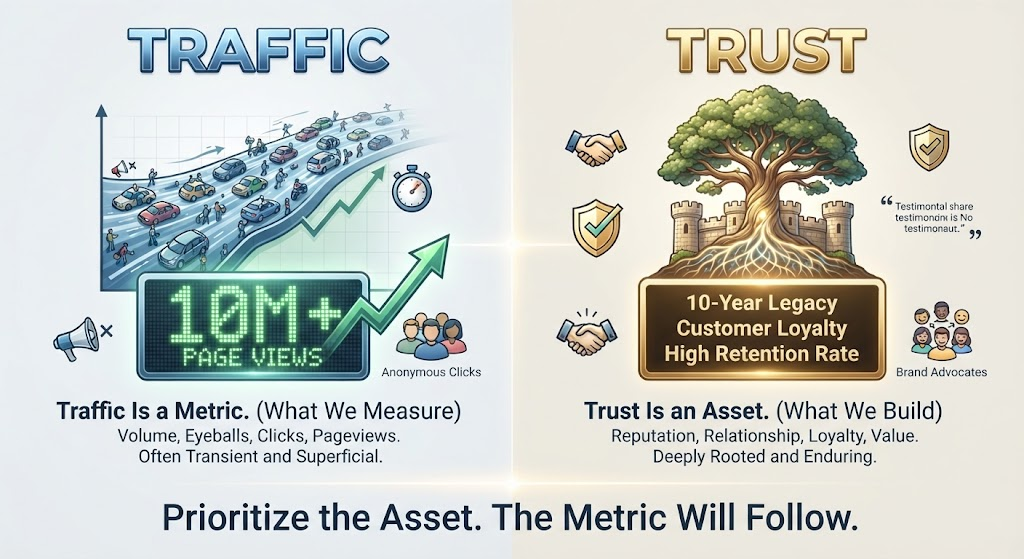
You simply measured attention instead of trust.
And those are two very different things.
Traffic Tells You Who Arrived
Traffic is important.
I’m not here to pretend it isn’t.
Without people visiting your website, discovering your content or finding your brand, you don’t have much of an audience to work with.
Traffic can help you understand:
- How many people are finding your website
- Where visitors are coming from
- Which content attracts attention
- What search terms bring people in
- Which channels are generating visitors
- Whether your visibility is growing
Those are useful insights.
But traffic only answers one basic question:
Did people arrive?
It doesn’t answer:
Did they trust you?
Trust Tells You What Happens Next
Imagine two websites.
Website A gets 20,000 visitors every month.
Website B gets 2,000.
At first glance, Website A looks like the obvious winner.
But imagine that Website B has a loyal audience that reads multiple articles, subscribes to its emails, recommends its content, returns regularly and eventually buys its products.
Suddenly, the numbers look very different.
That’s because trust changes the relationship.
A visitor is someone who arrived.
A trusted brand is somewhere they choose to return to.
That’s a much more valuable position.
The Internet Has an Attention Problem
We live in a world where attention is constantly being measured.
Views.
Likes.
Shares.
Followers.
Reach.
Impressions.
Clicks.
The problem is that these numbers can become addictive.
You post something.
It performs well.
You feel successful.
Then the next post gets half the engagement.
Suddenly you wonder whether you’ve done something wrong.
This is where strategy can get hijacked by vanity metrics.
You start creating content for the number rather than for the person behind the number.
And that’s dangerous.
A Thousand Views Don’t Mean a Thousand Relationships
Someone can see your content without caring about your brand.
They can click without reading.
They can read without remembering.
They can follow without ever engaging again.
They can even buy once without becoming a loyal customer.
That’s why the journey matters.
Attention → Interest → Trust → Action → Loyalty
Traffic mostly lives near the beginning.
Trust helps move people further down the journey.
And that’s why a smaller audience can sometimes be significantly more valuable than a massive one.
Trust Is Built Slowly
Here’s the inconvenient part:
Trust doesn’t usually have a shortcut.
You build it through consistency.
You deliver what you promised.
You don’t exaggerate every claim.
You acknowledge when something doesn’t work.
You provide useful information even when there isn’t an immediate sale attached to it.
You communicate like an actual human being.
You show expertise without pretending to know everything.
You give people reasons to believe that your recommendations are genuinely worth considering.
None of that produces an instant spike on a dashboard.
But it compounds.
Trust Makes Recommendations More Powerful
Think about the difference between two people recommending a product.
Person A:
“BUY THIS! It’s AMAZING! 🔥🔥🔥”
Person B:
“I’ve tried this myself. Here’s what I liked, here’s what I didn’t, and here’s who I think it would actually suit.”
Which recommendation feels more credible?
Probably the second.
Because the second person isn’t simply trying to get your attention.
They’re helping you make a decision.
That’s what trust does.
It changes promotion into recommendation.
And that distinction matters enormously in affiliate marketing, content marketing and personal branding.
Your Audience Is Not a Traffic Source
This might be one of the most important mindset shifts a marketer can make.
Your audience isn’t a number.
They’re people.
They have limited time.
They have questions.
They have doubts.
They have competing options.
And they’ve seen enough clickbait to recognise when someone is simply trying to squeeze a conversion out of them.
If every piece of content screams:
CLICK HERE. BUY THIS. SIGN UP. DON’T MISS OUT.
eventually people stop listening.
Trust gives you permission to make an offer because the audience understands the relationship behind it.
Trust Can Outlive an Algorithm
Algorithms change.
Search rankings change.
Platforms change.
Trends disappear.
A strategy that works beautifully today might be useless six months from now.
But if people trust you, you aren’t completely dependent on the platform.
They can search for your name.
Visit your website directly.
Subscribe to your email list.
Recommend you to someone else.
Follow you somewhere new.
That’s why trust is an asset.
It travels with you.
The Simmba Principle 🐈⬛

Even Simmba has something to teach us here.
If Simmba suddenly appeared on Instagram tomorrow and immediately started screaming:
“BUY MY PRODUCT.”
I would have some serious questions. 😂
But when an audience has watched his personality develop, seen the stories, followed the recurring content and understands what Simmba’s Corner is about, the relationship becomes different.
The content has context.
The audience isn’t just seeing a random tuxedo cat.
They’re recognising a familiar personality.
That’s the same principle brands can use.
Familiarity creates recognition. Consistency creates credibility. Trust creates relationships.
What Should You Measure Besides Traffic?
Traffic still matters.
Keep measuring it.
Just don’t let it become the entire definition of success.
Consider tracking:
- Returning visitors
- Email subscribers
- Time spent engaging with content
- Pages viewed per session
- Repeat customers
- Direct traffic
- Referral traffic
- Comments and meaningful conversations
- Saves and shares
- Conversion rates
- Customer retention
- Brand mentions
Not every metric will matter equally to every business.
The point is to look beyond:
“How many people saw me?”
and start asking:
“What happened because they saw me?”
That’s where strategy gets interesting.
Build the Asset, Not Just the Number
Traffic can fluctuate.
One viral post can send thousands of people your way.
A Google update can change your search traffic.
An algorithm change can destroy your reach overnight.
Trust is different.
It accumulates through repeated experiences.
Someone discovers your content.
They find it useful.
They come back.
They recognise your voice.
They recommend you.
Eventually, they become a customer.
Then they might become an advocate.
That’s not just traffic.
That’s an ecosystem.
Final Thought
Traffic is useful because it gives you data.
Trust is valuable because it gives you relationships.
One tells you that people arrived.
The other gives them a reason to stay.
So by all means, watch your analytics.
Study your traffic sources.
Analyse your search rankings.
Celebrate the occasional viral post.
But don’t build your entire strategy around making the numbers bigger.
Build something people can believe in.
Because traffic can put you on someone’s screen.
Trust is what can keep you in their mind.
And in a digital world overflowing with content, being trusted is worth far more than simply being seen.