


The Psychology of Getting a Cat’s Attention vs. Getting a Customer’s Attention
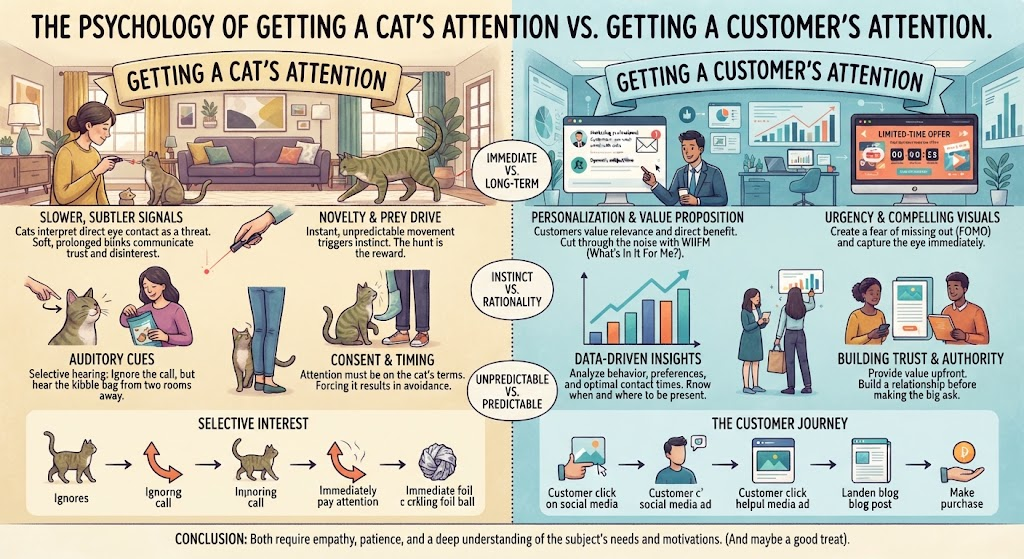
My human has been studying marketing for years.
She talks about attention.
She talks about engagement.
She talks about customer behaviour.
She talks about something called a “hook.”
Meanwhile, I have been getting her attention without saying a single word.
I stare at her.
She looks at me.
I walk into another room.
She follows me.
I sit beside the food cupboard.
She suddenly understands exactly what I want.
Honestly, humans make marketing sound unnecessarily complicated.
Getting attention is getting attention.
Whether you’re trying to get a customer’s attention or mine, there are a few basic rules.
And I am generously willing to share them.
1. Attention Has to Be Earned
You cannot demand someone’s attention.
Well, you can.
But that doesn’t mean you’ll get it.
I don’t walk up to my human and announce:
“PLEASE GIVE ME YOUR ATTENTION IMMEDIATELY.”
I simply sit somewhere inconvenient.
Works every time.
Customers work similarly.
Your audience is surrounded by notifications, advertisements, emails, videos, headlines, messages, and approximately 9,000 other things competing for their attention.
So saying:
“LOOK AT MY PRODUCT!”
isn’t necessarily enough.
You need to give them a reason.
That reason could be curiosity.
Entertainment.
A useful solution.
An interesting story.
A problem they recognize.
Or simply a perspective they haven’t heard before.
Attention is earned when the audience feels there is something worth paying attention to.
2. Curiosity Is Powerful
I am curious about everything.
What’s inside that cupboard?
Why did my human move that box?
What is that noise?
Why is there a closed door?
Why is my human using the bathroom without me?
These questions require investigation.
Customers aren’t much different.
Curiosity creates a tiny psychological itch.
You see a headline and think:
“Wait… what does that mean?”
Now you want the answer.
That’s why curiosity can be such a powerful part of content marketing.
Instead of giving someone a generic statement, create a reason to continue.
For example:
“How to Improve Your Social Media Strategy”
is useful.
But:
“Your Social Media Strategy Might Be Working Against You”
creates a question.
What am I doing wrong?
Why?
How?
That curiosity creates the opportunity for attention.
Just like the suspicious rustling inside a paper bag.
Obviously, I must investigate.
3. Relevance Matters
My human could wave the most expensive toy in the world in front of me.
If I am hungry?
I don’t care.
If I’m sleeping?
Absolutely not.
If I’ve decided the cardboard box is my current obsession?
That toy has no chance.
Timing and relevance matter.
Marketing works the same way.
You can have fantastic content, but if it doesn’t connect with what your audience currently needs, they may ignore it.
A customer looking for SEO advice doesn’t necessarily want to see your unrelated product announcement.
Someone comparing products wants useful information.
Someone discovering your brand may simply want to understand who you are.
The right message needs to reach the right person at the right moment.
Even cats understand context.
4. Don’t Overstimulate the Audience
Humans have discovered bright colours, flashing graphics, dramatic headlines, twelve pop-ups, autoplay videos, and approximately seventeen different buttons on one webpage.
Why?
I don’t know.
Sometimes more isn’t better.
Cats understand overstimulation very well.
One toy?
Interesting.
Ten toys being waved around my face?
I’m leaving.
Customers can feel the same way.
When everything is shouting for attention, nothing feels particularly important.
Good marketing doesn’t require constant noise.
Sometimes simplicity wins.
One clear headline.
One strong idea.
One obvious next step.
One reason to care.
Make it easy for people to understand what you’re offering.
5. Familiarity Builds Trust
I know my human.
I know her voice.
I know her routines.
I know when she is about to open the food cupboard.
I know when she is trying to sneak out of the house.
This familiarity creates trust.
Customers also become more comfortable with brands they repeatedly encounter in meaningful ways.
That doesn’t mean you should bombard them with content.
It means you should create a recognizable presence.
A consistent voice.
A familiar style.
A clear point of view.
A predictable level of quality.
Over time, people stop thinking:
“Who is this?”
and start thinking:
“Oh, I know them.”
That little shift is powerful.
6. Don’t Trick People Into Paying Attention
I could technically knock a glass off the table to get my human’s attention.
And sometimes I do.
But let’s pretend we’re discussing ethical marketing.
Clickbait might get someone to stop scrolling.
But if the content doesn’t deliver on the promise, you’ve gained attention and lost trust.
That’s a terrible trade.
Your headline should match your content.
Your advertisement should match your landing page.
Your product promise should match the actual experience.
If you tell people there’s something valuable behind the click, there better be something valuable waiting for them.
Otherwise, even Simmba would give your strategy one star.
7. Emotion Gets Remembered
I don’t understand all the complicated things humans say about consumer psychology.
But I do know this:
People remember how something made them feel.
A funny video.
A useful explanation.
A story that made them cry.
A post that made them feel understood.
A brand that made buying something easier.
Emotion gives information somewhere to stick.
That’s why storytelling is so effective in marketing.
Facts can inform people.
Stories can make those facts memorable.
And if your audience remembers you after they’ve closed the app, you’ve already achieved something valuable.
8. Give People a Reason to Come Back
I don’t demand that my human spend every waking second with me.
I simply make myself part of her routine.
Morning?
Simmba.
Working?
Simmba.
Eating?
Simmba.
Trying to sleep?
Surprise.
Customers need reasons to return too.
Maybe it’s useful content.
A recurring series.
A newsletter.
A community.
A helpful resource.
A brand they genuinely enjoy following.
The strongest audiences aren’t built around one successful post.
They’re built around repeated positive experiences.
Attention gets you noticed.
Consistency gives people a reason to remember you.
Trust gives them a reason to stay.
What Cats Can Teach Marketers About Attention
If I were teaching a marketing class, I’d keep it simple.
🐾 Be interesting.
Don’t expect attention simply because you’ve posted.
🐾 Be relevant.
Give people something that matters to them.
🐾 Create curiosity.
Make them wonder what comes next.
🐾 Don’t overwhelm them.
Attention isn’t the same as sensory overload.
🐾 Be trustworthy.
Don’t make promises your content or product can’t deliver.
🐾 Make people feel something.
Emotion makes content memorable.
🐾 Give them a reason to return.
One click isn’t a relationship.
The Simmba Attention Test 🐈⬛
Before publishing something, I recommend asking:
Would this make someone stop?
Would they understand why it matters?
Does it create curiosity?
Is it relevant to the person seeing it?
Does the content deliver on the promise?
Would they remember it afterward?
And most importantly:
Would they actually want to see another post from me?
If the answer to all of these is yes, congratulations.
You’ve probably created something worth paying attention to.
If the answer is no…
Perhaps stare at the content until it improves.
It works for me.
The Final Word From Simmba 🐾
Getting a cat’s attention isn’t about shouting louder.
Neither is getting a customer’s attention.
It’s about understanding what makes someone stop.
Curiosity.
Relevance.
Emotion.
Familiarity.
Timing.
Trust.
These aren’t just marketing concepts.
They’re human concepts.
And perhaps that’s the funniest lesson of all.
You don’t need to think like a marketer to understand attention.
Sometimes you just need to think like a cat.
Now if you’ll excuse me, my human has opened a packet.
And I have decided this is the most important thing happening on the internet today.
