


The Simmba Test: Would a Distracted Cat Understand Your Content?
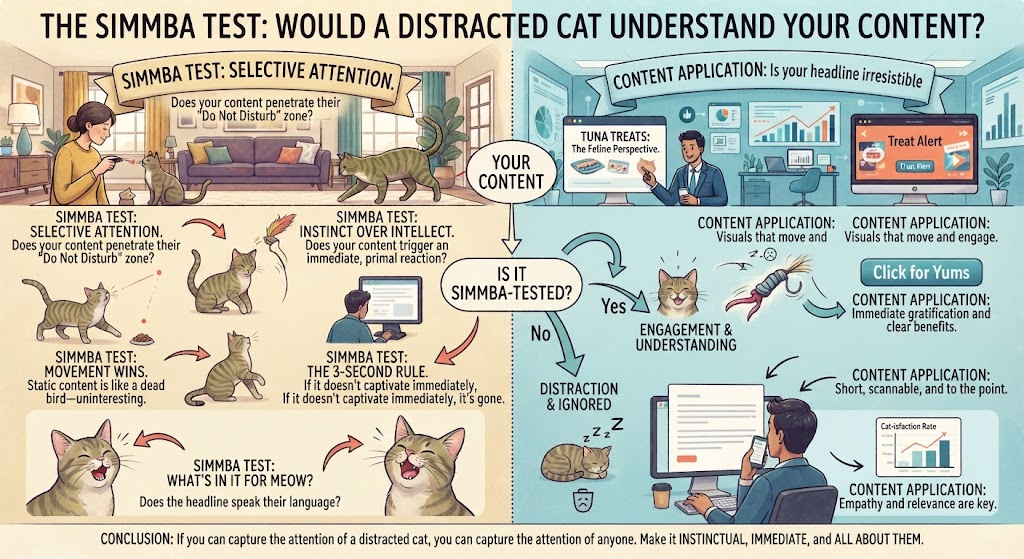
My human spends a lot of time creating content.
She writes.
She edits.
She researches.
She changes headlines.
She talks about SEO.
She talks about marketing.
She talks about storytelling.
And then sometimes she shows me something and asks:
“Does this make sense?”
I have several concerns.
First, I am a cat.
Second, I was probably looking at a bird when she asked.
Third, I was definitely not listening.
And yet, that is precisely why I have developed a brilliant new content test.
The Simmba Test:
Would a distracted cat understand what you’re trying to say?
If the answer is no, your content might need some work.
1. If Your Message Takes Forever to Find, We Have a Problem
I have a short attention span.
You know who else has one?
Your audience.
People aren’t necessarily reading your content from beginning to end while sitting peacefully with a cup of tea and unlimited patience.
They’re scrolling.
They’re multitasking.
They’re checking notifications.
They’re eating.
They’re waiting for a bus.
They’re watching television.
They’re probably doing three things at once.
So if your main point is buried underneath five paragraphs of introduction, complicated terminology, and unnecessary fluff…
I have already left.
Your message should be easy to find.
Tell people what you’re talking about.
Tell them why it matters.
Then give them the information they came for.
Don’t make your audience dig through an archaeological site just to discover your point.
2. Simplicity Doesn’t Mean Your Content Is Basic
Humans sometimes think complicated writing sounds smarter.
It doesn’t.
If you can explain something complicated clearly, that’s usually a much stronger demonstration of understanding.
Marketing jargon can make content feel impressive while making it harder to understand.
Words like:
- omnichannel
- synergize
- optimization framework
- customer-centric ecosystem
- integrated conversion architecture
Please.
I am a cat and even I am tired.
You can often say the same thing in plain English.
“Reach customers across different platforms.”
There.
Much better.
Clear content isn’t less intelligent.
It’s more considerate.
3. One Piece of Content Should Have a Clear Job
I have one job.
Being Simmba.
I take it very seriously.
Your content should have a job too.
Are you trying to:
Teach?
Entertain?
Tell a story?
Start a conversation?
Build trust?
Promote something?
Get someone to take action?
It can do more than one thing, but there should be a clear primary purpose.
If your blog post starts by discussing SEO, suddenly moves into personal branding, then becomes an advertisement for a completely unrelated product before ending with a motivational quote…
I’m confused.
And I’m a cat.
4. Your Headline Should Tell Me Why I Should Care
Imagine I see:
“A Comprehensive Analysis of Contemporary Content Strategy.”
No.
I am going back to sleep.
Now try:
“Why Your Content Isn’t Getting Attention.”
Interesting.
What am I doing wrong?
That’s a question worth answering.
Your headline doesn’t need to reveal everything.
But it should give people a reason to continue.
A strong headline creates clarity or curiosity.
Ideally, both.
5. Make Your Content Easy to Scan
Humans scroll.
Cats scan rooms.
We have different methods, but the principle is surprisingly similar.
When I enter a room, I immediately notice:
Food.
Potential threats.
Interesting objects.
My human.
Windows.
Possible hiding locations.
Your audience does something similar with content.
They scan the page looking for signals.
That’s why headings matter.
Short paragraphs matter.
Bullet points matter.
Bold emphasis can help.
Clear structure matters.
Don’t create a giant wall of text and expect someone to lovingly climb over it.
Break things up.
Make the content visually inviting.
6. Get to the Point
Humans love introductions.
Sometimes too much.
You don’t need seven paragraphs explaining why you’re about to explain something.
If you’re writing about email marketing, tell me what I’m going to learn.
If you’re reviewing a product, tell me what makes it worth considering.
If you’re teaching SEO, tell me what problem you’re solving.
You can still tell stories.
You can still have personality.
But don’t confuse personality with unnecessary padding.
I can be entertaining without writing 2,000 words about why I decided to sit on a chair.
Although, admittedly, I could.
7. Ask Yourself: “Could I Explain This to Simmba?”
This is the heart of the test.
Take your main idea.
Now imagine explaining it to a distracted cat.
Could you?
If you’re explaining affiliate marketing:
Don’t start with an encyclopedia definition.
Try:
“You recommend something you genuinely think is useful, and if someone buys through your special link, you may earn a commission.”
That’s understandable.
If you’re explaining SEO:
“SEO helps people find your content when they search for something online.”
Simple.
Once people understand the foundation, you can introduce the more complicated details.
Clarity first.
Complexity later.
8. Don’t Confuse More Information With More Value
I have seen humans create enormous pieces of content because they think longer automatically means better.
It doesn’t.
More words aren’t necessarily more useful.
If five sentences explain something perfectly, you don’t need fifteen.
Your audience doesn’t receive bonus points for surviving a long article.
The goal isn’t:
“How much can I say?”
The goal is:
“How clearly can I communicate this?”
That’s a very different question.
9. Your Content Should Survive Distraction
Here’s the real test.
Imagine your reader gets a notification halfway through your article.
They leave.
Ten minutes later, they come back.
Can they quickly figure out where they were?
Can they remember what the article is about?
Can they scan the headings and understand the structure?
Can they identify the main takeaway?
If yes, you’ve created resilient content.
Content that doesn’t require perfect attention to be understood.
That’s valuable in an internet where everyone’s attention is being pulled in seventeen directions at once.
The Simmba Content Test 🐾
Before publishing, ask yourself:
🐈 Is the main point obvious?
Can someone quickly understand what this piece is about?
🐈 Is the language clear?
Could you remove some jargon?
🐈 Does the headline create interest?
Would someone actually want to continue?
🐈 Is the structure easy to scan?
Can someone find the information they need?
🐈 Does every section have a purpose?
Or are you simply filling space?
🐈 Is there one clear takeaway?
What should the reader remember?
🐈 Would Simmba understand it?
This is obviously the most important question.
What Happens If Your Content Fails the Simmba Test?
Nothing catastrophic.
Your website won’t explode.
Google won’t send a formal complaint.
Simmba won’t revoke your marketing license.
Probably.
Instead, treat the test as a reminder to simplify.
Cut unnecessary sentences.
Replace jargon.
Strengthen the headline.
Break up long paragraphs.
Move important information higher.
Give the reader a clear takeaway.
Your content doesn’t need to become childish.
It needs to become clear.
There is a difference.
The Final Word From Simmba 🐈⬛
The internet is full of complicated content.
Sometimes it is genuinely complicated because the subject itself is complicated.
But sometimes the content is complicated because the writer didn’t take the time to make it clear.
That’s where the Simmba Test comes in.
Before you publish, step back and ask:
Would a distracted cat understand what I’m trying to say?
If yes, you’re probably communicating clearly.
If no…
Remove the jargon.
Simplify the message.
Make the structure easier to follow.
And perhaps explain it to a cat.
Because sometimes the best content editor isn’t a marketing expert.
It’s a tuxedo cat who was supposed to be napping but somehow ended up reviewing your entire content strategy.
Now, if you’ll excuse me, I have forgotten everything I just said.
There is a bird outside.
Content strategy can wait. 🐾
