


Simmba vs. The Marketing Bro
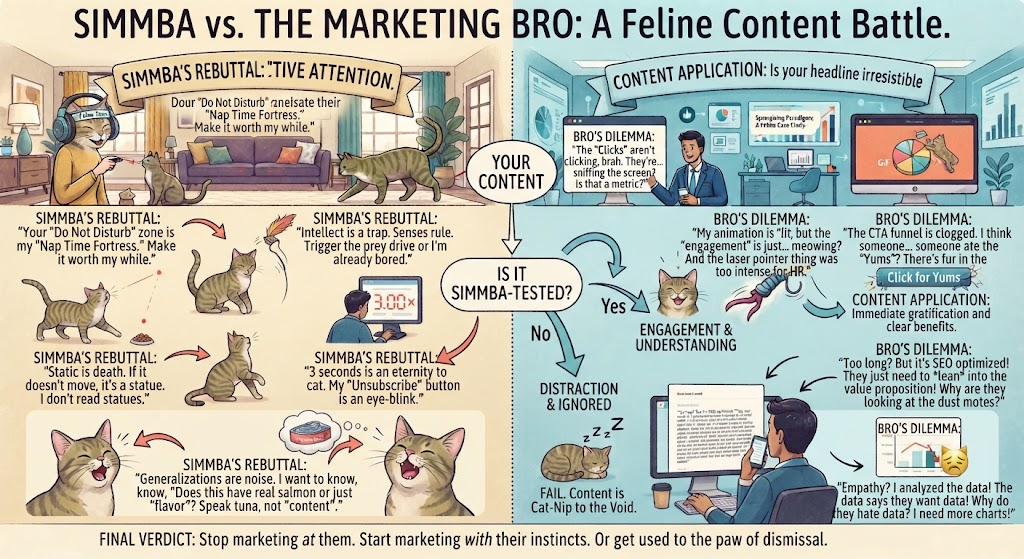
I was peacefully sitting on the couch when my human showed me a marketing post.
It contained:
- 17 emojis
- 14 exclamation marks
- the word “SCALABLE”
- something about a $10K MONTH
- a funnel
- a funnel inside another funnel
- and a man standing beside a sports car.
I stared at the screen.
Then I stared at my human.
Then I went back to sitting down.
Apparently, this is what humans call marketing.
I have concerns.
So today, we’re settling an important question:
Who has the better marketing strategy?
Me, Simmba the tuxedo cat…
or
The Marketing Bro.
Let the battle begin. 🐾
Round One: The Marketing Bro Wants Attention
The Marketing Bro says:
“You need to POST. EVERY. SINGLE. DAY.”
He has a content calendar.
It has 47 posts scheduled.
There are three Reels planned before breakfast.
There is a motivational quote scheduled for 6:00 a.m.
There is another motivational quote scheduled for 6:15 a.m.
And somehow, there is a carousel about passive income scheduled for 6:30.
My strategy?
I appear when I feel like it.
And somehow, people still want to see me.
Here’s the lesson:
Consistency matters. But constant noise isn’t the same thing as valuable content.
You don’t need to publish simply because the calendar tells you to.
Create something worth someone’s attention.
Then let it breathe.
Round Two: The Marketing Bro Says “SELL, SELL, SELL”
The Marketing Bro has a solution for everything.
His content?
Selling.
His emails?
Selling.
His stories?
Selling.
His breakfast?
Probably selling an online course about breakfast.
Every interaction somehow leads to a funnel.
I prefer a different approach.
I let people get to know me.
I entertain them.
I give them something useful.
I build familiarity.
And occasionally, I stare at my human until she understands that I want food.
That’s a softer conversion strategy.
The lesson?
Not every piece of content needs to ask for money.
Sometimes the goal is simply to build trust.
People are more likely to listen to recommendations from someone they already trust than from a stranger who appeared five seconds ago and immediately asked for their credit card.
Round Three: The Marketing Bro Loves Jargon
The Marketing Bro says:
“We need to leverage an omnichannel, customer-centric, data-driven ecosystem to optimize the conversion journey.”
I blink.
My human translates:
“We need to make it easier for customers to buy.”
Much better.
Marketing doesn’t become smarter because you use bigger words.
If your audience doesn’t understand you, you’ve created a communication problem.
Good marketers know their subject well enough to explain it simply.
I know approximately six words.
And yet my human understands me perfectly.
Food.
Treat.
No.
Come.
Simmba.
And the sound of a cupboard opening.
Communication is about being understood.
Not sounding impressive.
Round Four: The Marketing Bro Chases Every Trend
The Marketing Bro has discovered a new trend.
Everyone must use it.
Immediately.
He changes his content strategy.
Then his branding.
Then his posting schedule.
Then his entire business model.
Two weeks later, another trend appears.
We’re back to square one.
I have watched this happen repeatedly.
I refuse.
I am still a tuxedo cat.
I have been a tuxedo cat for years.
No rebrand required.
Trends can absolutely be useful.
But they should serve your strategy rather than become your strategy.
If something doesn’t fit your audience, voice, or goals, you don’t need to force it.
You are allowed to say:
“That’s not for me.”
I do this constantly.
Usually when my human buys a toy I don’t like.
Round Five: The Marketing Bro Wants Everyone
The Marketing Bro says:
“My target audience is everyone.”
Wrong.
Everyone isn’t a target audience.
Everyone is approximately… everyone.
You need to know who you’re actually trying to reach.
What do they care about?
What problems do they have?
What do they want?
What language do they use?
What makes them stop scrolling?
What would make them trust you?
I don’t try to appeal to every animal on Earth.
I have my people.
And they know me.
That’s branding.
Round Six: The Marketing Bro Talks About Engagement
The Marketing Bro sees a post with 50,000 likes.
He celebrates.
I see a post with 50 comments from people having meaningful conversations.
I approve.
Because engagement isn’t just a number.
A like can mean:
“I enjoyed this.”
A comment can mean:
“I have something to say.”
A share can mean:
“This reminded me of someone.”
A saved post can mean:
“I want to come back to this.”
Different interactions tell you different things.
The goal isn’t to collect the biggest number possible.
It’s to understand what your audience is actually doing.
Numbers are useful.
Context is better.
Round Seven: The Marketing Bro Thinks AI Should Do Everything
The Marketing Bro has discovered AI.
Now apparently AI will:
Write everything.
Create everything.
Strategize everything.
Think everything.
Possibly make his coffee.
I have nothing against AI.
My human uses it too.
But here’s the problem:
Tools don’t replace perspective.
AI can help you brainstorm.
It can help you organize ideas.
It can help you research, refine, and experiment.
But if you give it no original thought, no experience, no opinion, and no personality…
you get content that sounds like it was assembled in a warehouse.
I may be a cat.
But at least I have a point of view.
Usually:
“Feed me.”
Final Round: The Marketing Bro vs. Simmba
Let’s review.
| Marketing Bro | Simmba |
|---|---|
| Chases every trend | Knows his identity |
| Posts constantly | Appears when there’s something worth seeing |
| Uses endless jargon | Keeps things simple |
| Sells immediately | Builds familiarity first |
| Wants everyone as a customer | Knows his audience |
| Obsesses over vanity metrics | Values meaningful engagement |
| Wants AI to do everything | Uses tools without losing personality |
| Treats people like leads | Treats people like an audience |
And somehow…
the cat wins.
What Simmba’s Strategy Actually Teaches Us
This isn’t really about cats versus marketers.
It’s about strategy versus noise.
Marketing doesn’t have to be loud to be effective.
You don’t have to constantly chase trends.
You don’t need to turn every interaction into a sales opportunity.
You don’t need to sound complicated.
You don’t need millions of followers.
And you certainly don’t need to pretend you have everything figured out.
Good marketing starts with understanding people.
Then you create something useful, interesting, entertaining, or meaningful for them.
Simple.
Very cat-like.
The Simmba Marketing Rules 🐾
If I were writing the Marketing Bro’s handbook, I’d replace most of it with seven rules:
1. Know your audience.
Stop trying to sell to everyone.
2. Make something worth noticing.
Attention isn’t automatic.
3. Be recognizable.
Your personality matters.
4. Build trust before demanding a sale.
Relationships come first.
5. Use simple language.
If your audience needs a dictionary, rethink the sentence.
6. Don’t chase every trend.
Your strategy should have a backbone.
7. Think for yourself.
Tools can assist you.
They shouldn’t replace your brain.
The Final Word From Simmba 🐈⬛
The Marketing Bro may have his funnels.
He may have his dashboards.
He may have his seven-step framework for achieving exponential growth.
He may even have a podcast.
I have a cardboard box.
And yet, I know something important.
People don’t connect with strategies. They connect with people, personalities, stories, and ideas.
Marketing is ultimately about communication.
Understand people.
Give them something worth their time.
Treat their attention with respect.
Build trust.
And don’t be afraid to sound like yourself.
You don’t need to become a Marketing Bro to become a good marketer.
In fact…
please don’t.
There are already enough of them.
Now excuse me.
My human has opened the snack cupboard.
The most important conversion of the day is about to happen. 🐾
