
Every few weeks, someone declares that AI is killing creativity.
AI-generated articles.
AI-generated images.
AI-generated videos.
AI-generated social media posts.
And somehow, creativity itself is supposedly on life support.
I’m not convinced.
Because here’s the uncomfortable part:
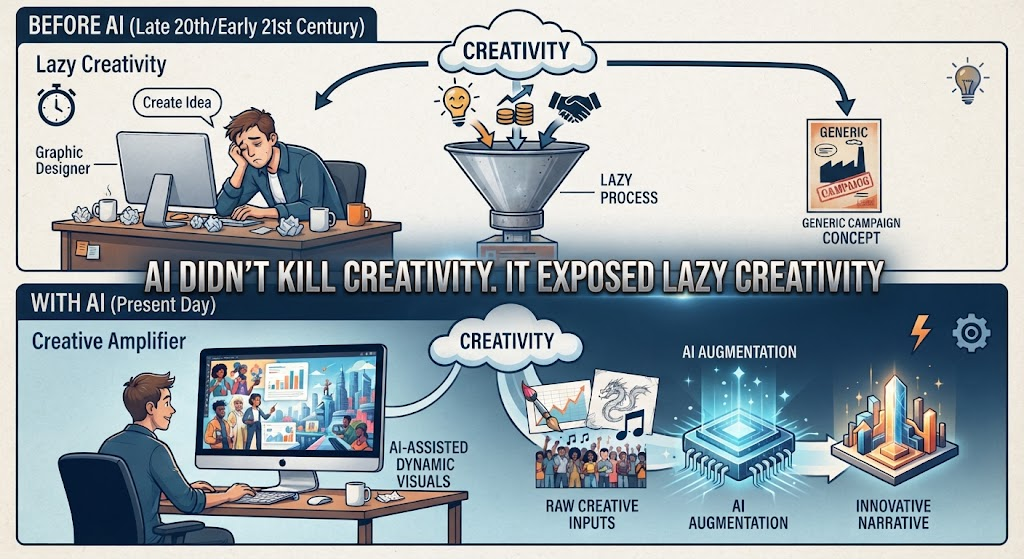
AI didn’t kill creativity. It made lazy creativity much easier to produce.
And there’s a difference.
Before AI, people could still copy trends, recycle the same ideas, write generic content and imitate whatever everyone else was doing.
AI simply made the process faster.
Now we can produce five versions of the same bland idea before breakfast.
That’s not the death of creativity.
That’s a creativity problem.
The Tool Isn’t the Problem
Let’s start with something simple.
AI is a tool.
And tools have never been inherently creative or uncreative.
A camera didn’t destroy photography.
Photoshop didn’t destroy graphic design.
The internet didn’t destroy writing.
And AI doesn’t automatically destroy creativity.
What matters is how the tool is used.
Give the same AI tool to ten different people and you can get ten completely different outcomes.
One person might use it to brainstorm.
Another might use it to research.
Someone else might use it to challenge their assumptions.
Another person might use it to generate an entire article, publish it without reading it and call it a day.
Same technology.
Very different levels of creativity.
The Copy-Paste Problem
Here’s where AI gets interesting.
AI makes it incredibly easy to create something that looks complete.
That’s both its strength and its weakness.
You can ask for a blog post and receive one.
You can ask for ten captions and receive ten.
You can ask for a marketing strategy and receive a polished-looking document.
But polished doesn’t automatically mean good.
And complete doesn’t automatically mean creative.
The biggest danger isn’t that AI will make everyone creative.
It’s that it can make lazy work look finished.
That’s a much more interesting problem.
Creativity Has Always Required a Human
Creativity isn’t just producing words, images or ideas.
It’s making choices.
What should I say?
Why should I say it?
What do I actually believe?
What perspective can I bring?
What experience shaped this idea?
What would make someone stop and think?
AI can help you explore those questions.
But it can’t replace the responsibility of answering them.
That’s still your job.
AI Can Actually Make Creativity More Accessible
There’s another side to this conversation that often gets ignored.
AI can help people who struggle with the mechanics of creating.
Someone with an idea but limited writing confidence can use AI to organise their thoughts.
A marketer can brainstorm campaign angles.
A writer can overcome the dreaded blank page.
A business owner can explore ideas they wouldn’t otherwise have the time or resources to develop.
That doesn’t necessarily make the work less creative.
Sometimes it allows the creativity to finally get out of someone’s head.
And I think that’s worth recognising.
The Difference Between AI-Assisted and AI-Dependent
This is where I draw my own line.
AI-assisted creativity means the human is still driving.
You bring the idea.
You bring the perspective.
You make the decisions.
You edit.
You question.
You reject things.
You reshape them.
You make the final piece yours.
AI-dependent content is different.
The human essentially presses generate and accepts whatever comes back.
There’s little personal perspective.
Little editing.
Little experimentation.
Little reason for the audience to connect with it.
The technology isn’t necessarily the problem.
The lack of human input is.
Why AI Slop Feels So Obvious
You’ve probably seen it.
The perfectly structured article.
The endless headings.
The overly polished sentences.
The same recycled phrases.
The same five-point list.
The same generic conclusion about how “in today’s digital landscape” something is more important than ever.
You read it and immediately think:
I’ve seen this before.
That’s because you probably have.
The problem isn’t necessarily that AI was involved.
The problem is that nothing human was added afterwards.
No strong opinion.
No personal story.
No unusual observation.
No humour.
No experience.
No risk.
No point of view.
Just information arranged into paragraphs.
And information alone isn’t personality.
Originality Comes From Perspective
Here’s something I think marketers and content creators need to remember:
You don’t have to invent a completely new subject to create original content.
You can make a familiar subject interesting by bringing a different perspective to it.
Thousands of people write about AI.
Thousands write about SEO.
Thousands write about personal branding.
Thousands write about social media.
The question isn’t:
“Has someone already written about this?”
They probably have.
The better question is:
“What can I say about it that sounds like me?”
That’s where originality starts.
Your Weird Ideas Matter
Sometimes the thing that makes content memorable is the part that doesn’t fit neatly into a marketing template.
A strange analogy.
A personal story.
An unpopular opinion.
A fictional character.
A conversation with your cat.
Yes, I’m looking directly at Simmba here. 🐈⬛
The internet is full of perfectly optimised content.
What it isn’t full of is your exact combination of experiences, opinions, humour and perspective.
That’s your advantage.
AI can help you organise those ingredients.
It can’t manufacture your life for you.
What Marketers Should Actually Be Learning From AI
Instead of asking:
“How do I use AI to create more content?”
Maybe we should ask:
“How can I use AI to create better thinking?”
Use it to challenge an idea.
Ask it to argue against you.
Generate perspectives you hadn’t considered.
Find weaknesses in your strategy.
Help organise messy thoughts.
Explore different audiences.
Then bring the human part back into the process.
The goal shouldn’t be to produce more noise.
It should be to produce something worth hearing.
The Real Creative Advantage
AI has lowered the barrier to producing content.
That’s not necessarily bad.
But when everyone can produce content quickly, content production stops being the competitive advantage.
Thinking becomes the advantage.
Perspective becomes the advantage.
Experience becomes the advantage.
Taste becomes the advantage.
Knowing what not to publish becomes the advantage.
And perhaps most importantly:
Having something worth saying becomes the advantage.
Final Thought
AI didn’t suddenly make people less creative.
It simply removed some of the excuses.
You no longer need hours to get a rough draft started.
You don’t need to stare at a blank document for half the afternoon.
You don’t need to have perfect technical skills before experimenting with an idea.
The tools are here.
So now the question becomes:
What are you going to do with them?
If you use AI to avoid thinking, you’ll probably create more generic content faster.
If you use AI to expand your thinking, challenge your ideas and bring your own perspective into the process, you can create something much more interesting.
Because creativity was never about doing everything manually.
It was about having something of your own to contribute.
AI didn’t kill creativity.
It just made it much harder to hide when there wasn’t any.