
Think about the last advertisement you remember.
Can you remember the exact campaign?
The colours? The slogan? The call to action?
Maybe.
Now think about a character you grew up watching.
Suddenly, the memory gets much clearer.
You remember their personality. Their voice. Their expressions. Their habits. Maybe even the ridiculous things they used to do.
That difference isn’t accidental.
People are naturally drawn to personalities and stories.
And that is exactly why characters can become incredibly powerful marketing tools.
Characters Give Brands a Personality
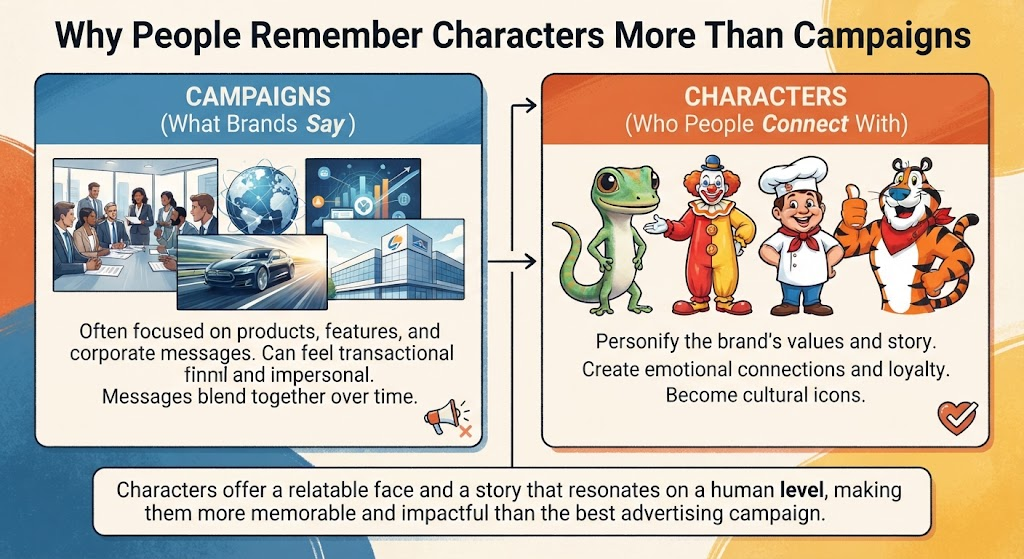
A campaign has a beginning and an end.
A character can feel like they have a life beyond the campaign.
That’s an important distinction.
When a brand creates a memorable character, that character can represent the personality of the brand in a way that a logo or slogan often can’t.
Think about characters such as the M&M’S characters, Duolingo’s Duo, or the Geico Gecko.
You don’t simply recognise what they represent.
You recognise who they are.
That’s powerful because personality creates familiarity.
And familiarity can create trust.
We Connect With People, Not Just Products
Marketing often focuses heavily on features.
Faster.
Cheaper.
Better.
More powerful.
But consumers don’t experience brands as spreadsheets.
They experience them emotionally.
A memorable character gives people something human to connect with.
The character might be funny, sarcastic, dramatic, chaotic, wholesome or completely ridiculous.
And that’s okay.
In fact, those imperfections can make the character more memorable.
Think about your favourite fictional characters.
You probably don’t remember them because they were perfectly designed.
You remember them because they had personality.
Marketing can work the same way.
Characters Create Continuity
One of the biggest advantages of a recurring character is consistency.
A campaign might run for several weeks.
A character can appear again and again.
They can show up in advertisements, social media posts, packaging, videos, websites and even conversations between customers.
Over time, the character becomes part of the brand’s identity.
Instead of constantly introducing themselves, they already have an established relationship with the audience.
It’s almost like having a familiar face walk into the room.
You already know what kind of energy they’re bringing.
Characters Make Brands Easier to Talk About
Here’s something marketers sometimes overlook:
People share personalities.
It’s much easier to say:
“That Duolingo owl is absolutely unhinged.”
than:
“I really like Duolingo’s current brand communication strategy.”
One sounds like a conversation.
The other sounds like someone is preparing a presentation for the boardroom. 😭
Memorable characters give audiences something tangible to discuss.
They become shorthand for the brand.
And when people start talking about the character, they’re also talking about the brand.
Characters Can Turn Marketing Into Entertainment
This is where modern marketing gets particularly interesting.
People don’t necessarily want to be marketed to.
They want to be entertained, informed, inspired or understood.
A character can help blur that boundary.
Instead of:
Brand → Advertisement → Customer
you can create:
Character → Story → Audience → Brand
The marketing becomes part of an experience.
That’s one reason storytelling has become such an important part of content strategy.
People don’t just want information.
They want something worth remembering.
The Simmba Test 🐈⬛

And yes, I’m absolutely going to bring Simmba into this.
Because if there is one thing I’ve learned from creating content around a tuxedo cat, it’s that personality gives content somewhere to go.
Simmba isn’t interesting simply because he’s a cat.
There are millions of cats online.
What makes the content more recognisable is the personality attached to him.
The opinions.
The attitude.
The little quirks.
The imaginary commentary.
Suddenly, the audience isn’t just looking at a cat.
They’re getting to know a character.
That’s exactly what brands can do.
You don’t necessarily need a mascot.
You need something that gives your audience a reason to recognise you.
So Should Every Brand Create a Character?
Absolutely not.
This is where strategy matters.
Adding a cartoon mascot to a brand doesn’t automatically make it memorable.
A character needs to serve a purpose.
Ask:
- Does the character fit the brand?
- Does it have a recognisable personality?
- Can the personality remain consistent?
- Does it make the brand easier to understand?
- Does the audience actually enjoy interacting with it?
- Can the character exist beyond one campaign?
If the answer is no, you might just be putting a costume on your marketing strategy.
And nobody needs that.
What Marketers Can Learn From Characters
You don’t have to create a fictional character to use the same principles.
You can build personality into your existing brand.
Give your content a recognisable voice.
Have opinions.
Tell stories.
Create recurring formats.
Develop inside jokes.
Use consistent language.
Show the people behind the business.
Let your audience know what you stand for.
In other words, make your brand recognisable before you try to make it unforgettable.
Because memorability isn’t always about shouting louder.
Sometimes it’s about becoming familiar enough that people recognise you before they even see your name.
Final Thought
Campaigns come and go.
Characters can stay.
That’s the real lesson.
A campaign tells people what you’re selling.
A character can give them someone to remember.
And in a digital world where audiences are exposed to thousands of messages every day, being remembered is a pretty valuable marketing advantage.
So the next time you’re planning a campaign, don’t just ask:
“What are we going to say?”
Ask:
“Who are we going to be?”
Because sometimes the strongest marketing strategy isn’t another clever campaign.
It’s giving people a personality they actually want to remember