I think we’re used to seeing AI as a product category.
AI writing tools.
AI image generators.
AI chatbots.
AI assistants.
But what happens when we stop thinking of AI as a separate product?
What happens when it simply becomes part of everything else?
🤖 AI Is Moving Into Ordinary Things
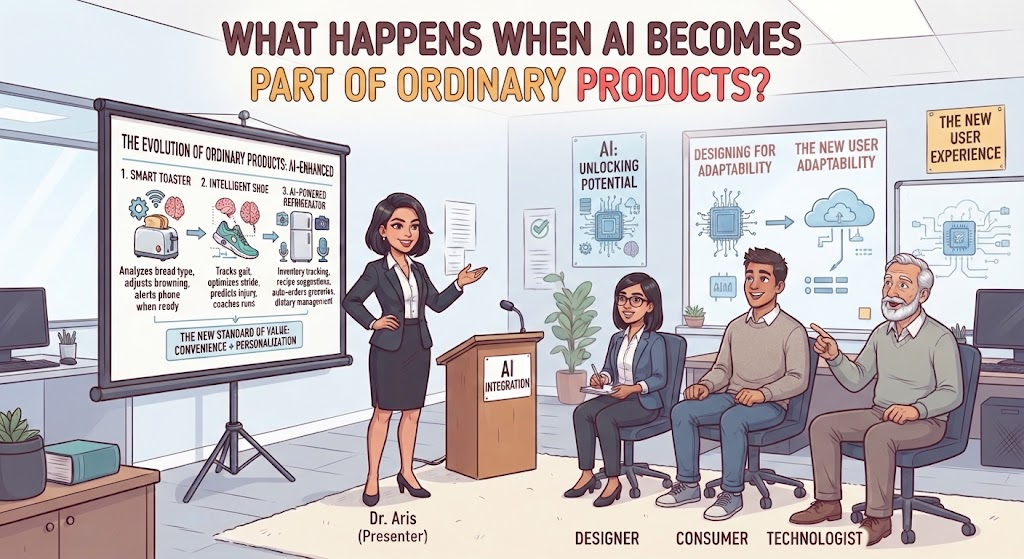
We’re already seeing AI appear in products and services that aren’t marketed primarily as “AI products.”
It can help with recommendations, personalization, automation, search, customer support and decision-making.
Eventually, the AI itself may become less interesting to the customer.
They may not care what model is running behind the scenes.
They’ll care about what the product actually does for them.
🧠 The Technology Becomes Invisible
Think about other technologies we barely think about anymore.
We don’t usually ask whether an app is “internet-powered.”
We just expect it to work.
AI could move in a similar direction.
Instead of asking:
“Does this product have AI?”
people may start asking:
“Does this product understand what I need?”
That changes the marketing conversation.
🎯 The Feature Isn’t the Whole Story
Adding AI to an ordinary product doesn’t automatically make it innovative.
The important question is what the technology actually improves.
Does it save time?
Make something easier?
Personalize an experience?
Help someone make a decision?
Reduce repetitive work?
If the answer is no, then adding AI might simply be adding another feature nobody asked for.
🔮 What Marketers Should Watch
I think the interesting part of AI’s future isn’t only the newest chatbot or model.
It’s what happens when AI becomes embedded into everyday experiences.
That means marketers may eventually have to explain less about the technology and more about the outcome.
The customer doesn’t necessarily need a technical lecture.
They need to understand:
“What’s better for me because this exists?”
My Takeaway
AI may eventually become less of a headline and more of an underlying capability.
And when that happens, marketing will have to evolve with it.
The question won’t always be:
“How do we market this AI?”
It might become:
“How does AI make this ordinary product meaningfully better?”
My foresight input: The future of AI marketing may not be about making AI look extraordinary. It may be about making ordinary experiences work extraordinarily well.