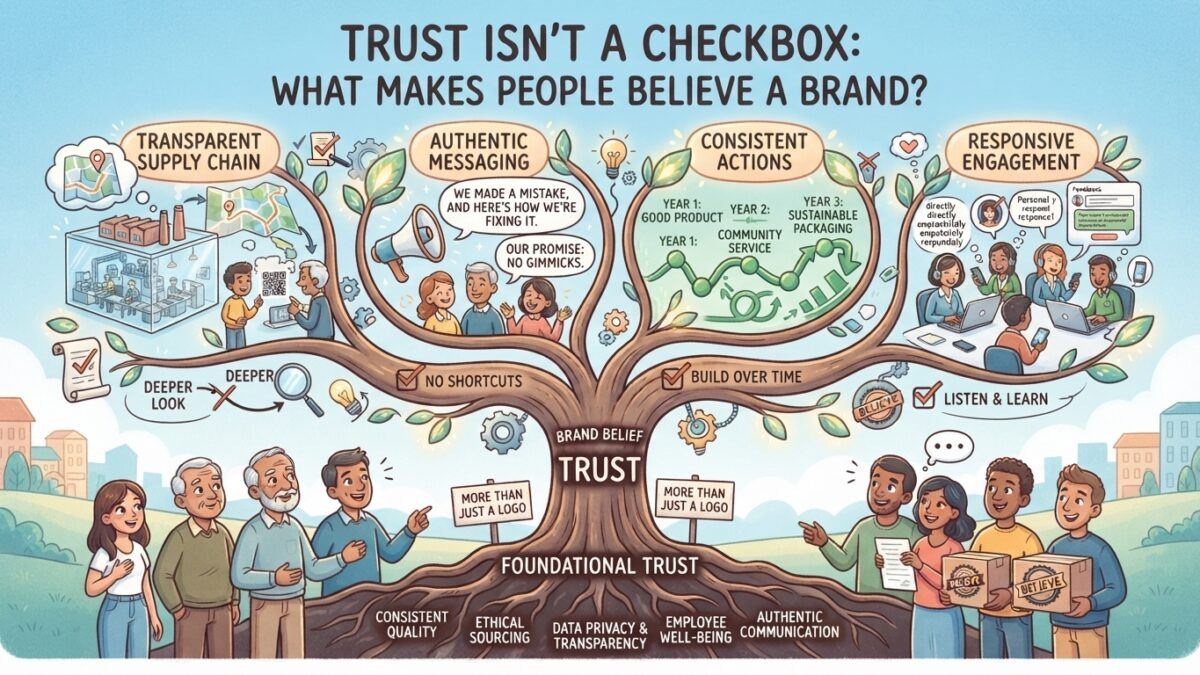

Trust Isn’t a Checkbox: What Makes People Believe a Brand?

Trust is one of those things brands love to talk about.
“Trusted by thousands.”
“Customers first.”
“Your privacy matters.”
But seeing those words doesn’t automatically make someone trust a brand. In fact, when every website uses the same language, those claims can start feeling like background noise.
So what actually makes people believe a brand?
1. Show, don’t just tell
A brand can say it values transparency, but the real test is what happens when something goes wrong.
Clear pricing, straightforward policies, accessible contact information, honest product descriptions, and visible explanations of how information is used all give people something concrete to evaluate.
Truth becomes easier when the customer doesn’t have to play detective.
2. Consistency matters
Trust isn’t created by one beautifully written About page.
It develops across the entire customer experience.
If a brand sounds friendly on social media but becomes vague and evasive when someone has a problem, there is a disconnect. If the website promises simplicity but the checkout process is confusing, the experience contradicts the message.
Every touchpoint contributes to the picture.
3. Don’t hide the important information
Transparency doesn’t mean dumping a wall of legal language on a webpage and calling it a day.
It means making important information understandable and reasonably easy to find.
Customer’s shouldn’t need a treasure map to discover shipping costs, cancellation terms, subscription conditions or how their data is handled.
Good transparency respects the persons time.
4. Admit what you don’t know
This is becoming particularly important as AI becomes part of the marketing.
There can be pressure to make every brand appear polished, certain, and authoritative. But sometimes the more trustworthy response is:
“We don’t know yet.”
Or
“Here’s what we know, here’s what we’re still checking, and here’s where the information came from.”
That kind of communication gives people context instead of manufactured certainty.
5. Trust is built through evidence
Reviews, testimonials, case studies, demonstrations, clear sourcing and real examples can all help people assess whether a brand’s promises match reality.
But even these need context.
A testimonial isn’t proof of everything a brand claims. A five-star review doesn’t guarantee everyone’s experience will be identical.
The goal isn’t to manufacture certainty. It’s to give people enough useful information to make an informed decision.
The S&S takeaway
Trust isn’t a badge a brand earns once and then puts on its website forever.
It’s something reinforced through actions, consistency, clarity and evidence.
And perhaps that’s the biggest shift marketers need to make:
Instead of asking, “How can we make our brand look trustworthy?”
Ask:
“What can we show people that allows them to decide whether they trust us?”
That puts the customer back in control.
