
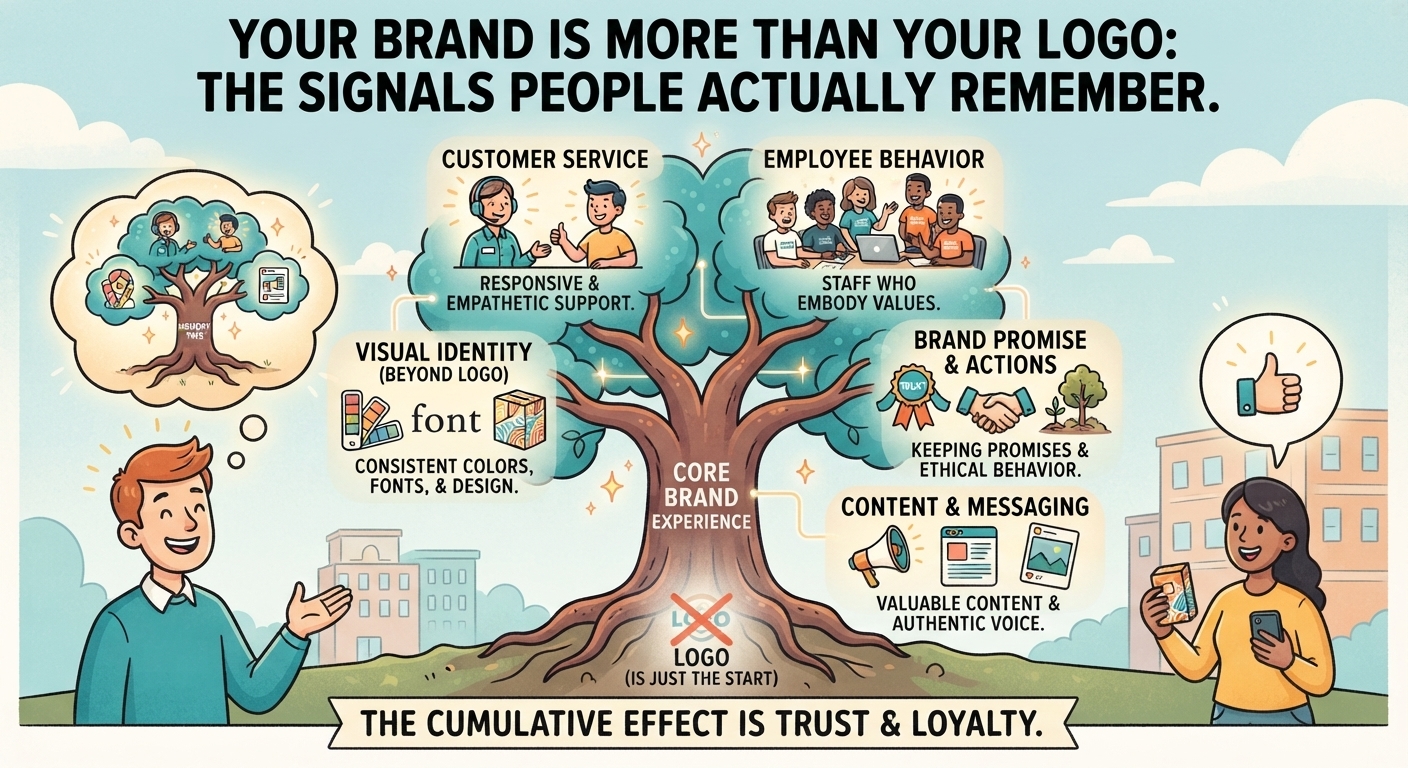

When people hear the word branding, a logo, colour palette or font might be the first thing that comes to mind.
But a brand is much bigger than its visual identity.
It is the collection of signals people experience before, during and after they interact with a business.
Your logo might get someone’s attention. Your brand experience is what gives that logo meaning.
1. Your brand starts before the sale
A potential customer may encounter your business through a search result, social media post, advertisement or recommendation.
That first interaction already communicates something.
Is the information clear? Does the messaging feel consistent? Does the business understand the problem the customer is trying to solve?
Brand strategy begins before someone ever clicks Buy.
2. Consistency creates recognition
Consistency doesn’t mean repeating the exact same sentence everywhere.
It means the important parts of your identity remain recognisable across different platforms.
Your website, social media, emails and customer service should feel like they belong to the same business.
When the experience keeps changing, people have to work harder to understand who the brand actually is.
3. Strategy gives creativity somewhere to go
A strong visual identity can make a brand memorable, but creativity works better when it has direction.
Before choosing another colour, slogan or trend, ask:
What are we trying to communicate?
Who are we communicating with?
And what do we want people to understand, remember or do?
Without those answers, branding can become decoration rather than strategy.
4. Small details become big signals
Sometimes the strongest brand signals aren’t the things a business deliberately puts in the spotlight.
They can be found in the tiny details.
How quickly does the website answer a question?
Does the copy sound like it was written for a real person?
Are prices easy to understand?
Does the business respond consistently when customers need help?
These details can quietly shape someone’s impression of the entire brand.
5. Your audience helps shape the meaning
A brand doesn’t exist entirely inside a company’s own description of itself.
People interpret what they experience.
A business might describe itself as innovative, friendly or premium, but customers form their own conclusions from the evidence they encounter.
That means brand strategy isn’t simply about controlling perception.
It is about creating an experience that supports the perception you want to communicate.
The S&S takeaway
A logo can identify a business.
A brand strategy gives people a reason to remember it.
The strongest branding decisions connect visual identity, messaging, customer experience and business goals rather than treating each one as a separate piece.
So instead of asking:
“Does our brand look good?”
Try asking:
“What is our brand communicating at every point where someone encounters it?”
That question takes branding from decoration to strategy.