Content creation used to feel like juggling flaming swords while blindfolded. Now? It’s more like having a full creative pit crew in your laptop—fast, precise, and slightly too good at guessing your next move.
Welcome to the era where AI doesn’t just assist creation… it co-authors the chaos. Let’s break down the top AI tools shaping content generation right now.
🧠 1. OpenAI (ChatGPT)
The heavyweight brain of modern content workflows.
ChatGPT is basically your all-in-one writing partner: brainstorming ideas, drafting blogs, scripting videos, rewriting content, and even refining tone like a linguistic stylist with attitude.
Why creators love it:
- Instant blog drafts + ideation storms
- Tone switching (formal → Gen Z → corporate → storytelling mode)
- SEO structuring support
- Research synthesis without the overwhelm
Think of it as: a strategist, copywriter, and editor arguing nicely in your browser.
🎨 2. Canva (Magic Studio)
Canva isn’t just design anymore—it’s visual content generation with AI embedded into every corner.
From Magic Write to AI image generation tools, Canva turns “I need a post” into “here’s a fully branded campaign in 10 minutes.”
Best for:
- Social media content batches
- Brand kits + visual consistency
- Fast carousel + infographic creation
It’s giving: design agency energy without the invoice trauma.
✍️ 3. Jasper
Jasper is the marketing-focused AI writer that behaves like it actually read your brand guidelines… and remembered them.
Strengths:
- Long-form blog generation
- Conversion-focused copywriting
- Brand voice training
- Campaign-level content planning
If ChatGPT is your creative freestyle rapper, Jasper is your disciplined marketing manager with a clipboard and ambition.
🧾 4. Notion AI
Notion AI turns your messy thoughts into structured, usable content systems.
Use it for:
- Content calendars
- Blog outlines
- Meeting-to-content transformation
- Knowledge base creation
It doesn’t just generate content—it organizes your entire creative brain into shelves you’ll actually use.
🖼️ 5. Midjourney (Visual Story Engine)
Midjourney lives in the “stop scrolling, what is THAT?” category of AI tools.
It turns prompts into cinematic visuals that feel like they belong in film posters, album covers, or dystopian dream sequences.
Perfect for:
- Brand visuals
- Concept art
- Social media aesthetics
- Moodboarding entire campaigns
🔍 6. Grammarly (AI Refinement Layer)
Grammarly is the final polish step—the tool that catches what your brain skipped when it was moving too fast.
Key wins:
- Clarity improvement
- Tone adjustment
- Grammar + flow correction
- Professional refinement for publishing
It’s less “grammar checker,” more “your content’s finishing coach.”
⚙️ The Real Strategy Behind All These Tools
Here’s the secret nobody says loudly:
AI tools don’t replace creators.
They compress production time so strategy becomes the real flex.
Winning workflow looks like this:
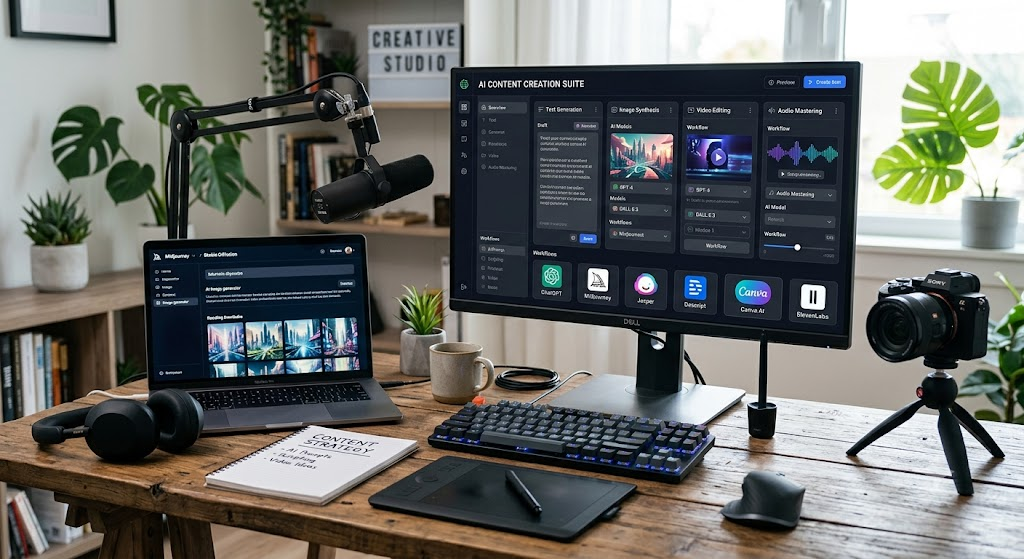
Idea (ChatGPT) → Structure (Notion AI) → Copy (Jasper/ChatGPT) → Design (Canva) → Visuals (Midjourney) → Polish (Grammarly)
That’s not content creation anymore.
That’s a content assembly line with creative intent.
🚀 Final Signal Insight
The creators who win in 2026 won’t be the ones using AI.
They’ll be the ones orchestrating it like a system, not a shortcut.
Because content isn’t about speed anymore.
It’s about signal clarity in a world screaming for attention.