

Episode 1 | Monday
Part 2: Stiles Stilinski
Marketing Analytics & Consumer Insights
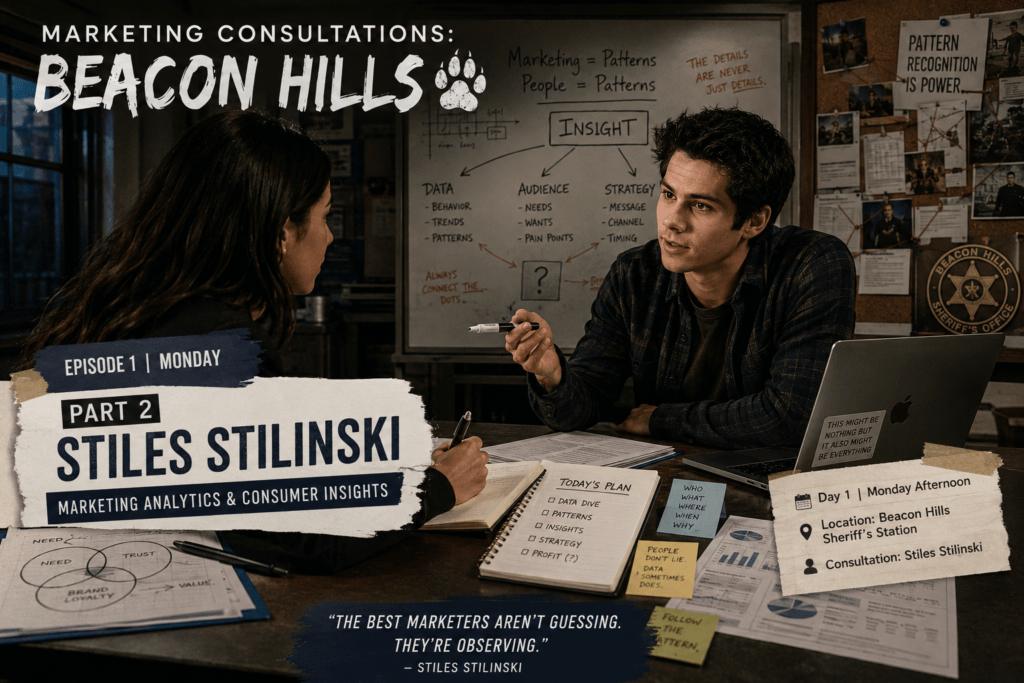
Day 1 | Monday Afternoon
After wrapping up my consultation with Scott McCall at the Animal Clinic, I made my way across town to the Beacon Hills Sheriff’s Station.
Scott had warned me about my next consultation.
“Be prepared,” he’d laughed. “Stiles doesn’t think in straight lines.”
As it turns out, he wasn’t exaggerating.
The moment I stepped into the Sheriff’s Station, I found Stiles standing in front of a whiteboard covered in sticky notes, arrows, maps, and what looked suspiciously like three completely unrelated investigations connected by red string.
He looked over his shoulder.
“Perfect timing.”
He pointed at the board.
“Do you see it?”
I blinked.
“See… what exactly?”
“The pattern.”
There was a long pause.
“I’ll be honest, Stiles… I don’t even know where to start.”
He grinned.
“Exactly.”
“Most marketers don’t.”
That was my introduction to one of the most fascinating marketing consultations I’ve ever had.
Data Tells a Story
After clearing a space on his desk between notebooks, maps, and far too many coffee cups, I asked the question I’d been saving all morning.
“When you investigate something, what’s the first thing you look for?”
He didn’t hesitate.
“Patterns.”
“Anyone can collect information.”
“The trick is figuring out what actually matters.”
That immediately made me think about marketing analytics.
Many marketers spend hours looking at dashboards filled with impressions, clicks, engagement rates, and page views.
But numbers by themselves don’t tell you anything.
The story behind those numbers does.
Stop Guessing. Start Observing.
Stiles leaned back in his chair.
“People leave clues everywhere.”
“Most of them don’t even realise they’re doing it.”
In Beacon Hills, those clues help solve mysteries.
In marketing, they help us understand our audience.
Every search query.
Every abandoned shopping cart.
Every blog comment.
Every email open.
Every click.
They’re all clues.
Analytics isn’t about watching numbers rise and fall.
It’s about understanding the people creating those numbers.
Consumer Insights Are Hidden in Behaviour
One thing I noticed while talking to Stiles was how observant he is.
He notices details that everyone else overlooks.
That’s exactly what great marketers should be doing.
Instead of asking:
“Why didn’t this campaign perform?”
Ask:
“What is the audience trying to tell us?”
Sometimes your highest-performing blog post isn’t your best-written one.
Sometimes your most-clicked email wasn’t the one you spent hours perfecting.
Consumer behaviour often reveals opportunities we would never have predicted.
If we’re willing to pay attention.
Curiosity Is Your Greatest Marketing Tool
I asked Stiles what separates a good investigator from a great one.
He smiled.
“Curiosity.”
“The moment you thik you already know the answer… you stop asking the right questions.”
Marketing works the same way.
Curious marketers test ideas.
They experiment.
They analyse results.
They ask why instead of simply accepting what happened.
That’s how better strategies are built.
My Biggest Takeaway
Before I packed up my notebook, Stiles wrote something on the whiteboard.
He underlined it twice before handing me the marker.
“This is probably the most important thing you’ll write down today.”
It simply read:
People aren’t random.
They’re predictable once you understand their behaviour.
That sentence perfectly captures what marketing analytics should be.
Not spreadsheets.
Not charts.
Understanding people.
Consultation Notes
Character: Stiles Stilinski
Marketing Topic: Marketing Analytics & Consumer Insights
Key Takeaways
- Analytics should uncover patterns, not just numbers.
- Consumer behaviour always leaves valuable clues.
- Curiosity leads to better marketing decisions.
- Testing beats assuming.
- Great marketers observe before they optimise.
Wrapping Up
Walking out of the Sheriff’s Station, I realised my notebook looked more like one of Stiles’ investigation boards than a set of marketing notes.
Arrows connected ideas.
Questions led to more questions.
Patterns began to emerge.
Scott had shown me that trust is the foundation of every successful brand.
Stiles reminded me that understanding your audience is what allows that trust to grow.
The best marketers aren’t guessing.
They’re observing.
And the better we become at recognising patterns, the better we become at serving the people behind the data.