
Most advice on how to make AI-written website content sound human says to add personality, loosen the tone or throw in a contraction. Those edits change how the words sound and leave what they say untouched. When AI copy reads as empty, the usual cause is that it contains nothing specific to you, and no change of tone fixes that.
This piece gives you one question and a short edit pass built around it, aimed at the three pages that carry the most weight: the homepage, the About page and your service pages.
The homepage that says nothing in 120 words
Here is a homepage in the style most AI drafts produce when the prompt is thin. The business is invented for this example.
Welcome to Brightpath Studio, where innovation meets excellence. In today’s fast-paced digital world, businesses need a partner they can trust. We are passionate about delivering tailored solutions that help you unlock your full potential and achieve your goals.
Our team of dedicated professionals combines years of expertise with cutting-edge strategies to drive meaningful results. Whether you’re a startup or an established brand, we take a holistic approach that puts your needs first.
Why choose us? We are committed to quality, transparency and customer satisfaction. Our seamless process ensures a stress-free experience from start to finish.
Ready to take your business to the next level? Get in touch today and let’s start your journey.
Nothing in it is wrong, and it is grammatical and polite. But you cannot tell what Brightpath sells, who it sells to, what it costs, how it works or why anyone should pick it over the next studio. Swap in any company name and the copy still fits, and that interchangeability is the problem.
Why AI drafts sound smooth and still feel empty
Language models produce likely text. The most likely sentence about any business is one that could be true of every business, so a draft with no specifics going in comes out with none. Specifics are unlikely by nature, because they belong to one business and the model has no way to know which one you mean unless you tell it.
Smoothness hides the gap. Fluent sentences read as effort, and a visitor skimming a page will often credit the writer with substance until they look for something to use, such as a price range, a process or a position. When they find nothing, they leave without being able to say why. Visitors who leave this way tend to describe the page as “fine,” which is about the worst reaction a homepage can get.
This is also why the standard fixes disappoint. A friendlier version of “tailored solutions that unlock your full potential” is still a sentence with nothing in it.
The one-question edit: would a real person want to read this?
Read the draft one sentence at a time and ask: would a real person want to read this?
“Want to read” has a practical meaning here. A person wants to read a sentence when it gives them something: a fact they can check, a position they can agree or disagree with, a detail that tells them whether this business is for them, or a next step that is clear. A sentence that gives them none of those is filler, however polished.
In practice the question breaks into three quick tests:
- Swap test: could a competitor paste this sentence on their site unchanged?
- Repeat test: could a reader tell a friend one concrete thing from this paragraph?
- Say-it-aloud test: would you say this sentence to a prospective client across a table?
A sentence that fails any of the three gets rewritten with something specific or deleted. Deleting is allowed, and it is often the better edit. A homepage with six real sentences beats one with twenty padded ones.
Apply the pass to the pages where visitors make decisions. The homepage decides whether they stay, the About page decides whether they trust you, and the service pages decide whether they contact you. Blog posts matter too, but a weak sentence on a service page costs you more.
Four things to replace
AI drafts fail in repeating ways, so the edit can be systematic. Look for these four.
Vague claims. “Tailored solutions,” “results-driven,” “high-quality service.” Replace each with what you do, for whom, and how it works. Add a number only if it is real and you can back it up. A made-up figure is worse than a missing one, and your own publishing standards should treat it that way.
Borrowed analogies. Roadmaps, journeys, engines of growth, symphonies. They arrive because the genre of business copy uses them, and they stand in for a description. Replace the picture with the statement: instead of “we’ll be the engine behind your growth,” say what you will actually do in the first month.
Safe openers. “In today’s fast-paced digital world” could open any page ever written. Start with the visitor’s real situation or with your position. A reader who sees their own problem named in the first line keeps reading.
Tidy endings. The closing line that sums everything up, or the “Ready to take your business to the next level?” call. Replace it with a specific next step and what happens after the click: “Send me your current homepage URL and I’ll reply with three changes within two working days,” for example, if that is true of you. End the page on the last useful thing you have to say.
Before and after: rewriting a homepage hero and an About paragraph
The example business is invented: a freelance bookkeeper who works with independent dog groomers. Every detail below is made up to show the shape of the edit. Your version must use details that are true of your own business.

Hero, before:
Tailored financial solutions to help your business thrive.
Hero, after:
Bookkeeping for independent dog groomers. Your supply invoices, card payments and tips sorted every month, so you stop sorting receipts in January.
The first version names no customer and no service. The second can be checked: a groomer reads it and knows immediately whether it applies to them.
About paragraph, before:
I’m a passionate bookkeeper dedicated to helping small businesses unlock their financial potential. With a client-first approach, I turn numbers into stories that drive growth.
About paragraph, after:
I do bookkeeping for independent dog groomers, and only for them. That means I already know the categories: table and dryer purchases, shampoo orders, van fuel for mobile groomers, and how to record tips. I work with solo groomers and teams of up to three. If you run a larger salon, I’ll point you to someone better suited.
What changed is that each sentence in the second version can now be wrong. A claim that can be wrong is also a claim that can be right, and that is what gives a reader something to trust. The last sentence, which turns away some visitors, does a lot of the work. A business that says who it is not for sounds like it knows who it is for.
The “after” versions only work because they use facts. If you do not have those facts to hand, the model cannot supply them. You need to find them first, from your own work, your clients’ real questions and your own process.
What to leave to the machine and what only you can supply
Used well, AI is good at the mechanical parts of this edit:
- Turning your rough notes into a first draft with a sensible structure
- Offering five alternative phrasings of a sentence you already like
- Trimming a paragraph by a third
- Flagging repeated words and stock phrases when you give it a list of ones to avoid
- Checking that tone and terminology stay consistent across pages
What only you can supply is the material the draft is built from:
- Who you serve, described narrowly enough that some people are excluded
- What you do differently, in terms of how the work actually happens
- Real numbers, names and examples, used with permission where they involve clients
- A position, meaning something you believe about your field that a competitor might dispute
- Limits, such as what you do not offer and who you are not right for
The practical consequence is to put these in before you ask for a draft. Paste in your notes on audience, process, pricing logic and opinions, and tell the model to use only what you gave it and to mark anything it would otherwise have to guess. That produces a draft built on your material rather than a generic one you then try to rescue.
Every brand that skips this step ends up sounding like every other brand that skipped it, a pattern covered in why every brand sounds the same. Check every factual claim in the final copy yourself, too, because a model will state invented details as confidently as true ones.
A 10-minute human-read checklist for your next draft
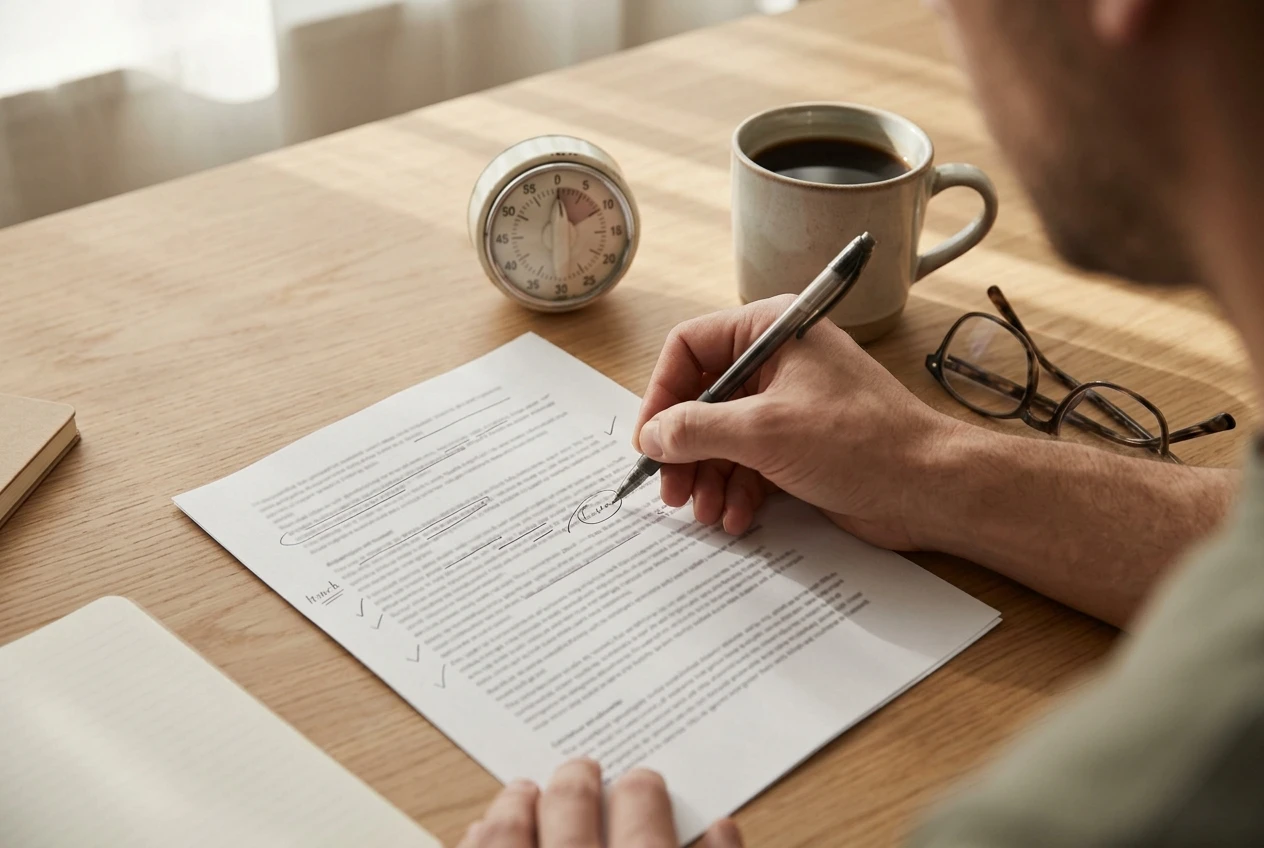
Run this on the homepage first, then the About page, then each service page.
- Read it aloud (2 minutes). Mark every sentence you would not say to a prospective client. Those are your first cuts.
- Run the swap test (2 minutes). Replace your business name with a competitor’s. Any sentence that still works gets rewritten or removed.
- Find the four patterns (2 minutes). Highlight vague claims, borrowed analogies, safe openers and tidy endings. Replace each with a statement of what you actually do.
- Check the facts (2 minutes). Every number, name, date and promise should be true and provable. Cut anything you cannot back up.
- Add one limit (1 minute). Write one sentence saying who the page is not for or what you do not offer.
- Check the ending (1 minute). Make sure the last line gives a specific next step and says what happens after it.
The five-minute version is steps 1 to 3 applied to three things only: the homepage hero, the first paragraph of your About page and the opening of your main service page. It will not finish the job, but it will catch the worst of the filler.
Your next step
Run your own homepage through the five-minute version of this edit this week. Start with the hero, because it is the line every visitor reads. If you want to go deeper on the trust side of AI use, read How to Use AI Without Losing Credibility next.