
Let me establish something immediately.
I am Simmba.
I am a tuxedo cat.
I have excellent instincts.
I know when someone is approaching me because they genuinely want to spend time with me.
I also know when someone is approaching me because they want to pick me up when I have specifically decided that I do not want to be picked up.
And guess what?
I walk away.
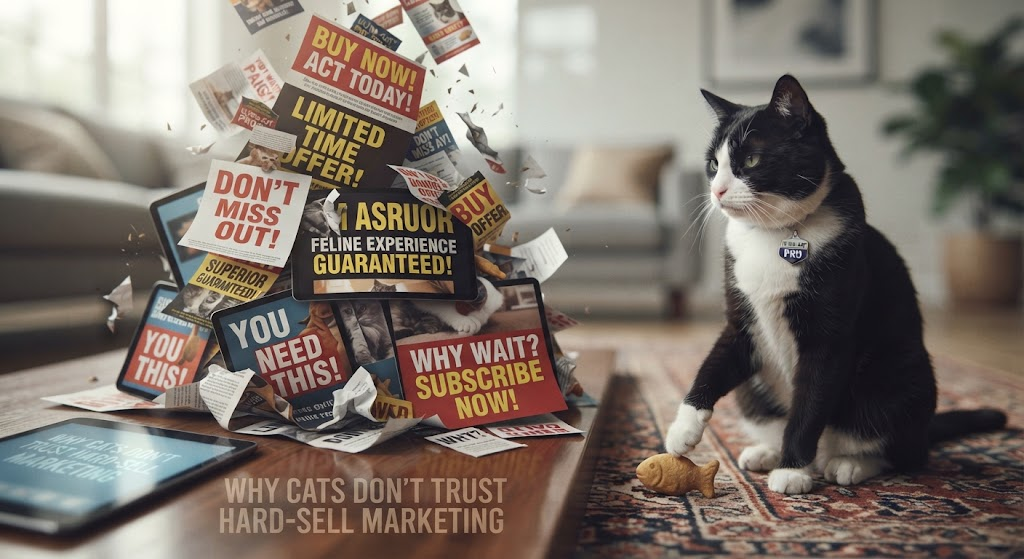
This is essentially how I feel about hard-sell marketing.
🐈⬛ What Is Hard-Sell Marketing?
Hard-sell marketing is the kind of marketing that focuses heavily on pushing someone toward an immediate purchase.
You’ve probably seen it.
“BUY NOW!”
“LIMITED TIME!”
“DON’T MISS OUT!”
“YOU’LL REGRET IT IF YOU DON’T BUY THIS!”
“CLICK HERE NOW!”
And then somehow, five minutes later, you’re still being followed around the internet by the same product.
Humans call this marketing.
I call it:
“Why are you chasing me?”
Because here’s the thing.
People don’t like feeling pressured.
Neither do cats.
🐾 Imagine Trying to Sell Something to a Cat
Let’s say you walk into a room.
You see me sitting peacefully on the couch.
You approach me.
You say:
“Simmba, you NEED this toy.”
I stare at you.
You continue.
“Seriously, Simmba. This toy will change your life.”
I blink.
“BUY IT NOW.”
I leave.
Congratulations.
You just lost a customer.
Possibly forever.
And that’s the problem with aggressive selling.
The more you push, the more people may feel like you’re trying to get something from them rather than help them.
🧠 Trust Comes Before the Sale
One of the biggest lessons humans can learn from cats is that trust isn’t automatic.
You have to earn it.
A cat might watch you for a while before deciding you’re safe.
We observe.
We test.
We remember.
And yes, we judge.
Extensively.
Marketing isn’t all that different.
Your audience is also watching.
They’re thinking:
- Do I trust this person?
- Do they actually use this product?
- Are they being honest?
- Do they understand what they’re talking about?
- Are they recommending this because it’s useful?
- Or are they recommending it because they want my money?
That last question can change everything.
🐈⬛ Stop Treating Every Click Like a Victory
Clicks are useful.
Conversions are useful.
Sales are obviously useful.
But if your entire strategy becomes:
“How do I get this person to click?”
you can easily forget the bigger picture.
What happens after the click?
Does the person trust you?
Did they actually find the information useful?
Would they come back to your website?
Would they read another article?
Would they recommend your content to someone else?
Would they trust your next recommendation?
Those questions matter.
Because one transaction isn’t the same thing as building an audience.
🐾 What Cats Know About Permission
Cats are surprisingly good at understanding something marketers sometimes forget:
People like having a choice.
If I want attention, I’ll come to you.
If I want food, I’ll make my presence known.
If I want to sit beside you, I’ll sit beside you.
But if I walk away?
Respect the boundary.
Affiliate marketing can work the same way.
Instead of forcing the audience toward a purchase, give them enough useful information to make their own decision.
You can say:
“Here’s what this product does.”
“Here’s who it might be useful for.”
“Here’s what I like about it.”
“Here are some limitations to consider.”
“Here’s where you can learn more.”
Then let them decide.
That’s not weak marketing.
That’s trust-based marketing.
🛋️ The Cat Approach to Selling
If I were running an affiliate marketing strategy, my approach would be very simple.
1. Be useful.
Help someone solve a problem before asking them to buy anything.
2. Be honest.
Don’t pretend every product is perfect.
3. Explain the why.
Don’t just throw an affiliate link at someone. Tell them why you’re recommending it.
4. Give people room.
Your audience doesn’t need to be chased around the internet.
5. Build familiarity.
Consistent, useful content can make people more comfortable with your recommendations over time.
6. Let your personality exist.
People connect with people, not just sales pages.
Even if that person is technically a tuxedo cat writing the article.
🐈⬛ The Simmba Rule
Here’s my rule:
If your audience feels chased, you’re probably selling too hard.
Affiliate marketing shouldn’t feel like someone is standing behind you with a megaphone screaming:
“BUY THIS!”
It should feel more like a knowledgeable friend saying:
“I’ve looked into this. Here’s what I found. It might be useful for you.”
That’s a completely different experience.
And that difference is where trust lives.
🖤 Final Thoughts From Simmba
Cats don’t trust people who move too quickly.
We like consistency.
We like observing.
We like deciding when we’re ready.
And apparently, humans aren’t all that different.
If you’re using affiliate marketing, don’t focus exclusively on getting someone to buy today.
Focus on becoming someone they trust enough to listen to tomorrow.
Because a hard sell might get you one purchase.
Trust can get you an audience.
And personally, I would rather have an audience that trusts me than one that keeps running away every time I pull out an affiliate link.
Now please put the sales pitch away.
I’m trying to nap.
🐈⬛💤