

The Pros and Cons of Using AI to Create Marketing Content
AI has become part of the modern marketer’s toolkit.
It can brainstorm ideas, create outlines, rewrite copy, suggest headlines, analyse patterns and help turn a blank page into something workable in minutes.
But that doesn’t mean every piece of AI-assisted marketing content is automatically good.
There are genuine advantages to using AI, but there are also drawbacks worth understanding before you let it become the unofficial employee of your content team.
The question isn’t simply “Should marketers use AI?”
It’s:
“How can marketers use AI without sacrificing creativity, strategy and trust?”
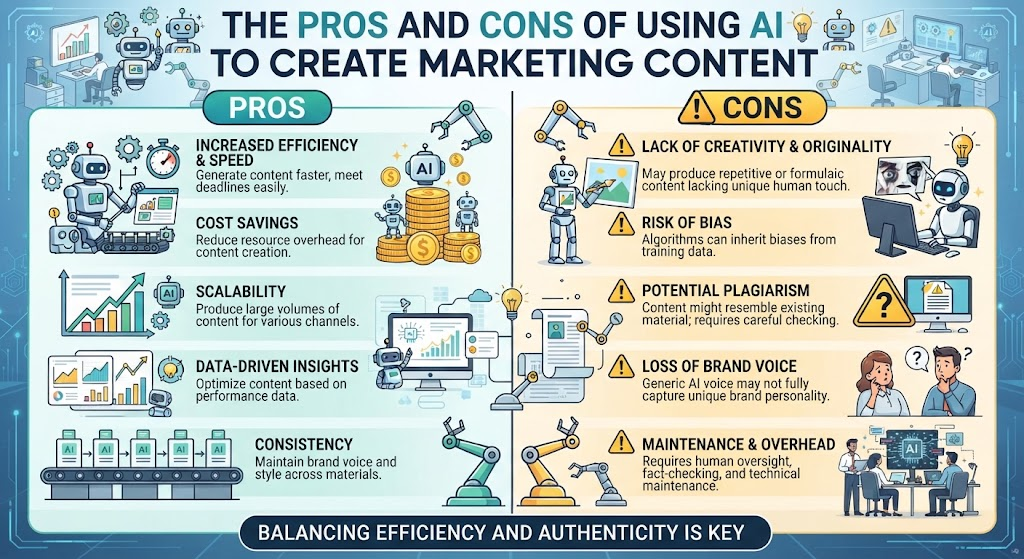
The Pros of Using AI for Marketing Content
1. It Saves Time
One of the biggest advantages of AI is speed.
A marketer can spend hours staring at a blank document trying to decide where to begin. AI can help generate starting points almost instantly.
That doesn’t mean the first draft should go straight onto your website.
It means you can spend less time fighting the blank page and more time improving the actual idea.
AI can reduce the friction of getting started.
2. It Helps With Brainstorming
Sometimes the hardest part of content creation isn’t writing.
It’s figuring out what to write about in the first place.
AI can generate topic ideas, content angles, questions, headlines and different perspectives on a subject.
For marketers managing multiple platforms, campaigns or audiences, that can be incredibly useful.
The key is to treat those ideas as starting points rather than instructions.
3. It Can Improve Your Workflow
AI doesn’t have to be the writer.
It can be the assistant.
You can use it to:
- Organise rough notes
- Create content outlines
- Suggest alternative headlines
- Simplify complicated explanations
- Repurpose existing content
- Identify gaps in an article
- Generate questions your audience might ask
- Help with editing and clarity
That can make the overall content workflow much more efficient.
4. It Can Help You Repurpose Content
You’ve already created a detailed blog post.
Why make it live in only one place?
AI can help transform that original idea into social posts, email concepts, Pinterest descriptions, video scripts or discussion prompts.
This can help marketers get more value from content they’ve already created.
But there’s an important distinction:
Repurposing isn’t copying.
Each platform still needs its own context, audience and purpose.
5. It Can Help Small Teams Do More
Not every marketer has a huge content department.
Some people are doing SEO, social media, email marketing, design, analytics and content creation themselves.
AI can act as an additional layer of support.
It doesn’t replace having a strategy, but it can help one person handle a much larger workload.
And for small businesses and independent creators, that’s a pretty significant advantage.
The Cons of Using AI for Marketing Content
1. AI Can Make Generic Content Very Quickly
This is probably the biggest problem.
AI can produce content quickly.
But quickly producing generic content is still producing generic content.
If everyone asks AI the same question and accepts the first answer, we’re going to end up with a lot of websites saying essentially the same thing in slightly different arrangements.
More content doesn’t automatically mean more value.
2. Your Brand Voice Can Get Lost
Your brand isn’t just your logo, colour palette or font.
It’s how you communicate.
It’s your opinions.
Your humour.
Your vocabulary.
Your stories.
Your way of looking at a problem.
If AI writes everything without meaningful human input, your content can slowly lose those characteristics.
And once your voice disappears, your content becomes much harder to distinguish from everyone else’s.
3. AI Doesn’t Know Your Audience Like You Do
AI can understand patterns in language.
But your audience isn’t just a collection of keywords.
You know the questions your customers repeatedly ask.
You know what frustrates them.
You know the objections they have before buying.
You know the language they actually use.
You know the context behind their problems.
AI can help you explore those things, but you still need to bring the audience knowledge to the table.
4. AI Can Get Things Wrong
AI-generated content still needs human review.
Facts can be inaccurate.
Claims can lack context.
Examples can be inappropriate.
Information can become outdated.
And something can sound extremely confident while being completely wrong.
That’s why “AI said it” should never become your research methodology.
Use AI to assist your thinking, not replace your judgment.
5. Overusing AI Can Flatten Creativity
Here’s an uncomfortable possibility:
The more we ask AI to generate ideas for us, the less comfortable we may become with generating our own.
Creativity needs room to wander.
Sometimes the strangest idea becomes the strongest campaign.
Sometimes the imperfect sentence sounds more human than the polished one.
Sometimes your weird little idea is exactly what makes people stop scrolling.
If AI becomes responsible for every creative decision, your content can become efficient while becoming less interesting.
So, Should Marketers Use AI?
Yes.
But strategically.
I don’t think the answer is to reject AI completely.
I also don’t think the answer is to hand over the entire content operation and hope for the best.
The sweet spot is somewhere in between.
Think of AI as a creative and operational assistant.
Let it help you move faster.
Let it challenge your ideas.
Let it handle repetitive tasks.
Let it help you organise your thoughts.
But keep the important decisions human.
Strategy should remain yours.
Your voice should remain yours.
Your perspective should remain yours.
The Best Approach Is Human + AI
A useful AI-assisted marketing workflow might look like this:
Human idea → AI assistance → Human evaluation → AI refinement → Human editing → Final strategy
The human remains involved throughout the process.
That’s important because marketing isn’t simply about producing words.
It’s about understanding people.
It’s about positioning.
It’s about trust.
It’s about knowing why something should be said, who needs to hear it and what you want them to do next.
AI can help with the how.
You still need to decide the why.
Final Thoughts
AI has plenty of advantages for marketers.
It can save time, support brainstorming, improve workflows and help small teams produce more content.
But it also comes with risks.
Content can become repetitive.
Brand voices can disappear.
Creativity can become overly dependent on automation.
And inaccurate information can slip through if nobody checks it.
So the goal shouldn’t be to create more AI content.
The goal should be to create better marketing content with AI where it genuinely helps.
Because ultimately, your audience doesn’t care whether your first draft came from a keyboard, a notebook or an AI tool.
They care whether what you published was useful, relevant, interesting and worth their attention.
AI can help you create faster.
Your strategy is what makes the content worth creating.
