
Trust plays an important role in how people perceive a brand. It can influence whether someone chooses to purchase a product, recommend a business or continue engaging with its content.
However, trust isn’t something a business can establish simply by describing itself as honest, reliable or customer-focused. Those qualities need to be reflected in its actions.
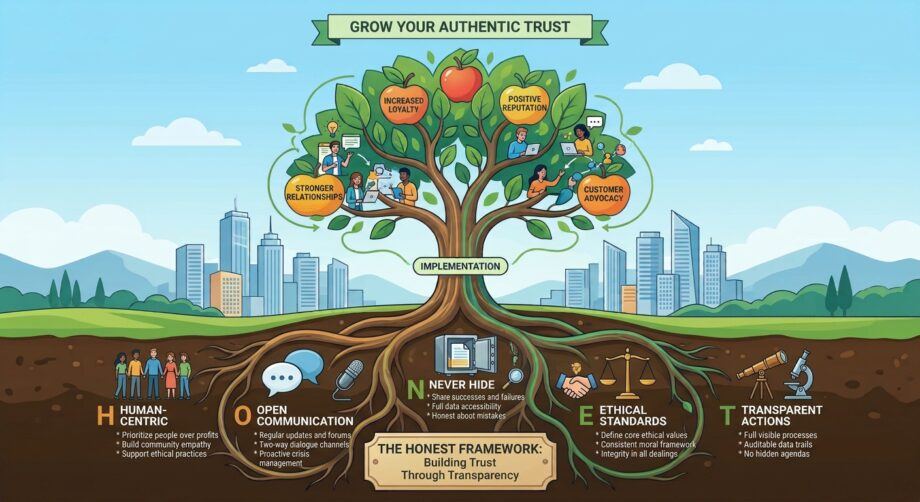
At Signal & Strategies, I believe trust and transparency should be part of a brand’s overall strategy rather than an afterthought. That’s why I’m developing the HONEST Framework, a six-step approach to communicating responsibly, demonstrating credibility and building stronger relationships with audiences.
What Is the HONEST Framework?
HONEST stands for Hold yourself accountable, Offer clear communication, Never compromise integrity, Earn trust through evidence, Safeguard the relationship, and Track, learn and improve.
Each stage focuses on a different way businesses can make their communication and customer relationships more responsible.
H: Hold Yourself Accountable
Accountability means taking responsibility for what a brand says and does.
Mistakes can happen, whether it’s inaccurate information, a delayed service or a campaign that doesn’t meet expectations. How a business responds can influence how people perceive its reliability.
Rather than ignoring an issue or shifting the blame, businesses should acknowledge concerns, communicate appropriately and take steps to address them.
Accountability isn’t about pretending a brand will never make mistakes. It’s about being willing to address them.
O: Offer Clear Communication
Transparency starts with making information understandable.
Customers should be able to find relevant details about products, services, pricing, policies and expectations without having to navigate confusing language or hidden conditions.
This also applies to marketing. Businesses should avoid exaggerated promises and communicate limitations when they’re relevant to a customer’s decision.
Clear communication helps people understand what they’re agreeing to and make informed choices.
N: Never Compromise Integrity
Marketing often involves decisions about partnerships, advertising, promotions and revenue opportunities. These decisions should reflect the brand’s values and responsibilities.
For example, affiliate relationships and sponsored content should be disclosed appropriately. A business should also avoid promoting products through claims it cannot substantiate.
Short-term opportunities aren’t always worth the potential damage caused by misleading communication.
Integrity means considering not only what benefits the business, but also whether the decision is fair to the people it serves.
E: Earn Trust Through Evidence
Credibility is stronger when claims are supported by evidence.
Businesses can demonstrate their expertise through relevant experience, accurate information, genuine customer feedback and clearly explained results.
However, evidence should be presented honestly. Testimonials shouldn’t be fabricated, statistics shouldn’t be taken out of context, and results shouldn’t be exaggerated to make an offer appear more attractive.
Not every claim requires a lengthy research report, but businesses should be prepared to explain the basis for important statements.
S: Safeguard the Relationship
Trust extends beyond the information a business publishes. It also involves how the business treats its customers and handles their information.
Respecting privacy, protecting personal data, listening to concerns and providing appropriate support all contribute to the customer experience.
Businesses should also consider whether their marketing practices respect people’s choices rather than relying on pressure, confusion or manipulative tactics.
The aim is to build relationships in which people feel respected, informed and able to make their own decisions.
T: Track, Learn and Improve
Trust isn’t a one-time achievement. It requires ongoing attention.
Customer feedback, complaints, reviews and recurring questions can reveal where communication or service delivery needs improvement.
Businesses can also review their marketing materials, disclosures and public claims to ensure that information remains accurate.
These reviews help identify gaps between what a brand promises and what it actually delivers.
Improvement should be an ongoing part of the strategy rather than something that only happens when a problem becomes public.
Putting HONEST Into Practice
Imagine a business launching a new product and promoting it across social media.
Using HONEST, the business would ensure its claims are supported, communicate pricing and relevant conditions clearly, disclose any applicable paid partnerships, protect customer information and establish a process for handling feedback.
If customers later identify an issue, the business can investigate, communicate its response and use what it learns to improve.
These actions don’t guarantee that every customer will trust the brand, but they create a more responsible foundation for building credibility.
Why Trust and Transparency Matter in Marketing
I think it’s important to recognise that trust cannot be created through messaging alone.
A business can publish polished content and make strong promises, but those messages need to align with its actual behaviour. When there’s a gap between what a brand says and what it delivers, its credibility can suffer.
Transparency doesn’t mean sharing every internal business detail. It means being open about the information people reasonably need to understand an offer, evaluate a claim or make a decision.
The HONEST Framework is my approach to making those responsibilities more intentional. It provides a structure for reviewing how businesses communicate, demonstrate credibility and maintain relationships with their audiences.
Because trust isn’t built by telling people you’re trustworthy. It’s built by giving them good reasons to believe you.
That’s the principle I want to bring into the Trust and Transparency pillar at Signal & Strategies.
What makes you trust a brand, and what kind of behaviour makes you question its credibility? Share your thoughts in the comments.