

For a while, AI marketing conversations were dominated by one question:
“What can AI do?”
It can generate content. Analyse data. Personalise messages. Automate tasks. Support research. Help marketers move faster.
But as AI becomes a more ordinary part of marketing, a more interesting question begins to emerge:
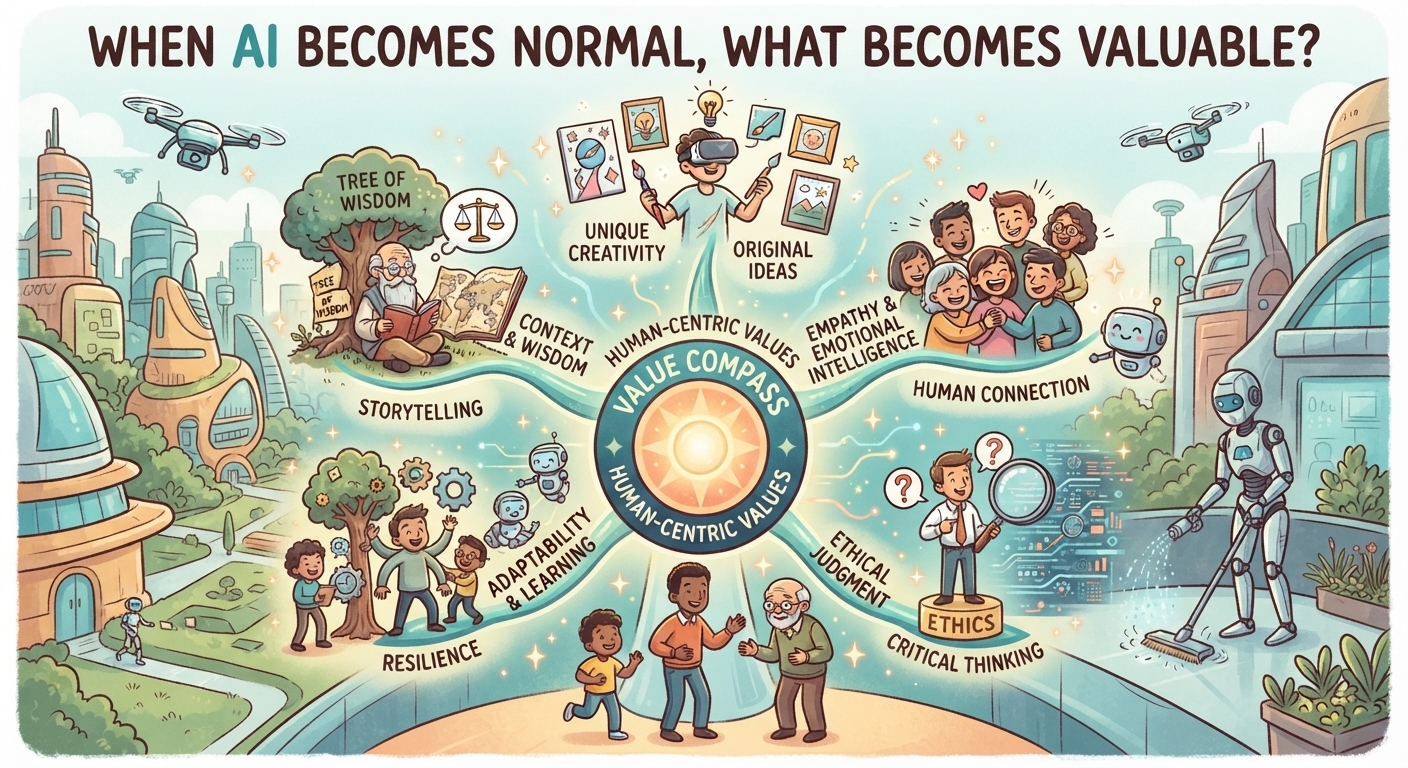
What becomes valuable when AI itself becomes normal?
AI Fluency May Become the Baseline
AI is increasingly becoming part of everyday marketing work rather than a specialist experiment.
The American Marketing Association’s 2026 State of Marketing Careers Report found that AI was the skill marketers expected to need most over the next five years, while AI appeared in twice as many marketing job postings in 2025 as the previous year.
That changes the conversation.
Knowing how to use AI may increasingly become less of a differentiator and more of a baseline capability.
Much like knowing how to use analytics, search tools or social platforms became part of modern marketing, AI fluency may simply become another part of the toolkit.
So where does differentiation move next?
From Producing More to Deciding Better
AI can increase the amount of work a marketing team can produce.
But producing more does not automatically mean producing something better.
BCG’s research into AI in marketing points toward a model where AI can accelerate areas such as personalisation, creative testing, adaptation and content production, while human judgment remains important in strategy and business planning.
That distinction matters.
If AI can help create ten versions of a campaign in minutes, the valuable skill may not be writing version eleven.
It may be knowing which idea deserves to exist in the first place.
Strategy Becomes More Important
As execution becomes increasingly automated, marketers may spend more time deciding:
- What problem are we actually solving?
- Who are we solving it for?
- What should the brand stand for?
- Which information can we trust?
- What should AI handle?
- What should remain human-led?
- How will we know whether the work actually helped?
Gartner has similarly highlighted reasoning skills as foundational for marketing teams adopting AI for core marketing activities.
The future marketer therefore isn’t necessarily the person who uses the most AI tools.
It may be the person who understands when, why and how to use them well.
Human Skills Don’t Disappear
Automation can change which tasks marketers perform, but it doesn’t remove the need for human judgment.
The AMA’s 2026 research highlights adaptability, critical thinking, creativity, emotional intelligence and leadership among skills requiring continued human involvement.
That doesn’t mean AI can’t assist with these areas.
It means marketers still need people who can interpret context, understand audiences, make decisions and take responsibility for the outcomes.
AI can generate an answer.
A marketer still has to decide whether it is the right answer.
The Future Isn’t Human vs AI
The more useful question may not be whether AI replaces marketers.
It may be how marketers redesign their work around it.
A team could use AI for repetitive production, data analysis and testing while keeping humans involved in strategy, judgment, brand direction and accountability.
That isn’t necessarily a compromise between technology and people.
It can be a different way of dividing the work.
So What Becomes Valuable?
If AI makes certain capabilities easier, their scarcity may decrease.
The valuable skills may increasingly include:
Judgment. Knowing what deserves attention.
Context. Understanding the audience and situation behind the data.
Strategy. Connecting individual marketing activities to meaningful business goals.
Creativity. Developing ideas rather than simply generating variations.
Adaptability. Learning as tools, platforms and customer behaviour change.
Trust. Being accountable for what technology produces and how it affects people.
These aren’t predictions that every marketer will suddenly need the same skill set. Different roles and organisations will evolve differently.
But the direction is worth watching.
The S&S Takeaway
The AI marketing conversation has spent a lot of time asking what machines can produce.
The next stage may be more interested in what humans choose to do with that capability.
When generating content becomes easier, judgment matters more.
When analysing information becomes faster, interpretation matters more.
When automation becomes widespread, strategy and accountability matter more.
AI becoming normal doesn’t necessarily make marketing less human.
It may make the distinctly human parts of marketing more visible.
Sources
- American Marketing Association, 2026 State of Marketing Careers Report: research on AI adoption, marketing skills and changing roles.
- Boston Consulting Group, “From Campaigns to Business Value: AI in Marketing”: research on AI-enabled marketing workflows and the role of human judgment.
- Gartner, “Build Marketers’ Reasoning Skills for Success in an AI Age”: analysis of reasoning skills in AI-enabled marketing teams.