

Creating content isn’t just about finding the right words. It’s about understanding what you want to communicate, who you’re communicating with, and why your message should matter to the reader.
At Signal & Strategies, I believe content writing and storytelling should work together. A blog post can provide useful information, but a story can help people understand that information in a more meaningful way.
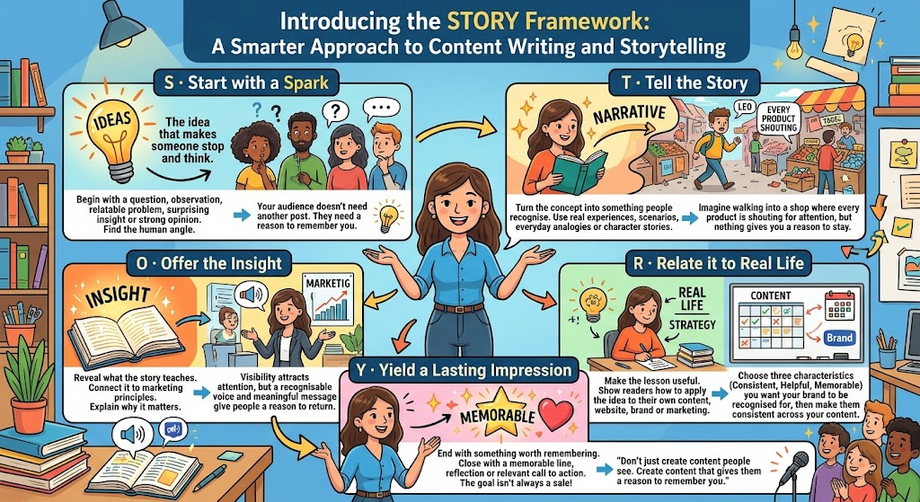
That’s why I’m developing the STORY Framework, a simple approach to creating content that informs, connects and leaves a lasting impression.
What Is the STORY Framework?
The STORY Framework is a five-step process designed to help guide content creation, from developing the initial idea to delivering a message that resonates with the audience.
S: Start with a spark
Every piece of content needs a starting point. This could be a question, a common problem, an observation or an opinion that makes someone stop and think.
For example, instead of starting an article with a definition of content marketing, you could begin with a question: Why do some brands stay in our minds long after we’ve scrolled past their content?
A strong opening gives readers a reason to keep going.
T: Tell the story
Once you have their attention, give your audience something they can relate to.
This could be a personal experience, a hypothetical situation, a brand example or an everyday problem. Storytelling helps turn an abstract marketing concept into something people can picture and understand.
You don’t need a dramatic story every time. Sometimes, a simple example is enough to make your point clearer.
O: Offer the insight
This is where you explain the bigger idea behind your story.
What should the reader understand? What does the example reveal about marketing, communication or audience behaviour?
For instance, a brand might receive plenty of views on social media but struggle to build a loyal audience. The insight could be that visibility alone doesn’t guarantee connection. People also need a reason to trust, recognise and remember a brand.
The aim is to give readers more than an interesting story. Give them something worth learning.
R: Relate it to real life
Good content should have a practical purpose.
Once you’ve explained your insight, show readers how they can apply it to their own work. This might involve improving their brand voice, making website content easier to understand or creating social media posts that address their audience’s actual needs.
Practical examples help bridge the gap between understanding an idea and putting it into action.
Y: Yield a lasting impression
Finally, think about what you want readers to take away from your content.
You could finish with a memorable statement, a question that encourages discussion or a simple call to action. Not every piece needs to sell something. Sometimes, helping someone see a familiar topic differently is valuable in itself.
For me, the goal is to create content that gives people a reason to remember the message, not just the post.
How Can You Use STORY in Content Creation?
The framework isn’t limited to blog writing. It can also be used for Instagram carousels, LinkedIn posts, website copy, brand storytelling and educational content.
For SEO articles, for example, you can still address search intent and provide accurate, useful information while using relatable examples to make the subject easier to understand.
For social media, you can use the framework to develop a carousel that begins with a relatable problem, explains the underlying issue and finishes with an actionable takeaway.
The structure can change depending on the format. A short caption might cover all five steps in a few sentences, while a longer article could explore each stage in greater detail.
My Thoughts on Storytelling and Content Writing
I don’t think every piece of content needs to be a masterpiece. Sometimes, the most effective content is straightforward, useful and easy to understand.
However, I do think we need to look beyond producing content simply to maintain a posting schedule.
Before writing, ask yourself three questions:
- What do I want my audience to understand?
- Why should this matter to them?
- What do I want them to remember?
These questions help bring purpose to the writing process.
The STORY Framework is my approach to making that process more intentional. It provides structure without requiring every piece of content to follow a rigid formula.
Because good content doesn’t just communicate information. It gives people a reason to connect with it.
That’s the principle I want to bring into the Content Writing and Storytelling pillar at Signal & Strategies.