Episode 9 | Friday
Mason Hewitt’s STEM Innovation Fair Campaign
Using Educational Marketing to Inspire the Next Generation
Location: Beacon Hills High School Science Lab
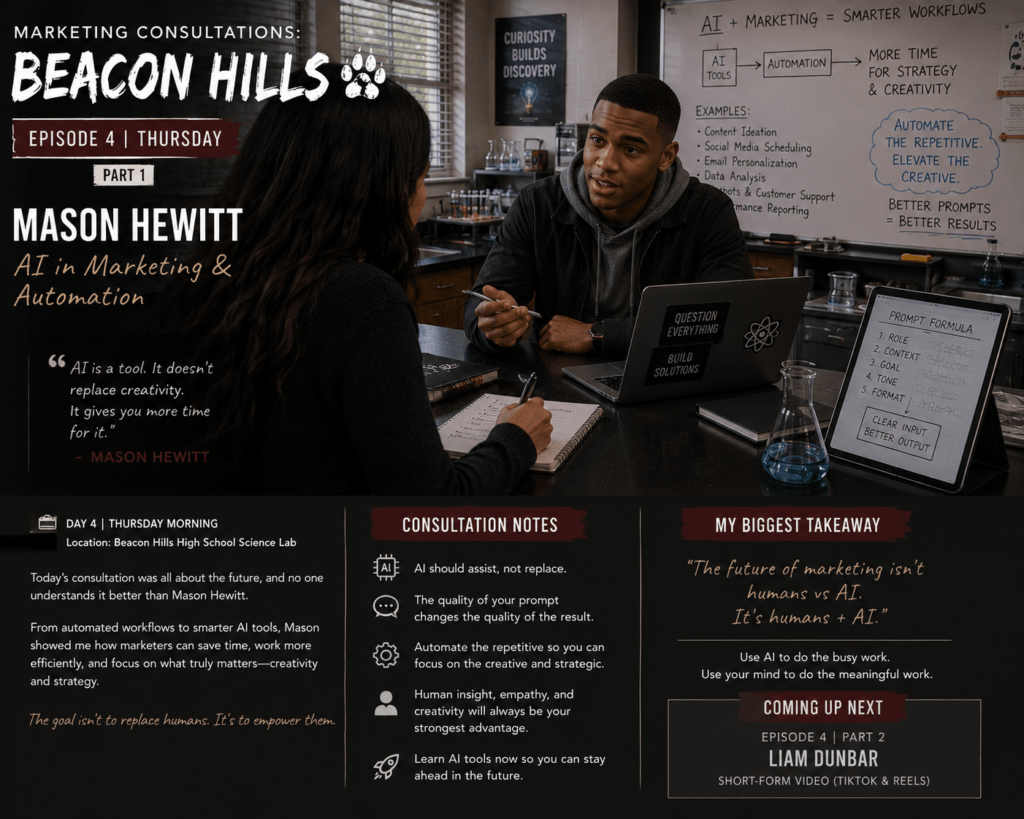
The science lab looked more like a startup workshop than a classroom.
Robotics kits covered one bench. A 3D printer hummed quietly in the corner. Posters about renewable energy, artificial intelligence, and engineering lined the walls.
Right in the middle of it all was Mason Hewitt.
He looked up from his laptop as I walked in.
“I’m glad you’re here,” he said. “I’ve got a great event, but I don’t think people realise why they should come.”
I looked around the room.
“Tell me about it.”
“We’re organising the Beacon Hills STEM Innovation Fair. Students have built incredible projects, local businesses are sponsoring exhibits, and universities are sending representatives. But if we market it like a school event, people will assume it’s only for science students.”
He had a point.
The Innovation Fair wasn’t just for future engineers.
It was for anyone curious enough to ask, “What if?”
The Challenge
The Beacon Hills STEM Innovation Fair had everything needed for a successful event:
- Student innovation projects
- Interactive technology demonstrations
- Robotics competitions
- Guest speakers
- University representatives
- Local business exhibitors
- Hands-on workshops
The challenge wasn’t the event itself.
It was changing the perception that STEM was only for a small group of students.
Our goal was to make innovation feel exciting, accessible, and welcoming to everyone.
Understanding the Audience
We identified several key audience groups:
- Secondary school students
- Parents
- Teachers
- University students
- Local businesses
- Technology enthusiasts
- Future entrepreneurs
- Community members
Each audience had a different reason to attend.
The campaign needed to communicate value for all of them.
Campaign Concept
As Mason demonstrated one of the student-built robots, it carefully navigated around a row of books before stopping perfectly.
He grinned.
“Curiosity starts with one question.”
That became our campaign.
Curious Minds Create Tomorrow
Instead of promoting the event as a science fair, we’d position it as a place where ideas become reality.
Content ideas included:
- Student inventor spotlights
- Behind-the-scenes project builds
- STEM career stories
- Interactive experiment videos
- Sponsor showcases
- Teacher interviews
- Innovation countdown posts
- Live event demonstrations
The focus wasn’t on technical knowledge.
It was on inspiring curiosity.
“You don’t have to know everything,” Mason said.
“You just have to be willing to learn.”
Content Strategy
We developed a content calendar leading up to the event.
Monday: Meet the Innovator
Tuesday: Tech Tuesday
Wednesday: Behind the Build
Thursday: Future Careers
Friday: Innovation Spotlight
Weekend: Event Countdown
Every post would encourage audiences to see STEM as something approachable and exciting.
Email Marketing Strategy
Unlike previous campaigns, Mason wanted to make strong use of email marketing.
We planned targeted email campaigns for:
- Students
- Parents
- Teachers
- Sponsors
- Local businesses
- Community organisations
Each audience would receive personalised messages highlighting the parts of the event most relevant to them.
The right message reaches the right audience at the right time.
Website Improvements
The Innovation Fair website would feature:
- Interactive event schedule
- Speaker profiles
- Exhibitor directory
- Project gallery
- Online registration
- Frequently asked questions
- Sponsor information
A clear, engaging website builds excitement before visitors even arrive.
Measuring Success
To evaluate the campaign, we’d monitor:
- Event registrations
- Email open rates
- Click-through rates
- Website traffic
- Social media engagement
- Workshop attendance
- Sponsor satisfaction
Success wouldn’t only be measured by attendance.
It would be measured by how many people left inspired to keep learning.
Final Thoughts
As students packed away their projects, Mason carefully switched off the 3D printer.
“People think innovation starts with technology.”
“Doesn’t it?” I asked.
He shook his head.
“It starts with curiosity.”
That stayed with me long after I left the science lab.
The greatest innovations don’t begin with expensive equipment.
They begin with someone asking a question nobody else thought to ask.
And that’s exactly what great marketing should do.
Spark curiosity.
Marketing Takeaways
✔ Make educational content engaging and accessible.
✔ Segment your audience for more effective communication.
✔ Use email marketing to deliver personalised messages.
✔ Focus on curiosity before complexity.
✔ Showcase real stories to inspire participation.
Ready to Inspire Your Audience?
Whether you’re promoting an educational event, a conference, or an innovation initiative, your marketing should do more than share information. It should spark curiosity and encourage action.
At Signal & Strategies, I help organisations create educational marketing campaigns that engage audiences, increase participation, and turn ideas into unforgettable experiences.

Leave a Reply